Pound Sterling clings to gains as slower decline in UK CPI dents BoE rate cut bets
- The Pound Sterling jumps to 1.2750 as UK inflation for April remains hotter than expected.
- UK annual core inflation rose by 3.9%, likely impacting BoE rate-cut hopes for August.
- The next move in the US Dollar will be guided by the FOMC minutes.

The Pound Sterling (GBP) posts a fresh two-month high to 1.2750 after the United Kingdom (UK) Office for National Statistics (ONS) has reported a slower-than-expected decline in the Consumer Price Index (CPI) data for April. UK inflationary pressures remained hotter than estimates but have softened significantly from March figures, suggesting that higher interest rates by the Bank of England (BoE) are maintaining downward pressure on inflation.
A slower decline in UK inflation is expected to negatively impact expectations for BoE rate cuts, which financial markets expect the central bank will begin from the August meeting. The major trigger that has spoiled expectations for BoE rate cuts is the annual service inflation, which decelerated modestly to 6.0% from the former reading of 6.1%, remaining the crucial barrier for inflation towards the 2% path.
The speculation for the BoE to begin reducing borrowing costs in August strengthened after BoE Deputy Governor Ben Broadbent commented on Monday: "If things continue to evolve with its forecasts – forecasts that suggest policy will have to become less restrictive at some point – then it's possible Bank Rate could be cut sometime over the summer," Reuters reported.
Daily digest market movers: Pound Sterling holds gains inspired by hot UK CPI report
- The Pound Sterling soars to 1.2750 as the UK ONS has reported a higher-than-expected growth in the consumer price inflation data for April. Headline inflation rose 2.3% year-over-year (YoY), higher than expectations of 2.1% but decreasing from the prior reading of 3.3%. Monthly headline inflation grew by 0.3%, beating the estimate of 0.2% but lowering sharply from March’s reading of 0.6%.
- UK’s annual core CPI data, which strips off volatile items such as food and energy prices, grew by 3.9% (YoY), above the consensus of 3.6% but decelerated from March’s reading of 4.2%. The core inflation data is the Bank of England’s preferred inflation measure for decision-making on interest rates. Though the inflation grew stronger than expectations, it is on course to return to the 2% target.
- On the other side of the Atlantic, uncertainty about when the Federal Reserve (Fed) will start reducing interest rates has deepened. Fed policymakers advised keeping interest rates at their current levels until they get evidence that inflation will sustainably decline to the desired rate of 2%. Though progress in the disinflation process has been restarted after stalling for three straight months at the beginning of the year, Fed policymakers lack confidence that it will last long.
- Like other Fed policymakers, Cleveland Fed Bank President Loretta Mester said on Tuesday that she wants to see inflation declining few more months to be sure that inflation is on course to return to 2% before considering rate cuts.
- The US Dollar (USD) rises to 104.80 as Fed’s hawkish stance on interest rates has supported the downside while firm speculation that the central bank will start lowering interest rates from the September meeting has limited the upside. Going forward, investors will focus on the Federal Open Market Committee (FOMC) minutes for the May meeting on Wednesday. The FOMC minutes will provide more guidance on the interest rate outlook.
Technical Analysis: Pound Sterling trades close to two-month high at 1.2750
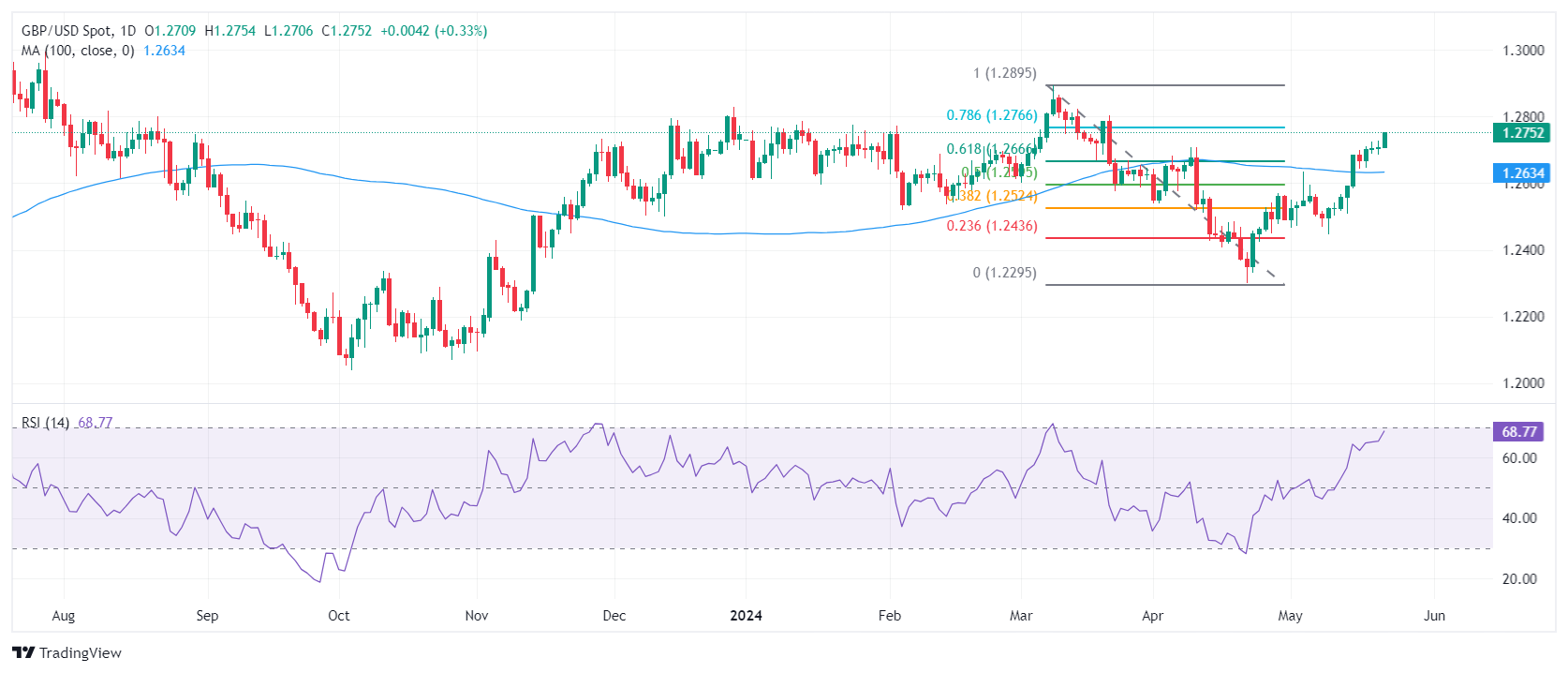
The Pound Sterling approaches a nine-month high at around 1.2900 registered in early March. The appeal for the GBP/USD pair has strengthened as it has comfortably stabilized above the 61.8% Fibonacci retracement (plotted from the March 8 high of 1.2900 to the April 22 low at 1.2300) at 1.2667.
The Cable is expected to remain in the bullish trajectory as all short-to-long-term Exponential Moving Averages (EMAs) are sloping higher, suggesting a strong uptrend.
The 14-period Relative Strength Index (RSI) has shifted into the bullish range of 60.00-80.00, suggesting that the momentum has leaned toward the upside.
Economic Indicator
Core Consumer Price Index (YoY)
The United Kingdom (UK) Core Consumer Price Index (CPI), released by the Office for National Statistics on a monthly basis, is a measure of consumer price inflation – the rate at which the prices of goods and services bought by households rise or fall – produced to international standards. The YoY reading compares prices in the reference month to a year earlier. Core CPI excludes the volatile components of food, energy, alcohol and tobacco. The Core CPI is a key indicator to measure inflation and changes in purchasing trends. Generally, a high reading is seen as bullish for the Pound Sterling (GBP), while a low reading is seen as bearish.
Read more.Last release: Wed May 22, 2024 06:00
Frequency: Monthly
Actual: 3.9%
Consensus: 3.6%
Previous: 4.2%
Source: Office for National Statistics
The Bank of England is tasked with keeping inflation, as measured by the headline Consumer Price Index (CPI) at around 2%, giving the monthly release its importance. An increase in inflation implies a quicker and sooner increase of interest rates or the reduction of bond-buying by the BOE, which means squeezing the supply of pounds. Conversely, a drop in the pace of price rises indicates looser monetary policy. A higher-than-expected result tends to be GBP bullish.
Author

Sagar Dua
FXStreet
Sagar Dua is associated with the financial markets from his college days. Along with pursuing post-graduation in Commerce in 2014, he started his markets training with chart analysis.

















