Pound Sterling finds cushion below 1.2800 after soft US PPI report
- The Pound Sterling edges lower against the USD as the Fed scales back to fewer rate-cut projections.
- UK’s economic recovery halts as factory and construction activities decline.
- Investors await the May US Producer Price Index for fresh guidance.

The Pound Sterling (GBP) finds support below the crucial support of 1.2800 against the US Dollar (USD) in Thursday’s American session. The GBP/USD pair finds cushion after the United States (US) Bureau of Labor Statistics (BLS) reported a cooler US Producer Price Index (PPI) report for May, which has prompted expectations of the Federal Reserve (Fed) returning to policy normalization from the September meeting. Market speculation for Fed rate cuts grew sharply on Wednesday too after the release of the cooler-than-expected Consumer Price Index (CPI) report for May.
However, the major is still under pressure as the US Dollar holds intraday gains. The US Dollar Index (DXY), which tracks the Greenback’s value against six major currencies, trades near 104.90, up 0.15% from Wednesday's close.
The PPI report showed that annual headline producer inflation surprisingly decelerated to 2.2% against expectations of 2.5% and April's reading of 2.3%, upwardly revised from 2.2%. In the same period, the core reading, which excludes volatile food and energy prices, grew at a slower pace of 2.3% from the estimates and the prior release of 2.4%. The monthly headline PPI contracted by 0.2%, and the core reading was unchanged.
The near-term outlook remains uncertain as the Fed's hawkish narrative. Latest interest rate projections from Fed policymakers in the June monetary policy meeting showed that there will be only one rate cut this year, against three anticipated in March. The Fed signaled fewer rate cuts due to robust labor market conditions, and price pressures remained stubbornly higher in the first quarter of the year.
After the Fed kept interest rates unchanged in the range of 5.25%-5.50%, as expected, officials acknowledged that the progress in inflation declining towards the 2% target is slower than they anticipated. The Fed also revised forecast for core Personal Consumption Expenditures Price Index (PCE), which is Fed’s preferred inflation measure, to 2.8% in 2024, up from March’s estimate of 2.6%.
Daily digest market movers: Pound Sterling outperforms other currencies amid sticky UK wage inflation
- The Pound Sterling is performing strongly against the majority of currencies, except the Euro, despite market speculation for the Bank of England (BoE) to start reducing interest rates in the August or September meeting has grown further. The expectations for BoE rate cuts surged after the United Kingdom (UK) Office for National Statistics (ONS) reported that economic recovery has stalled, as expected, in April.
- The UK economy remained stagnant in April after expanding 0.4% in March, indicating a subdued start to the second quarter. The economic recovery halted as the positive impact of 0.9% growth in service output was offset by a decline in manufacturing and construction activities by 0.9% and 1.4%, respectively, suggesting under-utilization of overall capacity due to a poor demand environment.
- Also, the UK’s factory activity report for April showed that Manufacturing and Industrial Production contracted at a faster pace, pointing to slowing economy recovery. This has also weakened claim for parliamentary elections by Prime Minister Rishi Sunak’s Conservative Party who promised a turnaround by improving economy’s health and bringing inflation down.
- The UK’s labor market has recorded layoffs in the past four months and the Unemployment Rate has risen to 4.4% in three months ending April, while wage growth has remained steadily high. Average Earnings data, which is a wage inflation measure that fuels service inflation, is significantly higher than what is needed for inflation to return to the desired rate of 2%.
- Going forward, investors will shift focus to the BoE’s interest rate policy, which is scheduled for June 20. The BoE is expected to leave interest rates unchanged. Therefore, investors will keenly focus on any guidance about when the bank is expected to cut rates.
Pound Sterling Price Today:
British Pound PRICE Today
The table below shows the percentage change of British Pound (GBP) against listed major currencies today. British Pound was the strongest against the Japanese Yen.
| GBP | USD | EUR | JPY | CAD | AUD | NZD | CHF | |
|---|---|---|---|---|---|---|---|---|
| GBP | -0.04% | -0.00% | 0.32% | 0.10% | 0.21% | 0.14% | 0.06% | |
| USD | 0.04% | 0.03% | 0.33% | 0.12% | 0.23% | 0.18% | 0.09% | |
| EUR | 0.00% | -0.03% | 0.32% | 0.09% | 0.19% | 0.15% | 0.04% | |
| JPY | -0.32% | -0.33% | -0.32% | -0.20% | -0.09% | -0.18% | -0.25% | |
| CAD | -0.10% | -0.12% | -0.09% | 0.20% | 0.11% | 0.05% | -0.03% | |
| AUD | -0.21% | -0.23% | -0.19% | 0.09% | -0.11% | -0.07% | -0.15% | |
| NZD | -0.14% | -0.18% | -0.15% | 0.18% | -0.05% | 0.07% | -0.08% | |
| CHF | -0.06% | -0.09% | -0.04% | 0.25% | 0.03% | 0.15% | 0.08% |
The heat map shows percentage changes of major currencies against each other. The base currency is picked from the left column, while the quote currency is picked from the top row. For example, if you pick the British Pound from the left column and move along the horizontal line to the US Dollar, the percentage change displayed in the box will represent GBP (base)/USD (quote).
Technical Analysis: Pound Sterling holds key 20-DEMA
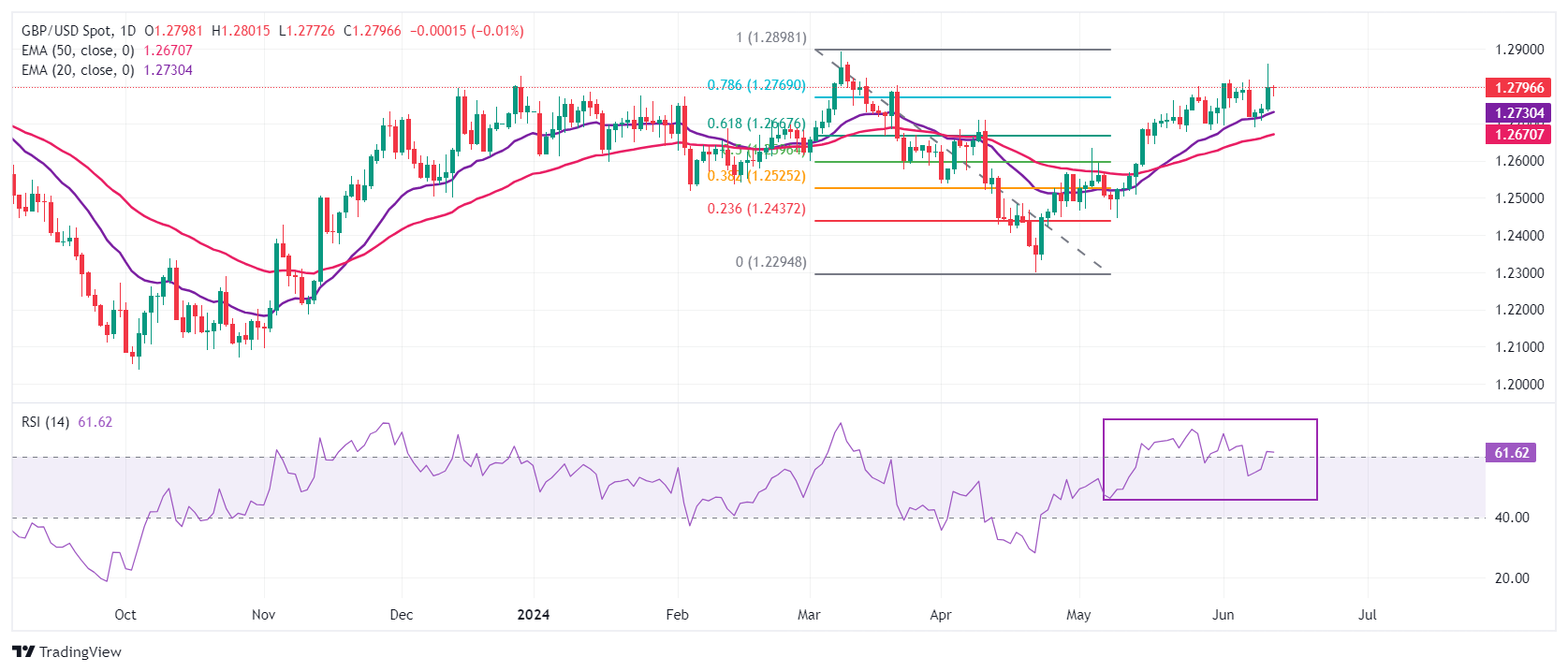
The Pound Sterling trades inside Wednesday’s trading range. The GBP/USD pair aims to sustain above the 78.6% Fibonacci retracement support at 1.2770, plotted from the March 8 high of 1.2900 to the April 22 low at 1.2300.
The 20-day Exponential Moving Average (EMA), which trades around 1.2730, continues to provide support to the Pound Sterling bulls. Also, the 50-day EMA near 1.2670 is sloping higher, suggesting that the near-term trend is still up.
The 14-period Relative Strength Index (RSI) returns to the 60.00-80.00 range and needs to sustain comfortable stability in this range to shift momentum towards the upside.
Economic Indicator
Producer Price Index ex Food & Energy (YoY)
The Producer Price Index ex Food & energy released by the Bureau of Labor statistics, Department of Labor measures the average changes in prices in primary markets of the US by producers of commodities in all states of processing. Those volatile products such as food and energy are excluded in order to capture an accurate calculation. Generally speaking, a high reading is seen as positive (or bullish) for the USD, whereas a low reading is seen as negative (or bearish).
Read more.Last release: Thu Jun 13, 2024 12:30
Frequency: Monthly
Actual: 2.3%
Consensus: 2.4%
Previous: 2.4%
Source: US Bureau of Labor Statistics
Author

Sagar Dua
FXStreet
Sagar Dua is associated with the financial markets from his college days. Along with pursuing post-graduation in Commerce in 2014, he started his markets training with chart analysis.