Pound Sterling slides amid uncertainty ahead of Fed/BoE interest rate meetings
- The Pound Sterling falls sharply against the US Dollar near 1.2850 with a focus on Fed/BoE policy meetings.
- Traders raise BoE rate-cut bets despite stubborn UK service inflation.
- Investors see the Fed delivering a dovish interest rate guidance.

The Pound Sterling (GBP) exhibits a weak performance against its major peers, except the Japanese Yen, on Tuesday. The British currency weakens as market speculation for the Bank of England (BoE) to begin reducing interest rates from the August meeting, which will be announced on Thursday, has improved further. Trades see a little over 58% chance that the BoE will cut its key borrowing rates by 25 basis points (bps) to 5%, Reuters reported.
Investors expect that the BoE’ rate-cut decision will be a tough call, with 5-4 vote split as inflation in the service sector is significantly higher than where it needs to be to boost policymakers’ confidence for rate cuts. United Kingdom’s (UK) annual service inflation remained higher at 5.7% in June than bank’s forecast of 5.1%.
In the last monetary policy meeting, BoE Governor Andrew Bailey said policymakers saw the decision to keep interest rates steady as ‘finely balanced’, which boosted expectations that the central bank will cut interest rates in August.
Meanwhile, fears of price pressures remaining persistent have deepened as UK Finance Minister Rachel Reeves vowed to deliver above-inflation pay rises worth 9.4 billion pounds for workers in the public sector such as doctors and teachers. Reeves told Parliament, "I have today set out our decision to meet the recommendation of the pay review bodies because the previous government failed to prepare for these recommendations in their departmental budgets," Reuters reported. Reeves announced that she will hold her first fiscal budget on October 30.
Daily digest market movers: Pound Sterling weakens against US Dollar after upbeat US JOLTS Job Openings data
- The Pound Sterling drops to near 1.2835 against the US Dollar (USD) in Tuesday’s American session. The US Dollar rises on upbeat United States (US) JOLTS Job Openings data for June. The report showed that fresh job vacancies were higher at 8.18 million than expectations of 8.04 million and the former release of 8.23 million, downwardly revised from 8.14 million.
- The GBP/USD pair remains inside Monday’s trading range but is on the backfoot with a focus on interest-rate decisions by the Federal Reserve (Fed) and the BoE on Wednesday and Thursday, respectively.
- The Fed is widely anticipated to maintain the status quo for the eighth consecutive meeting. Therefore, investors will keenly focus on the monetary policy statement and Fed Chair Jerome Powell’s press conference to get fresh cues about rate cut prospects.
- Market experts see the Fed sending a clear message that rate cuts are highly likely in the September meeting amid significant progress in inflation declining towards the bank’s target of 2% and increasing risks to labor market strength. The scenario would be unfavorable for the US Dollar and bond yields. At the time of writing, the US Dollar Index (DXY), which tracks the Greenback’s value against six major peers, advances to 104.80. 10-year US Treasury yields recovers to near 4.18%.
- This week, many economic data are lined up for release, which will impact the next move in the US Dollar, such as ADP Employment Change, ISM Manufacturing PMI, and Nonfarm Payrolls (NFP) for July.
Pound Sterling Price Today:
British Pound PRICE Today
The table below shows the percentage change of British Pound (GBP) against listed major currencies today. British Pound was the strongest against the Japanese Yen.
| GBP | EUR | USD | JPY | CAD | AUD | NZD | CHF | |
|---|---|---|---|---|---|---|---|---|
| GBP | -0.16% | -0.20% | 0.42% | -0.17% | 0.02% | -0.34% | -0.18% | |
| EUR | 0.16% | -0.06% | 0.55% | -0.00% | 0.16% | -0.19% | -0.02% | |
| USD | 0.20% | 0.06% | 0.60% | 0.03% | 0.22% | -0.14% | 0.03% | |
| JPY | -0.42% | -0.55% | -0.60% | -0.58% | -0.40% | -0.76% | -0.57% | |
| CAD | 0.17% | 0.00% | -0.03% | 0.58% | 0.18% | -0.18% | -0.02% | |
| AUD | -0.02% | -0.16% | -0.22% | 0.40% | -0.18% | -0.37% | -0.22% | |
| NZD | 0.34% | 0.19% | 0.14% | 0.76% | 0.18% | 0.37% | 0.17% | |
| CHF | 0.18% | 0.02% | -0.03% | 0.57% | 0.02% | 0.22% | -0.17% |
The heat map shows percentage changes of major currencies against each other. The base currency is picked from the left column, while the quote currency is picked from the top row. For example, if you pick the British Pound from the left column and move along the horizontal line to the US Dollar, the percentage change displayed in the box will represent GBP (base)/USD (quote).
Technical Analysis: Pound Sterling declines toward 1.2800
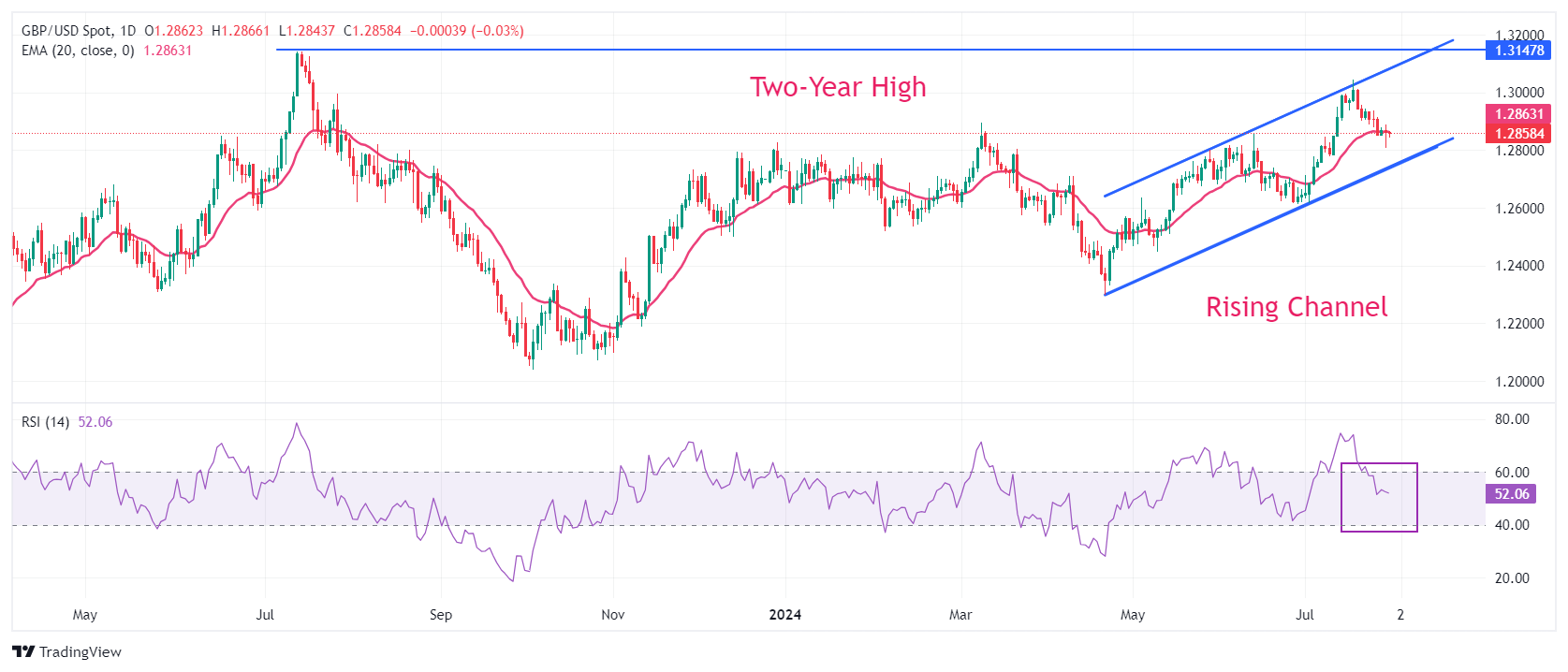
The Pound Sterling is going through a mean-reversion move toward the lower boundary of the Rising Channel chart pattern on a daily timeframe. The GBP/USD pair fell on the back foot after breaking below the crucial support of 1.2900. The Cable drops below the 20-day Exponential Moving Average (EMA) near 1.2860, suggesting uncertainty in the near-term trend.
The 14-day Relative Strength Index (RSI) declines toward 40.00, which would a be cushion for the momentum oscillator.
On the downside, the round-level of 1.2800 will be a crucial support zone for the Pound Sterling bulls. Meanwhile, the two-year high near 1.3140 will be a key resistance zone for the Cable.
Interest rates FAQs
Interest rates are charged by financial institutions on loans to borrowers and are paid as interest to savers and depositors. They are influenced by base lending rates, which are set by central banks in response to changes in the economy. Central banks normally have a mandate to ensure price stability, which in most cases means targeting a core inflation rate of around 2%. If inflation falls below target the central bank may cut base lending rates, with a view to stimulating lending and boosting the economy. If inflation rises substantially above 2% it normally results in the central bank raising base lending rates in an attempt to lower inflation.
Higher interest rates generally help strengthen a country’s currency as they make it a more attractive place for global investors to park their money.
Higher interest rates overall weigh on the price of Gold because they increase the opportunity cost of holding Gold instead of investing in an interest-bearing asset or placing cash in the bank. If interest rates are high that usually pushes up the price of the US Dollar (USD), and since Gold is priced in Dollars, this has the effect of lowering the price of Gold.
The Fed funds rate is the overnight rate at which US banks lend to each other. It is the oft-quoted headline rate set by the Federal Reserve at its FOMC meetings. It is set as a range, for example 4.75%-5.00%, though the upper limit (in that case 5.00%) is the quoted figure. Market expectations for future Fed funds rate are tracked by the CME FedWatch tool, which shapes how many financial markets behave in anticipation of future Federal Reserve monetary policy decisions.
Author

Sagar Dua
FXStreet
Sagar Dua is associated with the financial markets from his college days. Along with pursuing post-graduation in Commerce in 2014, he started his markets training with chart analysis.