Pound Sterling bounces back strongly with Fed Powell’s speech in focus
- The Pound Sterling recovers to near 1.3400 against the US Dollar as investors expect the Fed to cut interest rates by 50 bps in November.
- Investors await the Fed Powell’s speech on Thursday and the PCE inflation data for August on Friday.
- The BoE is expected to follow a shallow monetary policy-easing cycle.

The Pound Sterling (GBP) rebounds strongly to near the key support near 1.3400 against the US Dollar (USD) in Thursday’s North American session after correcting sharply on Wednesday. The GBP/USD finds cushion as investors have broadly underpinned the Pound Sterling against the Greenback due to firm speculation that the Federal Reserve’s (Fed) policy-easing cycle would be deeper and faster than the one to be followed by the Bank of England (BoE) in the remainder of the year.
According to the CME FedWatch tool, the central bank is expected to reduce its key borrowing rates further by 75 basis points (bps) in the remaining two meetings this year, suggesting that there will be one 50 bps and one 25 bps rate cut. 30-day Federal fund futures pricing data shows that the probability of the Fed reducing interest rates by a larger-than-usual margin in November has increased to 61% from 39% a week ago.
For fresh interest rate cues, investors will focus on speeches from various Fed policymakers, including Chair Jerome Powell, scheduled in the North American session. Last week, in the press conference after the monetary policy decision of the 50 bps interest rate cut, Powell emphasized remaining data-dependent for further policy action.
On the economic front, market participants await the United States (US) Personal Consumption Expenditure Price Index (PCE) data for August, which will be published on Friday. Signs of further slowdown in inflationary pressures would prompt market expectations of a Fed 50 bps interest rate cut, while hot figures would weaken them.
Daily digest market movers: Pound Sterling recovers against US Dollar
- The Pound Sterling trades with caution against its major peers on Thursday due to the absence of top-tier United Kingdom (UK) economic data. Therefore, the British currency is expected to be influenced by the market sentiment and expectations for the BoE interest rate outlook.
- The market mood appears to be favorable for risk-perceived assets due to China’s massive stimulus and growing expectation of additional larger-than-usual interest rate cuts by the Fed. S&P 500 futures have posted significant gains in the European session, exhibiting a strong risk appetite of investors.
- Meanwhile, the BoE is projected to deliver one interest rate cut in any of its two policy meetings remaining this year. The BoE’s policy-easing cycle appears to be shallower than that of other central banks as policymakers remain concerned over price pressures remaining persistent due to high inflation in the service sector. Annual service inflation, which is closely tracked by BoE officials, rose sharply to 5.6% in August from 5.2% in July.
Technical Analysis: Pound Sterling gathers strength to recapture 1.3400
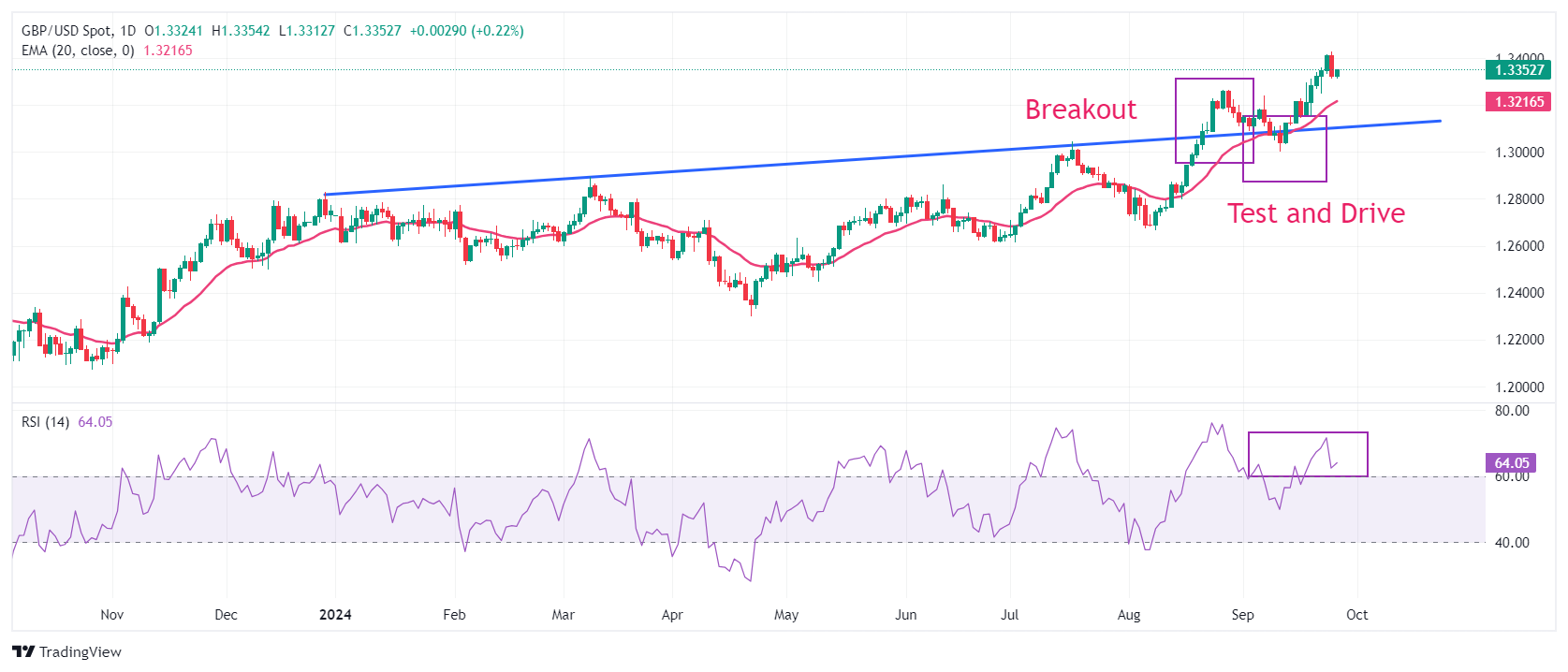
The Pound Sterling delivers a strong recovery move to near 1.3400 in North American trading hours against the US Dollar after correcting to near 1.3300 on Wednesday. The GBP/USD pair faced some selling pressure after posting a fresh more-than-two-year high at 1.3430. The near-term outlook of the Cable remains firm as the 20-day Exponential Moving Average (EMA) near 1.3216 is sloping higher.
Earlier in September, the Cable strengthened after recovering from a corrective move to near the trendline plotted from the December 28, 2023, high of 1.2828, from where it delivered a sharp increase after a breakout on August 21.
The 14-day Relative Strength Index (RSI) shifts above 60.00, suggesting an active bullish momentum.
Looking up, the Cable will face resistance near the psychological level of 1.3500. On the downside, the psychological level of 1.3000 emerges as crucial support.
Economic Indicator
Core Personal Consumption Expenditures - Price Index (YoY)
The Core Personal Consumption Expenditures (PCE), released by the US Bureau of Economic Analysis on a monthly basis, measures the changes in the prices of goods and services purchased by consumers in the United States (US). The PCE Price Index is also the Federal Reserve’s (Fed) preferred gauge of inflation. The YoY reading compares the prices of goods in the reference month to the same month a year earlier. The core reading excludes the so-called more volatile food and energy components to give a more accurate measurement of price pressures." Generally, a high reading is bullish for the US Dollar (USD), while a low reading is bearish.
Read more.Next release: Fri Sep 27, 2024 12:30
Frequency: Monthly
Consensus: 2.7%
Previous: 2.6%
Source: US Bureau of Economic Analysis
After publishing the GDP report, the US Bureau of Economic Analysis releases the Personal Consumption Expenditures (PCE) Price Index data alongside the monthly changes in Personal Spending and Personal Income. FOMC policymakers use the annual Core PCE Price Index, which excludes volatile food and energy prices, as their primary gauge of inflation. A stronger-than-expected reading could help the USD outperform its rivals as it would hint at a possible hawkish shift in the Fed’s forward guidance and vice versa.
Author

Sagar Dua
FXStreet
Sagar Dua is associated with the financial markets from his college days. Along with pursuing post-graduation in Commerce in 2014, he started his markets training with chart analysis.















