Pound Sterling faces pressure against USD as Fed signals caution on interest rate cuts
- The Pound Sterling seems vulnerable near 1.2400 against the US Dollar as the Fed has signaled fewer interest rate cuts this year.
- Lower US Initial Jobless Claims have signaled an improvement in labor market conditions.
- The BoE is expected to cut interest rates by 60 bps this year.

The Pound Sterling (GBP) trades near a more-than-eight-month low around 1.2400 against the US Dollar (USD) in Friday’s North A session. The GBP/USD pair is under pressure while the US Dollar has extended its bull run as market participants expect fewer interest rate cuts from the Federal Reserve this year.
The latest dot plot at the Fed's Summary of Economic Projections showed that policymakers collectively see Federal Fund rates heading to 3.9% by the end of 2025, higher than the 3.4% forecasted in September.
The US Dollar Index (DXY), which tracks the Greenback’s value against six major currencies, trades nearly a fresh two-year high above 109.00 recorded on Thursday. The positive move was backed partly by lower United States (US) Initial Jobless Claims and optimism about the economic outlook from the incoming policies, such as tighter immigration, higher import tariffs, and lower taxes, under the administration of President-elect Donald Trump.
The number of individuals applying for initial jobless benefits was 211K for the week ending December 27, the lowest in eight months, which indicates a healthy labor market.
In Friday’s session, investors will focus on the US ISM Manufacturing Purchasing Managers Index (PMI) data for December, which will be published at 15:00 GMT. Economists expect the PMI to remain unchanged at 48.4, suggesting that activity in the manufacturing sector contracted at a steady pace.
Daily digest market movers: Pound Sterling trades cautiously as BoE dovish bets tick higher
- The Pound Sterling trades with caution against its major peers on Friday, faces pressure from weak United Kingdom (UK) S&P Global/CIPS Manufacturing PMI data for December. On Thursday, the final PMI report showed that activity in the manufacturing sector contracted at a faster pace to 47.0 compared to the preliminary reading of 47.3. The report showed that the downturn was widespread in nature, with similarly sharp rates of decline across the consumer, intermediate, and investment goods industries.
- Rob Dobson, Director at S&P Global Market Intelligence said, "Business sentiment is now at its lowest for two years, as the new Government's rhetoric and announced policy changes dampen confidence and raise costs at UK factories and their clients alike. SMEs are being especially hard hit during the latest downturn."
- Meanwhile, rising Bank of England (BoE) dovish bets have also bruised the Pound Sterling. Traders price in roughly 60 basis points (bps) interest rate reduction by the BoE this year, up from 53 bps recorded in the last week of December.
Technical Analysis: Pound Sterling remains under pressure, sees support near 1.2300
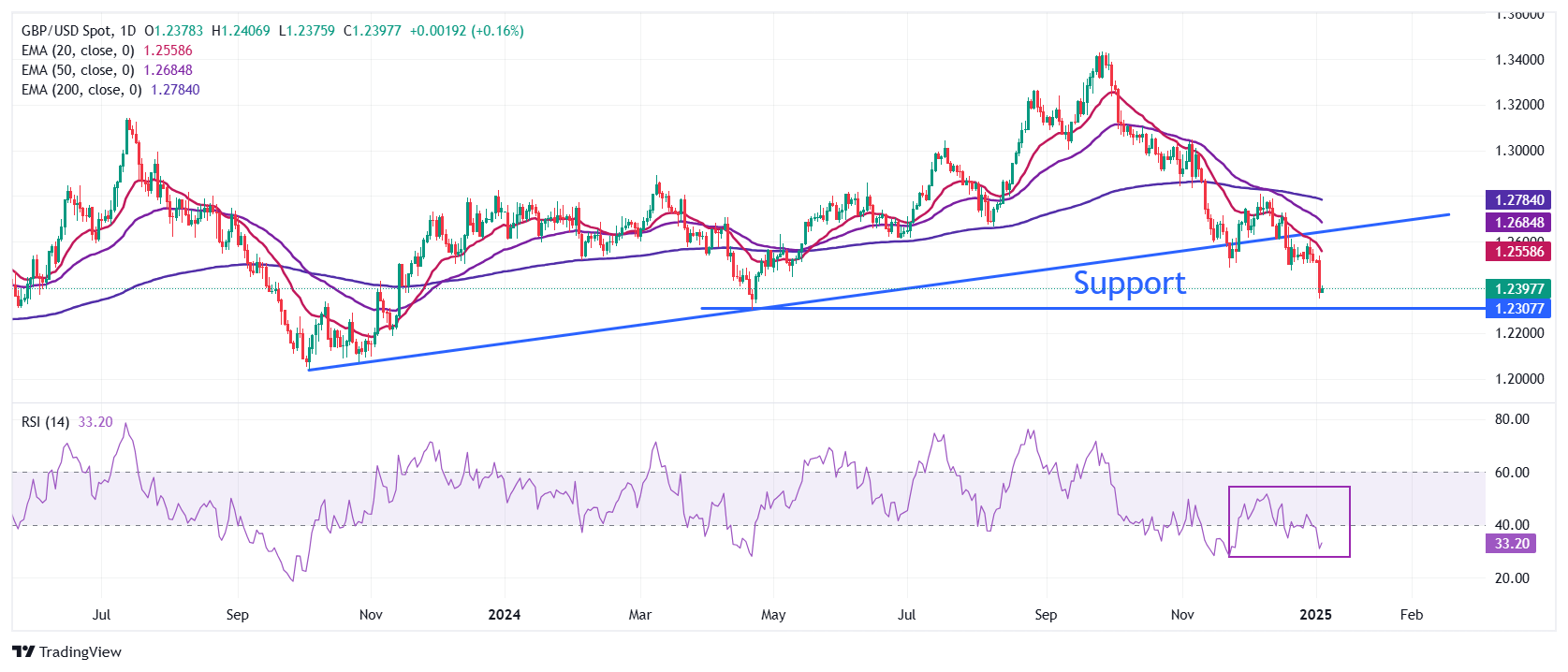
The Pound Sterling plunged below 1.2400 against the US Dollar on Thursday. The outlook of the GBP/USD pair was already vulnerable as the pair trades below the upward-sloping trendline around 1.2600, which is plotted from the October 2023 low of 1.2035.
All short-to-long-term Exponential Moving Averages (EMAs) are sloping down, suggesting a strong bearish trend in the long run.
The 14-day Relative Strength Index (RSI) oscillates below 40.00, signaling a strong downside momentum.
Looking down, the pair is expected to find a cushion near the April 22 low at around 1.2300. On the upside, the psychological level of 1.2500 will act as key resistance.
Author

Sagar Dua
FXStreet
Sagar Dua is associated with the financial markets from his college days. Along with pursuing post-graduation in Commerce in 2014, he started his markets training with chart analysis.