Pound Sterling plummets on surprisingly upbeat US job demand
- The Pound Sterling dives to near 1.2200 against the USD after upbeat US NFP data for December.
- The British currency remains under pressure as investors expect higher UK gilt yields could force Chancellor Reeves to cut spending and raise taxes in the Autumn Budget.
- BoE’s Breeden said recent evidence supports a gradual withdrawal of policy restrictiveness.

The Pound Sterling (GBP) plunges to near 1.2200 against the US Dollar (USD) in Friday’s New York session, the lowest level in 14 months. The GBP/USD pair faces intense selling pressure as the US Dollar rallies after the release of the United States (US) Nonfarm Payrolls (NFP) data, which showed that labor demand surprisingly remained robust in December.
The US NFP report showed that the economy added 256K fresh workers in December, significantly higher than the previous release of 212K, downwardly revised from 227K. Economists expected fewer job additions at 160K. The Unemployment Rate dropped to 4.1% from the estimates and the former release of 4.2%.
The outcome of the Federal Reserve’s (Fed) December monetary policy meeting already showed that officials were less concerned about labor market conditions and more worried about stalling progress in the disinflation trend. However, signs of weak labor demand could have stemmed fears that job market conditions have yet to return to their restoration state as the Fed pivoted to a dovish policy stance in September 2024 due to firm downside risks to employment generation.
Average Hourly Earnings data, a key measure of wage growth that drives consumer spending, rose by 3.9%, slower than estimates and the prior release of 4% on a year-on-year basis. On a month-on-month basis, the wage growth measure rose by 0.3%, as expected, but slower than the 0.4% in November.
According to the CME FedWatch tool, traders are confident that the Fed will not cut interest rates till the March meeting but are divided over the policy announcement in May.
Daily digest market movers: Pound Sterling falters as ramping UK gilt yields mirror weak economic outlook
- The Pound Sterling continues underperforming its major peers, rattled by rising borrowing costs on the United Kingdom (UK) government’s debt. The 30-year UK gilt yields have risen to 5.36%, the highest level since 1998, causing discomfort for Chancellor of the Exchequer Rachel Reeves.
- Market participants started dumping UK gilt securities amid fears of higher debt, lower growth, and potentially inflationary United States (US) President-elect Donald Trump policies, which could lead to economic stagflation. Investors anticipated that higher gilt yields would force Rachel Reeves to make fresh borrowings to fund day-to-day expenditures. Earlier, Reeves vowed to fund daily spending with tax receipts and cut public spending.
- The British Finance Ministry remained committed to not seeking fresh borrowings. UK Treasury Minister Darren Jones clarified at the House of Commons on Thursday that the government's decision to borrow only for investment was "non-negotiable." Jones added that it is normal for the price of gilts to "vary" and assured that financial markets continue to function in an "orderly way."
- Darren Jones also confirmed that public spending will be “in line with what was set out in the Autumn Budget” and added that there is no need for any “emergency intervention” by the Chancellor.
- On the sharp spike in UK gilt yields, BoE Deputy Governor Sarah Breeden said that the rise in government’s borrowing costs is partly linked to uncertainty over “incoming policies from United States (US) President-elect Donald Trump” in her speech at the University of Edinburgh. When asked about her view on the monetary policy outlook, Breeden said: "The recent evidence further supports the case to withdraw “policy restrictiveness.” She added that the withdrawal of policy restrictiveness will be “gradual” over time.
British Pound PRICE Today
The table below shows the percentage change of British Pound (GBP) against listed major currencies today. British Pound was the strongest against the New Zealand Dollar.
| USD | EUR | GBP | JPY | CAD | AUD | NZD | CHF | |
|---|---|---|---|---|---|---|---|---|
| USD | 0.52% | 0.76% | 0.32% | 0.18% | 0.84% | 0.89% | 0.61% | |
| EUR | -0.52% | 0.23% | -0.20% | -0.35% | 0.31% | 0.36% | 0.08% | |
| GBP | -0.76% | -0.23% | -0.41% | -0.57% | 0.08% | 0.13% | -0.15% | |
| JPY | -0.32% | 0.20% | 0.41% | -0.13% | 0.51% | 0.55% | 0.28% | |
| CAD | -0.18% | 0.35% | 0.57% | 0.13% | 0.65% | 0.71% | 0.43% | |
| AUD | -0.84% | -0.31% | -0.08% | -0.51% | -0.65% | 0.04% | -0.23% | |
| NZD | -0.89% | -0.36% | -0.13% | -0.55% | -0.71% | -0.04% | -0.28% | |
| CHF | -0.61% | -0.08% | 0.15% | -0.28% | -0.43% | 0.23% | 0.28% |
The heat map shows percentage changes of major currencies against each other. The base currency is picked from the left column, while the quote currency is picked from the top row. For example, if you pick the British Pound from the left column and move along the horizontal line to the US Dollar, the percentage change displayed in the box will represent GBP (base)/USD (quote).
Technical Analysis: Pound Sterling slides to 1.2200
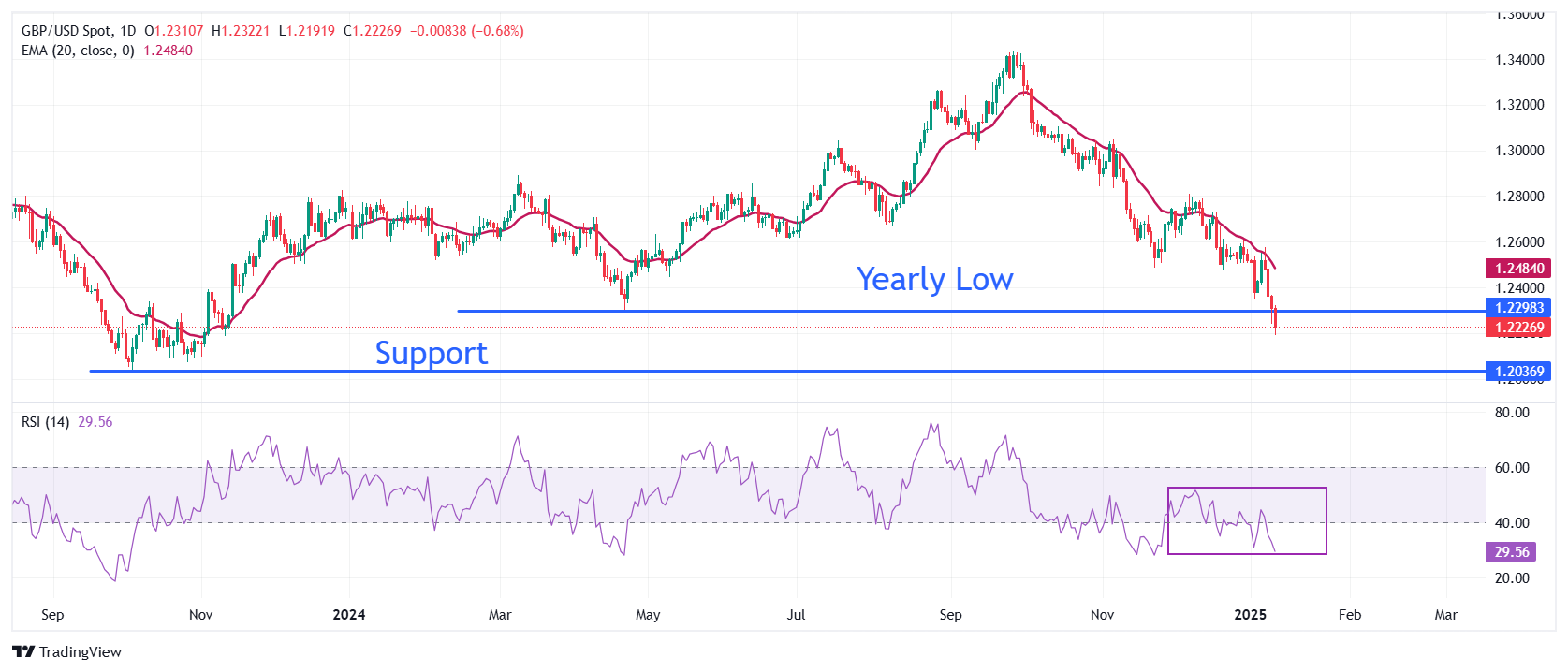
The Pound Sterling posts a fresh yearly low around 1.2200 against the US Dollar (USD) on Friday. The GBP/USD pair turned weak after a short-lived recovery move to near the 20-day Exponential Moving Average (EMA) near 1.2550, which is currently trading around 1.2490.
The 14-day Relative Strength Index (RSI) drops sharply to near 30.00, suggesting a strong bearish momentum.
Looking down, the pair is expected to find support near the October 2023 low of 1.2036. On the upside, the 20-day EMA will act as key resistance.
Economic Indicator
Nonfarm Payrolls
The Nonfarm Payrolls release presents the number of new jobs created in the US during the previous month in all non-agricultural businesses; it is released by the US Bureau of Labor Statistics (BLS). The monthly changes in payrolls can be extremely volatile. The number is also subject to strong reviews, which can also trigger volatility in the Forex board. Generally speaking, a high reading is seen as bullish for the US Dollar (USD), while a low reading is seen as bearish, although previous months' reviews and the Unemployment Rate are as relevant as the headline figure. The market's reaction, therefore, depends on how the market assesses all the data contained in the BLS report as a whole.
Read more.Last release: Fri Jan 10, 2025 13:30
Frequency: Monthly
Actual: 256K
Consensus: 160K
Previous: 227K
Source: US Bureau of Labor Statistics
America’s monthly jobs report is considered the most important economic indicator for forex traders. Released on the first Friday following the reported month, the change in the number of positions is closely correlated with the overall performance of the economy and is monitored by policymakers. Full employment is one of the Federal Reserve’s mandates and it considers developments in the labor market when setting its policies, thus impacting currencies. Despite several leading indicators shaping estimates, Nonfarm Payrolls tend to surprise markets and trigger substantial volatility. Actual figures beating the consensus tend to be USD bullish.
Author

Sagar Dua
FXStreet
Sagar Dua is associated with the financial markets from his college days. Along with pursuing post-graduation in Commerce in 2014, he started his markets training with chart analysis.

















