Pound Sterling gains on BoE Mann's hawkish gudiance, UK PMI expands again
- The Pound Sterling rises on continuous growth in the UK business activity.
- BoE Mann sees more rate cuts as premature and worries that service inflation is still elevated.
- The uncertainty over US presidential elections continues to weigh on risky assets.

The Pound Sterling (GBP) outperforms its major peers in Thursday’s North American session after the release of the preliminary United Kingdom (UK) S&P Global/CIPS Purchasing Managers Index (PMI) data for October. However, the initial reaction was on the weaker side. The flash PMI report showed that the output expanded but at a slower-than-expected pace in manufacturing as well as the service sector. The Composite PMI grew at a modest pace to 51.7 from 52.6 in September.
“The early PMI data are indicative of the economy growing at a meager 0.1% quarterly rate in October, reflecting a broad-based slowing of business activity, spending, and demand across both manufacturing and services," Chris Williamson, Chief Business Economist at S&P Global Market Intelligence, said.
However, the outlook of the Pound Sterling is expected to remain volatile as Bank of England (BoE) Governor Andrew Bailey remained confident about inflation decelerating faster than expected. “Disinflation is happening, I think, faster than we expected it to, but we still have genuine question marks about whether there have been some structural changes in the economy,” Bailey said during the Institute of International Finance event, Bloomberg reported.
The comments from Bailey prompted BoE’s dovish bets. According to market speculation, traders expect the BoE to cut interest rates in November and are heavily confident about repeating the move in December.
Meanwhile, BoE Monetary Policy Committee (MPC) member Catherine Mann also cited the recent decline in inflation data in September as good news. However, she believes that the service inflation is still elevated. Over the interest rate outlook, Mann said, "It would be premature to cut rates if you have structural persistence in the relationship between wages and price formation." Her comments came in the New York session on Thursday.
British Pound PRICE Today
The table below shows the percentage change of British Pound (GBP) against listed major currencies today. British Pound was the strongest against the Canadian Dollar.
| USD | EUR | GBP | JPY | CAD | AUD | NZD | CHF | |
|---|---|---|---|---|---|---|---|---|
| USD | -0.21% | -0.45% | -0.38% | 0.02% | -0.09% | -0.15% | 0.00% | |
| EUR | 0.21% | -0.25% | -0.18% | 0.23% | 0.11% | 0.05% | 0.19% | |
| GBP | 0.45% | 0.25% | 0.06% | 0.47% | 0.35% | 0.29% | 0.45% | |
| JPY | 0.38% | 0.18% | -0.06% | 0.42% | 0.30% | 0.21% | 0.39% | |
| CAD | -0.02% | -0.23% | -0.47% | -0.42% | -0.10% | -0.17% | -0.02% | |
| AUD | 0.09% | -0.11% | -0.35% | -0.30% | 0.10% | -0.05% | 0.08% | |
| NZD | 0.15% | -0.05% | -0.29% | -0.21% | 0.17% | 0.05% | 0.15% | |
| CHF | -0.00% | -0.19% | -0.45% | -0.39% | 0.02% | -0.08% | -0.15% |
The heat map shows percentage changes of major currencies against each other. The base currency is picked from the left column, while the quote currency is picked from the top row. For example, if you pick the British Pound from the left column and move along the horizontal line to the US Dollar, the percentage change displayed in the box will represent GBP (base)/USD (quote).
Daily digest market movers: Pound Sterling outperforms US Dollar
- The Pound Sterling bounces back to near 1.2980 against the US Dollar (USD) in North American trading hours on Thursday after refreshing a two-month low near 1.2900 on Wednesday. The GBP/USD pair gains as the US Dollar corrects slightly, with the US Dollar Index (DXY) dropping to near 104.20. However, the outlook of the US Dollar remains firm due to a slight decline in market expectations for the Federal Reserve (Fed) to reduce interest rates in each of the remaining policy meetings this year.
- According to the CME FedWatch tool, the likelihood that the central bank will reduce interest rates by 50 bps to 4.25%-4.50% by the year-end has slightly declined to 68.3% from 71.7% a week ago. The tool shows that traders have priced in a 25-bps interest rate cut in November but are not fully confident about a similar move in December.
- Growing uncertainty for the United States (US) presidential election outcome, coming in less than two weeks, has also improved the US Dollar’s appeal as safe-haven. Latest national polls show a fierce competition between former President Donald Trump and current Vice President Kamala Harris.
- On the economic front, US preliminary S&P Global PMI data for October came in better than expected. The report showed that activities in the service sector expanded at a surprisingly faster-than-expected pace to 55.3. Economists expected the Services PMI to have grown at a slower pace to 55.0 from 55.2 in September. Meanwhile, the Manufacturing PMI contracted for the fourth straight month but at a slower-than-expected pace to 47.8.
- Meanwhile, the Initial Jobless Claims data for the week ending October 18 came in lower at 227K, lower than estimates and the former release of 242K.
Technical Analysis: Pound Sterling recovers from 1.2900
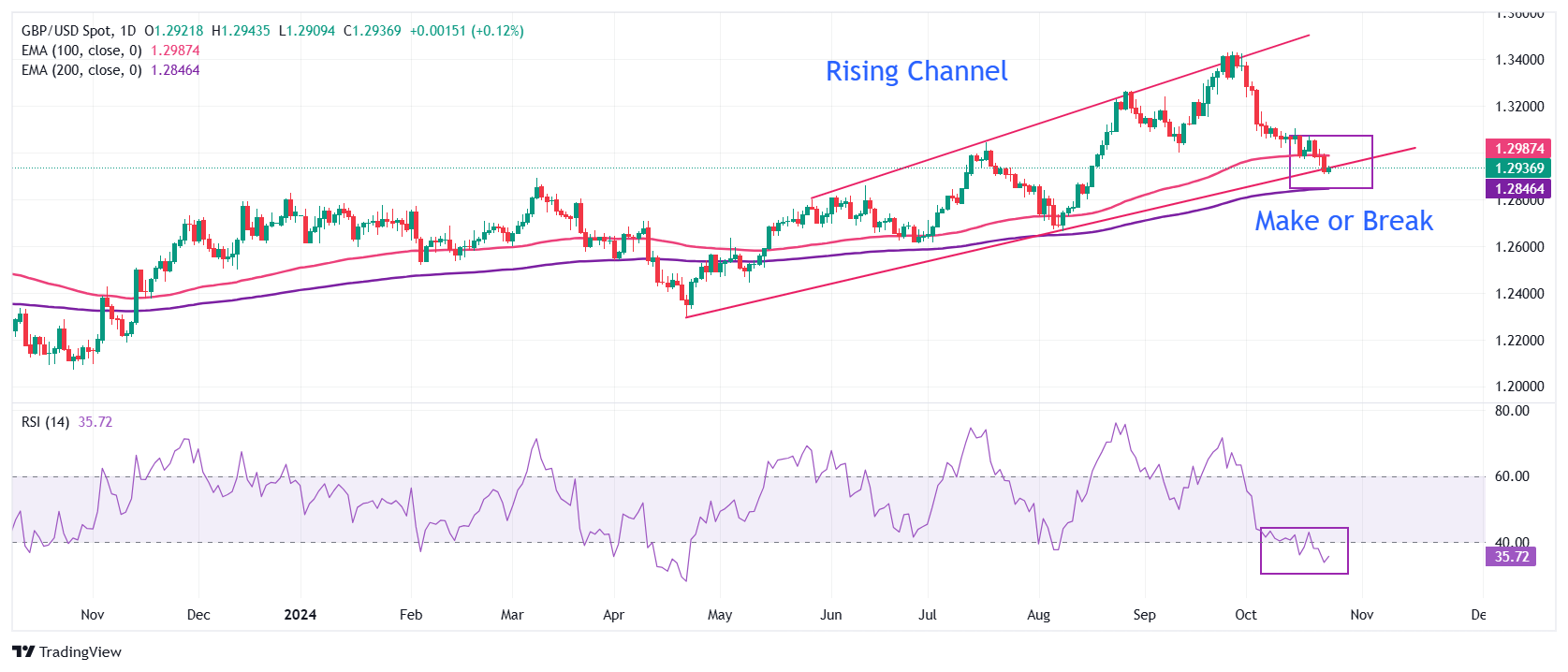
The Pound Sterling is at make or a break near the lower boundary of a Rising Channel chart formation on the daily timeframe. The GBP/USD pair could face sharp selling pressure if it fails to hold the same.
The near-term trend of the Cable has worsened further as it has broken below the 100-day Exponential Moving Average (EMA), which trades around 1.2990.
The 14-day Relative Strength Index (RSI) slides to near 35.00, signals an active bearish momentum.
Looking down, the 200-day EMA near 1.2845 will be a major support zone for Pound Sterling bulls. On the upside, the Cable will face resistance near the psychological figure of 1.3000 and the 20-day EMA around 1.3060.
Author

Sagar Dua
FXStreet
Sagar Dua is associated with the financial markets from his college days. Along with pursuing post-graduation in Commerce in 2014, he started his markets training with chart analysis.