Polestar Stock News and Forecast: PSNY consolidates near support as Precept model unveiled
- PSNY stock has consolidated between $8.61 and $9.12
- Polestar support at $8.64 held up fairly well for third time.
- Fellow EV upstart NIO has impressed the market with July deliveries.

Polestar (PSNY) stock is off 1.1% at the open on Tuesday, perfectly in line with its consolidation trend. The Swedish EV stock has jettisoned any volatility as investors await more news on deliveries. Trading around $8.80 on Tuesday morning, PSNY shares are solidly inside a thin consolidation zone that has held up for more than a week.
Also read: Tesla Stock Deep Dive: Price target at $400 on China headwinds, margin compression, lower deliveries
The general market is down, and many Chinese EV stocks have sold off somewhat as US congressional leader Nancy Pelosi becomes the first major US politician to visit Taiwan in a quarter century.
PSNY Stock News: Consolidation rules despite heavy growth ahead
Polestar stock is has traded between a low of $8.61 and high of $9.12 over the past six sessions. PSNY is a long way from the volatile equity it was after it first merged on June 24 with special purpose acquisition company (SPAC) Gores Guggenheim (GGPI). That session saw PSNY top out at $13.36. Volume is the primary culprit for the meager PSNY price action. While the three-month average volume sits at 3.74 million shares, 10-day average volume is must lower at 1.74 million.
PSNY share price did increase in mid-July after Polestar announced that it still expected to achieve delivery of 50,000 units for the full year. Polestar's deliveries of 21,200 in the first half of 2022 were 125% above its delivery of 9,510 vehicles in the same period of 2021.
Polestar CEO Thomas Ingenlath said in a recent interview: "I am very confident that the strong momentum we have seen this year in brand awareness and sales figures will accelerate powerfully in the coming years as more ground-breaking cars are revealed." In the first half of the year, Polestar moved into six new markets for a total of 25. The company increased its salesrooms from 103 to 125 and says it will add another 30 in the second half.
Also read: Citi Stock Deep Dive: Buy rating and price target at $60
Deutsche Bank initiated coverage of PSNY on Monday, giving the stock a Hold rating and a price target of $10. Despite the ungenerous target, Deutsche analysts said Polestar's "asset-light" business model could make it a solid contender in coming years.
The Swedish EV automaker is very clearly in growth mode, but the market has stopped paying attention due to the technical recession in the first half of the year and related worries over inflation and rising interest rates.
Polestar history
Polestar is a Swedish EV automaker that started out its life in the 1990s as Flash/Polestar Racing. The firm tuned up Volvo vehicles, which are normally thought of as mature family vehicles, into racing performance models that could compete on the track. Volvo struck up a relationship with Polestar in the 2000s and eventually bought it out in 2015. Only after that did Polestar, which is headquartered in Gothenburg, Sweden, make the turn toward its electric future.
Polestar vehicles have a short history as of yet. Its first production model, the aptly named Polestar 1, was actually a hybrid. The Polestar 2, its current primary model in production, was the first to be fully electric. The Polestar 3 is an SUV model expected to debut in October.
Volvo and China's Geely Automotive own Polestar in a sort of joint venture. This is complicated by the fact that Geely bought Volvo outright during the 2008-2009 financial crisis, so actually Geely owns both companies. With technical advice from Volvo and Geely, as well as the use of both companies' production facilities, Polestar is expected by many to become a major player in the years to come.
Polestar Precept becomes Polestar 5
Polestar recently announced that its Polestar Precept concept car has been merged with its designs for the Polestar 5. In a note on its website, Polestar says,
Indulging in design daydreams is fun. We do it ourselves. But with the climate crisis in the foreground, we decided to use the concept car as a showcase for what we need to see (namely, potential solutions to the most pressing issue our planet is currently facing), as opposed to what we'd like to see.
Several innovations from the Precept will now become reality in the Polestar 5 production vehicle, which is not expected to be delivered until 2024. The vehicle utilizes flax-fiber composites invented by a company called Bcomp. Polestar says the material is much more ecologically sound. The car will also use an updated version of the Android Automotive OS first used in the Polestar 2.
A version of the Polestar 5 was already a hit when it was unveiled to automotive enthusiasts at England's Goodwood Festival of Speed in late June. Most interesting is that Polestar has decided to document the merging of the Precept with the Polestar 5 in real time on YouTube and showcase how the design and engineering teams work in tandem.
Polestar 5
Polestar Stock Forecast: Bulls need to attack $9.12
PSNY stock, as already stated, seems to once again be heading back to support at $8.64. June 16 and July 1 both saw PSNY trade below there. July 25 and 26 also saw PSNY share price find its footing near the same price level.
The resistance in the current consolidation zone at $9.12 was laid out on July 28. To re-energize traders, PSNY stock needs to close above $9.12 and then again above $9.50. Both price levels stand in the way of heavier volume in the zone between $10.10 and $10.60.
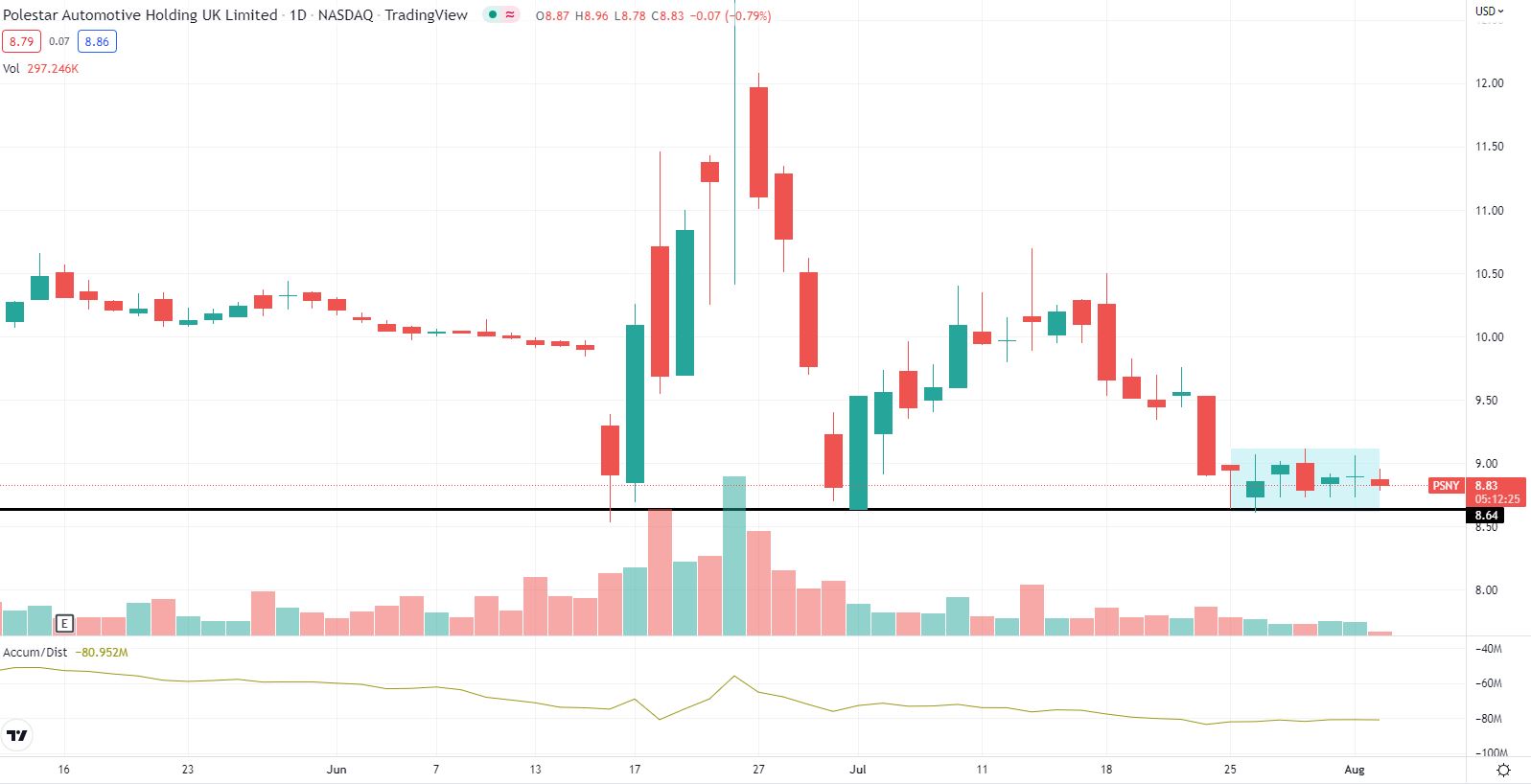
PSNY stock chart, daily
Author

Clay Webster
FXStreet
Clay Webster grew up in the US outside Buffalo, New York and Lancaster, Pennsylvania. He began investing after college following the 2008 financial crisis.