Oil steady with Russia set to decrease output production after missed quota
- Oil price ties up with a third consecutive day of gains on Friday.
- Traders are buying back into Crude with fears of recession abating.
- The US Dollar Index trades at a pivotal level ahead of the weekend.

Oil price is locking in more gains on Friday near the US trading session on headlines that Russia exceeded its production quota under the OPEC agreement, and commits to still holding that quota by limiting production in August and September, Interfax reports. Next to that, traders are buying back into the Black Gold with an eventful calendar ahead next week and some supportive headlines for Crude prices, with Israel giving the green light for talks again with Hamas. Meanwhile, Yahoo! Finance has reported that an Indian company has received a waiver from US authorities to purchase Crude from Venezuela.
The US Dollar Index (DXY), which tracks the performance of the US Dollar against six major currencies, is playing with fire and might see its recovery efforts pointless. The DXY has attempted for a fourth straight day to close above a pivotal level and is, yet again, giving up on Friday. This could point to a more substantial US Dollar outflow and result in another leg lower for the Greenback against most major peers on the quote board in the coming week.
At the time of writing, Crude Oil (WTI) trades at $75.40 and Brent Crude at $78.92
Oil news and market movers: Rig Count still matters
- Crude prices rally on an Interfax headline that Russia has reduced its oil production towards August and September after overshooting OPEC's production quota by 67,000 barrels per day.
- Yahoo! Finance reports that Reliance Industries in India has received approval from the US to resume its oil trading with Venezuela.
- Oil will have a very full week ahead, with headline risks from the monthly OPEC meeting and the International Energy Administration (IEA) report. The Chinese Industrial Production data for July will also move the needle for Crude prices.
- The recent correction in Oil prices could be a welcomed surprise for US consumers at the pump, and a rise in demand could be expected in the coming weeks, according to the Wall Street Journal.
- The weekly Baker Hughes US Oil Rig Count will be released at 17:00 GMT on Friday. The previous number was 482, and no forecast is available.
Oil Technical Analysis: Closing above crucial
Oil price is trying to continue its recovery, with a third consecutive day of profits. However, it might get tricky from here, with a pivotal level at $75.27 making it hard for bulls to cross above it. A second rejection, right at the end of the week, might mean issues ahead, while a break and close above might point to another leg higher to $77.70.
On the upside the first level that is imperative to regain control above is $75.27, which is into play as a pivotal level before heading back to the 200-day Simple Moving Average (SMA) at $77.70. The two other major moving averages reside very close, with the 55-day SMA at $78.58 and the 100-day SMA at $79.88.
The Relative Strength Index (RSI) has rebounded a touch in the daily chart, meaning there is room again to trend lower. Looking down, the first level to watch out for is $72.00. Once a new low for August gets printed in the charts, another leg lower would not rule out $68.00 or even $67.11, an 18-month low.
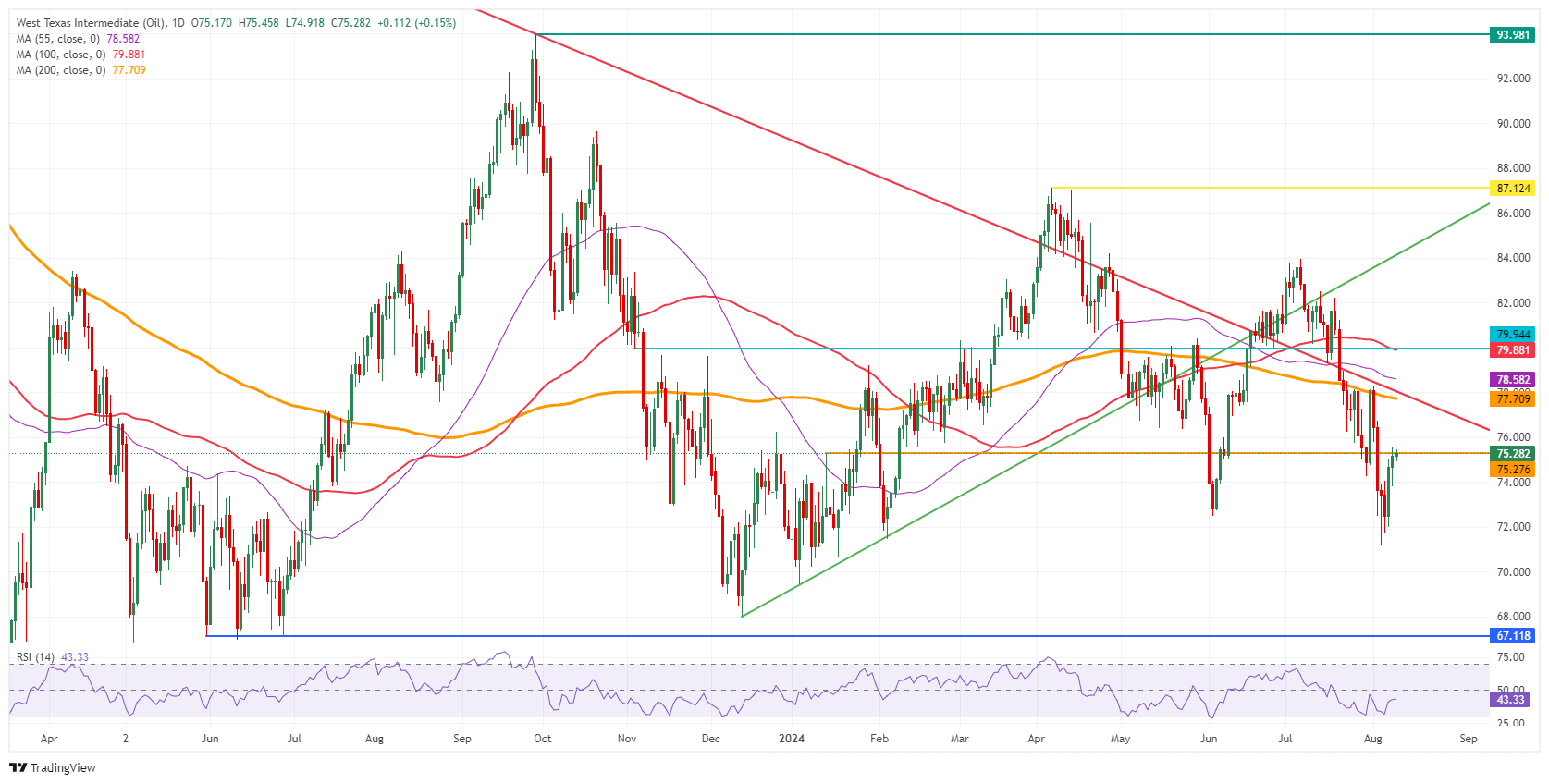
US WTI Crude Oil: Daily Chart
WTI Oil FAQs
WTI Oil is a type of Crude Oil sold on international markets. The WTI stands for West Texas Intermediate, one of three major types including Brent and Dubai Crude. WTI is also referred to as “light” and “sweet” because of its relatively low gravity and sulfur content respectively. It is considered a high quality Oil that is easily refined. It is sourced in the United States and distributed via the Cushing hub, which is considered “The Pipeline Crossroads of the World”. It is a benchmark for the Oil market and WTI price is frequently quoted in the media.
Like all assets, supply and demand are the key drivers of WTI Oil price. As such, global growth can be a driver of increased demand and vice versa for weak global growth. Political instability, wars, and sanctions can disrupt supply and impact prices. The decisions of OPEC, a group of major Oil-producing countries, is another key driver of price. The value of the US Dollar influences the price of WTI Crude Oil, since Oil is predominantly traded in US Dollars, thus a weaker US Dollar can make Oil more affordable and vice versa.
The weekly Oil inventory reports published by the American Petroleum Institute (API) and the Energy Information Agency (EIA) impact the price of WTI Oil. Changes in inventories reflect fluctuating supply and demand. If the data shows a drop in inventories it can indicate increased demand, pushing up Oil price. Higher inventories can reflect increased supply, pushing down prices. API’s report is published every Tuesday and EIA’s the day after. Their results are usually similar, falling within 1% of each other 75% of the time. The EIA data is considered more reliable, since it is a government agency.
OPEC (Organization of the Petroleum Exporting Countries) is a group of 13 Oil-producing nations who collectively decide production quotas for member countries at twice-yearly meetings. Their decisions often impact WTI Oil prices. When OPEC decides to lower quotas, it can tighten supply, pushing up Oil prices. When OPEC increases production, it has the opposite effect. OPEC+ refers to an expanded group that includes ten extra non-OPEC members, the most notable of which is Russia.
Author

Filip Lagaart
FXStreet
Filip Lagaart is a former sales/trader with over 15 years of financial markets expertise under its belt.