Oil jump over 3% on the back of unforeseen Libya's production halt
- Oil pops above $77.00 with Libya's oil production set to come to an abrupt halt.
- The recent uprising in tensions and violence might put negotiations for a ceasefire deal in Gaza on loose screws.
- The US Dollar Index trades back to 101.00 after its steep decline last week.

Oil prices are pumping higher on Monday after violence picked up in the Gaza region and Israel and Hezbollah exchanged heavy fire, with several bombings and drone attacks from both sides during the weekend. Additional catalyst which is making the price jump expontential for this Monday is the headline from Libya where OIl production is set to be halted. The sudden disruption comes on the back of a political spat internally between rival governments on who should lead the central bank.
The US Dollar Index (DXY) is licking its wounds after posting one of its worst weekly performances in over a year. US Federal Reserve Chairman Jerome Powell confirmed on Friday that an interest-rate cut is coming in September, but markets seem to be heading too far ahead of themselves by pricing in big rate cuts before the year ends. If the Fed wants to obtain a soft landing, it needs to cut gradually and slowly, not by big heaps as markets are expecting.
At the time of writing, Crude Oil (WTI) trades at $77.07 and Brent Crude at $80.44
Oil news and market movers: Benghazi forces Tripoli
- Both Bloomberg and Reuters report that the goverment in Benghazi announced oil production would shut down amid a dispute with the Tripoli goverment over who should lead the country's central bank.
- Bloomberg reports that Citigroup sees a big risk to a Libyan Oil disruption considering the recent local turmoil picking up with Israel.
- The above element is reflected in the Brent-Dubai spread in Crude prices, which is widening substantially.
- Meanwhile, Libya’s Waha Oil has said to start cutting its output gradually, Bloomberg reports, under a blockade of exports.
- China’s largest Crude refiner, Sinopec, is facing headwinds as the country’s economic slowdown weighs on its profits. The demand for Diesel especially remained poor, Reuters reports.
Oil Technical Analysis: That hurts
Oil is in good condition at the start of the week. The feared sell-off from hedge funds last week did not take place, and with the recent rally at hand, more positioning could take place. The recent violence over the weekend might even put question marks on the feasibility of a ceasefire deal taking place between Israel and Hamas. Should any headline in that direction be reported, expect to see another steep surge in Crude prices.
On the upside, the double level at $77.65, which aligns with both a descending trendline and the 200-day Simple Moving Average (SMA). In case bulls are able to break above it, the 100-day SMA at $78.45 could trigger a rejection.
On the downside, the low from August 5 at $71.17 is working its magic as it was able to eke out a bounce that now enters its third day. Under $70.00, the $68.00 big figure is the first level to watch followed by $67.11, which is the lowest point from the triple bottom seen back in June 2023.
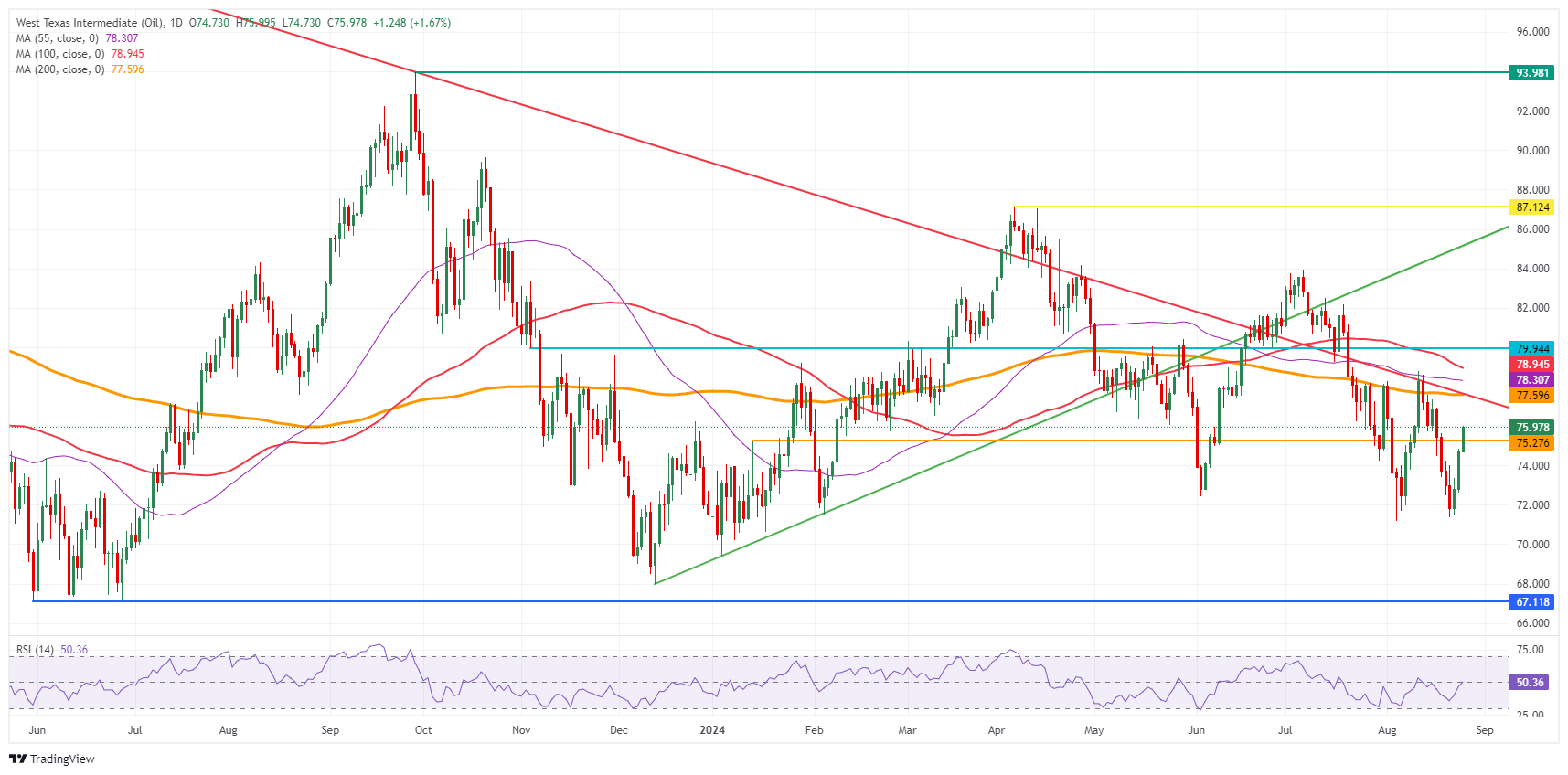
US WTI Crude Oil: Daily Chart
WTI Oil FAQs
WTI Oil is a type of Crude Oil sold on international markets. The WTI stands for West Texas Intermediate, one of three major types including Brent and Dubai Crude. WTI is also referred to as “light” and “sweet” because of its relatively low gravity and sulfur content respectively. It is considered a high quality Oil that is easily refined. It is sourced in the United States and distributed via the Cushing hub, which is considered “The Pipeline Crossroads of the World”. It is a benchmark for the Oil market and WTI price is frequently quoted in the media.
Like all assets, supply and demand are the key drivers of WTI Oil price. As such, global growth can be a driver of increased demand and vice versa for weak global growth. Political instability, wars, and sanctions can disrupt supply and impact prices. The decisions of OPEC, a group of major Oil-producing countries, is another key driver of price. The value of the US Dollar influences the price of WTI Crude Oil, since Oil is predominantly traded in US Dollars, thus a weaker US Dollar can make Oil more affordable and vice versa.
The weekly Oil inventory reports published by the American Petroleum Institute (API) and the Energy Information Agency (EIA) impact the price of WTI Oil. Changes in inventories reflect fluctuating supply and demand. If the data shows a drop in inventories it can indicate increased demand, pushing up Oil price. Higher inventories can reflect increased supply, pushing down prices. API’s report is published every Tuesday and EIA’s the day after. Their results are usually similar, falling within 1% of each other 75% of the time. The EIA data is considered more reliable, since it is a government agency.
OPEC (Organization of the Petroleum Exporting Countries) is a group of 13 Oil-producing nations who collectively decide production quotas for member countries at twice-yearly meetings. Their decisions often impact WTI Oil prices. When OPEC decides to lower quotas, it can tighten supply, pushing up Oil prices. When OPEC increases production, it has the opposite effect. OPEC+ refers to an expanded group that includes ten extra non-OPEC members, the most notable of which is Russia.
Author
Filip Lagaart
FXStreet
Filip Lagaart is a former sales/trader with over 15 years of financial markets expertise under its belt.