New Zealand Dollar holds positive ground on softer US Dollar, PBoC holds Loan Prime Rates steady
- The New Zealand Dollar gains momentum in Tuesday’s Asian session.
- The positive risk sentiment weighs on the US Dollar and lifts NZD/USD.
- The PBoC left the one-year and five-year Loan Prime Rates (LPR) unchanged on Tuesday.
- Investors await the Fed’s Bostic and Barr speeches on Tuesday.

The New Zealand Dollar (NZD) trades in positive territory for the third consecutive day on Tuesday. The People’s Bank of China (PBOC) decided to hold the one-year and five-year Loan Prime Rates (LPR) steady on Tuesday at 3.35% and 3.85%, respectively. Any development in the Chinese economy generally impacts Kiwi as China is New Zealand's largest trading partner. Meanwhile, the risk-on sentiment in global markets and easing geopolitical risks in the Middle East continue to undermine the Greenback.
Nonetheless, the dovish remarks from the Reserve Bank of New Zealand (RBNZ) after a surprise rate cut last week might cap the pair’s upside. RBNZ Governor Adrian Orr said on Monday that he is more convinced that inflation has returned to the 1-3% target area, boosting the likelihood of more rate reductions in the future.
Looking ahead, investors will keep an eye on the Fed’s Raphael Bostic and Michael Barr speeches on Tuesday. On Friday, New Zealand’s Retail Sales data and Fed Chair Powell's speech at the Jackson Hole symposium will be in the spotlight.
Daily Digest Market Movers: New Zealand Dollar gathers strength amid broad USD weakness
- New Zealand’s Trade Balance came in at NZD $-9.29B YoY in July versus $-9.5B prior, according to the latest data released by Statistics New Zealand on Tuesday.
- New Zealand’s Exports decreased to $6.15B in July versus $6.17B in June whereas Imports rose to $7.11B compared to $5.45B in previous readings.
- Federal Reserve Bank of Minneapolis President Neel Kashkari said on Monday that it was appropriate to discuss potentially cutting US interest rates in September due to concerns about the weakening labor market, per Reuters.
- Chicago Fed President Austan Goolsbee said on Sunday that the US economy does not show signs of overheating, so Fed policymakers should be cautious about keeping restrictive policy in place longer than necessary.
- The markets are now pricing in a nearly 77% chance of a 25 basis points (bps) Fed rate cut in its September meeting, according to the CME FedWatch Tool.
Technical Analysis: New Zealand Dollar resumes its broader bullish trend
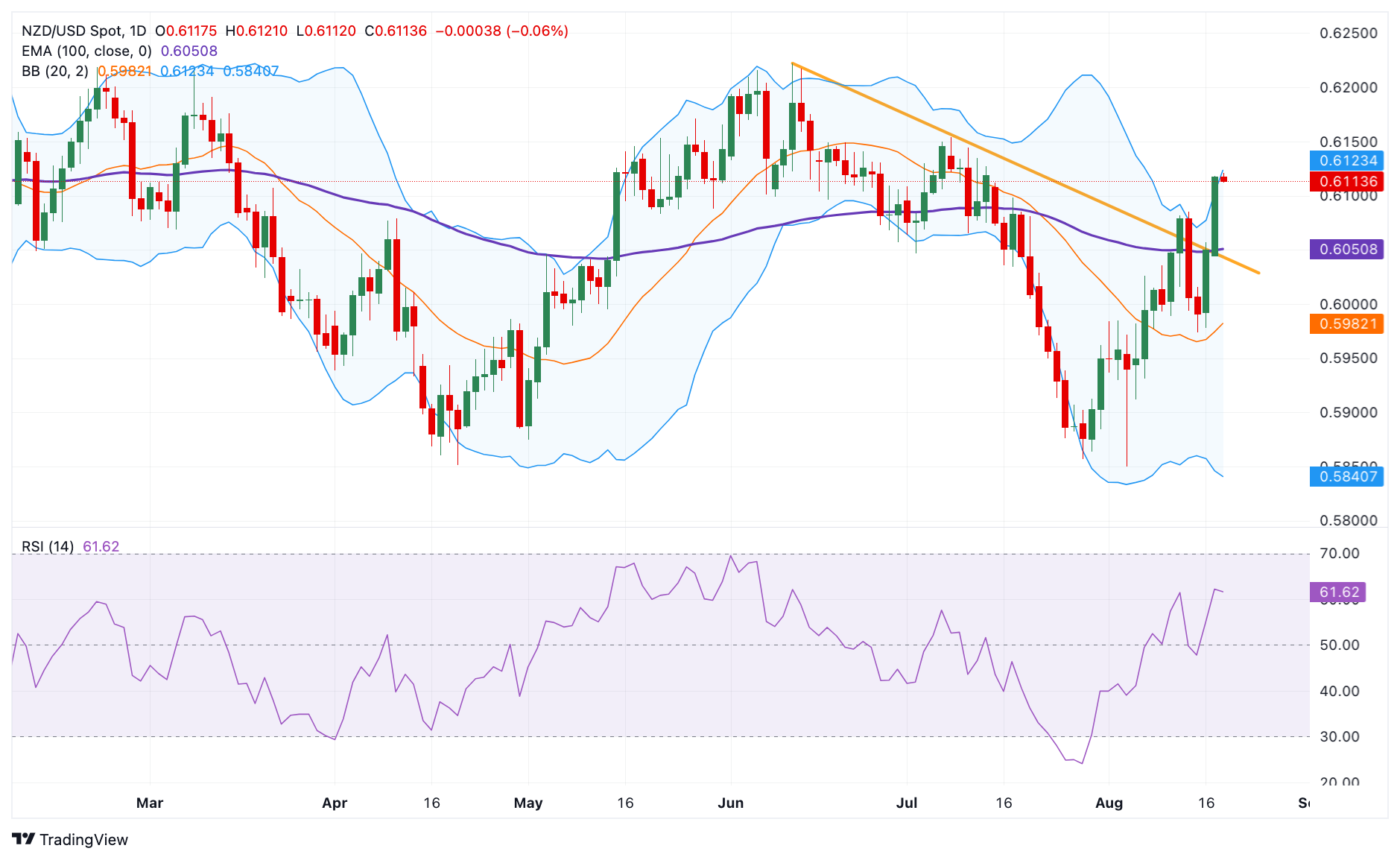
A decisive break above the upper boundary of the Bollinger Band at the 0.6100 psychological level could pave the way to 0.6154, the high of July 8. Further north, the next hurdle emerges at 0.6222, the high of June 12.
On the flip side, the crucial support level for NZD/USD is seen at 0.6050, representing the 100-day EMA and descending trendline. Sustained trading below this level could expose 0.5974, the low of August 15. The next contention level is located at 0.5846, the lower limit of the Bollinger Band.
(This story was corrected on August 20 at 05:45 GMT to say in the bullet points, that investors await the Fed’s Bostic and Barr speeches on Tuesday, not the PBoC rate decision.
US Dollar price in the last 7 days
The table below shows the percentage change of US Dollar (USD) against listed major currencies in the last 7 days. US Dollar was the weakest against the Australian Dollar.
| USD | EUR | GBP | CAD | AUD | JPY | NZD | CHF | |
| USD | -1.29% | -1.66% | -0.78% | -2.03% | -0.04% | -1.50% | -0.31% | |
| EUR | 1.28% | -0.35% | 0.51% | -0.77% | 1.24% | -0.20% | 0.96% | |
| GBP | 1.63% | 0.35% | 0.87% | -0.41% | 1.59% | 0.15% | 1.31% | |
| CAD | 0.77% | -0.51% | -0.87% | -1.26% | 0.73% | -0.72% | 0.46% | |
| AUD | 1.99% | 0.76% | 0.41% | 1.27% | 1.99% | 0.56% | 1.71% | |
| JPY | 0.04% | -1.26% | -1.62% | -0.75% | -2.03% | -1.47% | -0.30% | |
| NZD | 1.45% | 0.19% | -0.17% | 0.68% | -0.56% | 1.42% | 1.15% | |
| CHF | 0.30% | -0.95% | -1.32% | -0.45% | -1.74% | 0.30% | -1.18% |
The heat map shows percentage changes of major currencies against each other. The base currency is picked from the left column, while the quote currency is picked from the top row. For example, if you pick the Euro from the left column and move along the horizontal line to the Japanese Yen, the percentage change displayed in the box will represent EUR (base)/JPY (quote).
RBNZ FAQs
The Reserve Bank of New Zealand (RBNZ) is the country’s central bank. Its economic objectives are achieving and maintaining price stability – achieved when inflation, measured by the Consumer Price Index (CPI), falls within the band of between 1% and 3% – and supporting maximum sustainable employment.
The Reserve Bank of New Zealand’s (RBNZ) Monetary Policy Committee (MPC) decides the appropriate level of the Official Cash Rate (OCR) according to its objectives. When inflation is above target, the bank will attempt to tame it by raising its key OCR, making it more expensive for households and businesses to borrow money and thus cooling the economy. Higher interest rates are generally positive for the New Zealand Dollar (NZD) as they lead to higher yields, making the country a more attractive place for investors. On the contrary, lower interest rates tend to weaken NZD.
Employment is important for the Reserve Bank of New Zealand (RBNZ) because a tight labor market can fuel inflation. The RBNZ’s goal of “maximum sustainable employment” is defined as the highest use of labor resources that can be sustained over time without creating an acceleration in inflation. “When employment is at its maximum sustainable level, there will be low and stable inflation. However, if employment is above the maximum sustainable level for too long, it will eventually cause prices to rise more and more quickly, requiring the MPC to raise interest rates to keep inflation under control,” the bank says.
In extreme situations, the Reserve Bank of New Zealand (RBNZ) can enact a monetary policy tool called Quantitative Easing. QE is the process by which the RBNZ prints local currency and uses it to buy assets – usually government or corporate bonds – from banks and other financial institutions with the aim to increase the domestic money supply and spur economic activity. QE usually results in a weaker New Zealand Dollar (NZD). QE is a last resort when simply lowering interest rates is unlikely to achieve the objectives of the central bank. The RBNZ used it during the Covid-19 pandemic.
Author

Lallalit Srijandorn
FXStreet
Lallalit Srijandorn is a Parisian at heart. She has lived in France since 2019 and now becomes a digital entrepreneur based in Paris and Bangkok.