Microstrategy Stock News: Is MSTR facing possible bankruptcy on Bitcoin collapse?
- Microstrategy stock is in freefall as Bitcoin and crypto prices collapse.
- MSTR stock fell 25% on Wednesday and is down 12% in Thursday's premarket.
- MSTR is basically a leveraged Bitcoin play, and the CFO put a target out for Bitcoin bears.

Microstrategy (MSTR) stock is coming under increasing selling pressure as the crypto world stares into the abyss. First, we should point out we have been here before. Bitcoin has gone through similar collapses, and so far it is still here. The fact remains it is highly volatile, and that volatility could be the downfall of Microstrategy. Bitcoin is currently trading at $27,600, having traded near $25,000 earlier on Thursday.
Read more stock market research
Bitcoin is down 57% over the past six months and 40% year to date. Again, this is terrible, but some pandemic stocks such as Peloton, Netflix, Facebook, etc., are worse. Risk assets are all struggling.
Microstrategy Stock News
What is garnering the most attention for MSTR stock though is the obsession with the $21,000 level that Bitcoin is approaching. Now it is only a bad day away from hitting that level. Microstrategy CEO Michael Saylor is a big believer in cryptocurrency. Even in the most recent earnings call last week, he remained focused on Bitcoin deniers and haters.
"You also have another big development, which is that the deniers of Bitcoin and digital assets in general are now being silenced by the administration of the United States," Saylor said. "Bitcoin is better than gold. To call it digital gold is an understatement. It really is the hardest money in the history of the world."
Unfortunate timing then, but hindsight is always 20/20. Easy to take potshots now, I admit though.
Hmm, last time I checked the administration and government of the US were not exactly rushing to adopt Bitcoin. So far, let me see, oh yeah, the haven of El Salvador has adopted it. A good model for the US to follow then! The executive order announced by the Biden Administration is to protect American consumers, the financial system and investors and mitigate systemic risk. This to me means more regulation of crypto not less or adopting it. The US also said it will explore digital currencies, again meaning a digital dollar, not adopting Bitcoin.
Anyway, everyone has their own opinion on this, but the current price action and wild volatility in some other crypto names this week (Luna lost 99% this week) are not likely to see governments all of a sudden decide they are a good thing. It is likely to be the opposite. No government is going to give up control of their currency and economy.
Now, onto BTC's relation to Microstrategy. In the last earnings call on May 3, CFO Phong Le said in response to a question: "As far as where Bitcoin needs to fall, we took out the loan at a 25% LTV, the margin call occurs 50% LTV. So essentially, Bitcoin needs to cut in half or around $21,000 before we'd have a margin call. That said, before it gets to 50%, we could contribute more Bitcoin to the collateral package, so it never gets there."
This is where the obsession with $21k for MSTR stock comes from. Right now, though, MSTR does have more Bitcoin it can pony up to the loan, so the immediate margin call is not the problem. What is a problem is the domino effect. Microstrategy has never made a secret of the fact that it is a leveraged Bitcoin play. For now, it appears to have plenty of reserve assets on the hook if needed for extra collateral. On the same conference call, the CFO stated also said, "The remaining approximately 115,100 Bitcoins are held at the MacroStrategy subsidiary. Of the MacroStrategy of Bitcoins, approximately 19,500 Bitcoins are pledges collateral toward the Bitcoin-backed term loan and over 95,600 Bitcoins remain unpledged and unencumbered."
MSTR does, however, have a lot of debt, both in terms of convertible notes and bonds. Some of those are under extreme selling pressure with the convertible note offering maturing in 2027 and trading at just over 60 cents on the dollar and probably less when the market opens. The 2025 notes closed at 73 cents on Wednesday. MSTR 's average purchase price for all of its Bitcoin is $30,700 according to its latest report. So it is now underwater on its investment in Bitcoin. Not alone there, so too is Tesla (TSLA) we believe who famously pumped it with its purchase last year.
In total, according to Refinitiv, Microstrategy has $2.2 billion worth of loans outstanding with 650 million due in 2025.
Microstrategy (MSTR) stock forecast
The risk from the margin call at $21,000 is not immediate bankruptcy as many are predicting. As we have demonstrated in a normal market Microstrategy has plenty of Bitcoin it can pledge or sell to meet this margin call. MSTR stock does have a lot of debt, but most of it is unsecured, leaving the Bitcoin holdings free for use as more margin. The company has structured its debt profile quite well and taken advantage of investors' recklessness during the Fed printing time period of the past two years.
Basically, bondholders have lent Microstrategy unsecured money to buy Bitcoin. How that is going to work out for the bondholders is the question, not Microstrategy's solvency. With 2027 bonds likely to trade near 50 cents on the dollar today, that is pointing to a huge risk of default.
The convertible notes for 2027 are not convertible into ordinary shares until after 2026, so bondholders are not free to convert and dump MSTR stock. They are stuck.
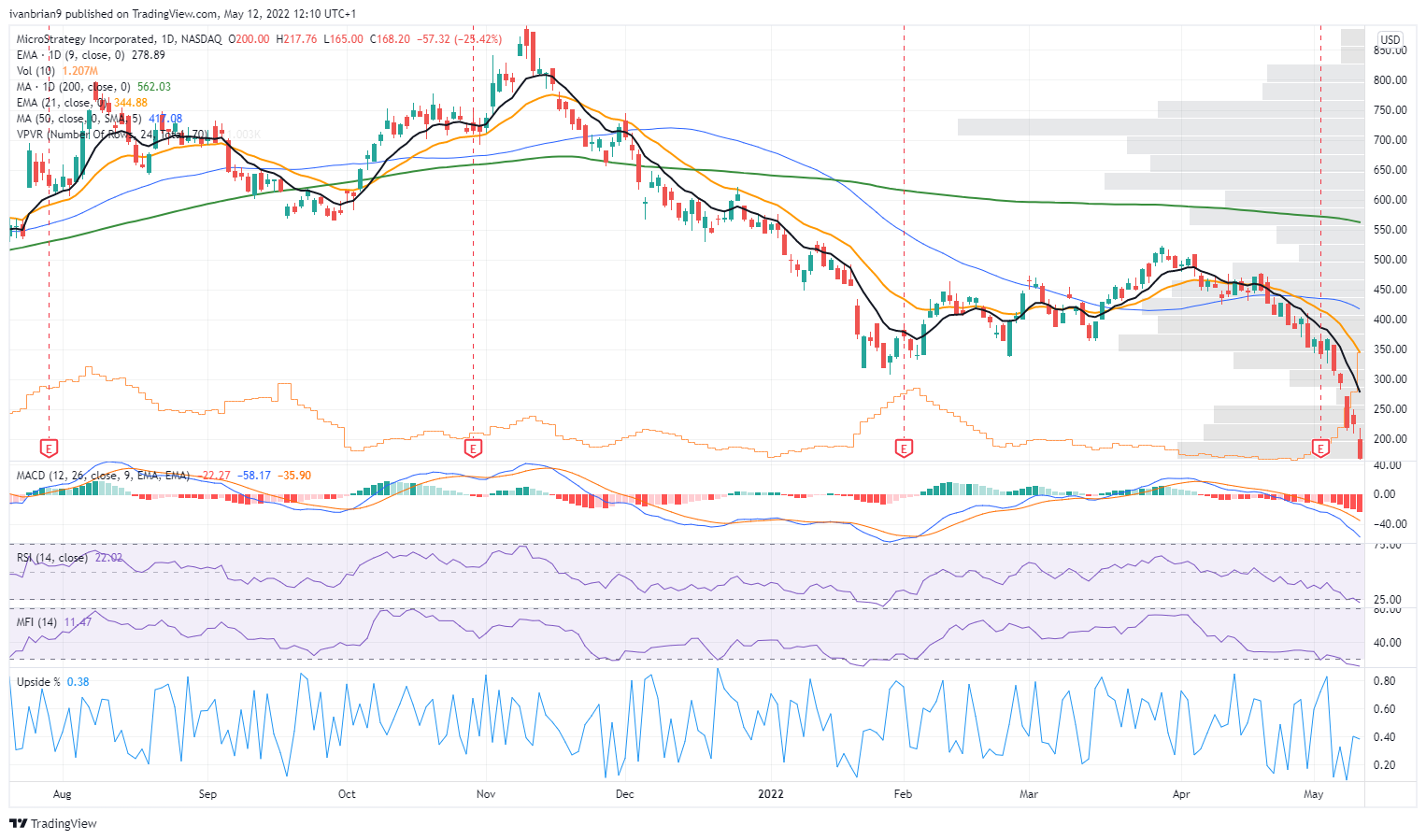
MSTR stock chart, daily
Like this article? Help us with some feedback by answering this survey:
Author

Ivan Brian
FXStreet
Ivan Brian started his career with AIB Bank in corporate finance and then worked for seven years at Baxter. He started as a macro analyst before becoming Head of Research and then CFO.