Microsoft stock sinks 1% ahead of Fed rate decision, post-market earnings
- Microsoft is set to release fiscal Q2 earnings after the close on Wednesday.
- Market wonders what CEO Nadella will say about competition from DeepSeek.
- Wall Street expects adjusted EPS of $3.12 and revenue north of $68.8 billion.
- Dow Jones and NASDAQ both trend lower ahead of Fed rate call.

Microsoft (MSFT) stock shed weight in the early going on Wednesday ahead of the Federal Reserve’s (Fed) latest interest rate decision, scheduled for 14:00 EST, and the mammoth tech conglomerate’s fiscal second-quarter results after the close.
MSFT shares tread 1% lower, while the Dow Jones Industrial Average (DJIA) sank a lesser 0.15%. The tech-heavy NASDAQ drifted 0.75% lower as it will be more affected by the central bank’s expected rate hold.
Microsoft stock news
As the entire market braces for the fed fund rate decision, which CME Group’s FedWatch Tool gives a 99.5% chance of a hold at the 4.25% to 4.50% range, Microsoft’s earnings loom large for the indices. As the first of the three largest publicly-traded firms to report — next to Apple (AAPL) and Nvidia (NVDA) — Microsoft could set the pace for this earnings season.
Wall Street expects the software giant led by Satya Nadella to report adjusted earnings per share (EPS) of $3.12 on revenue of $68.81 billion. This would amount to an 11% gain YoY in sales and a 6.5% gain in per share profit.
Analysts have been unusually pessimistic about Microsoft of late with the vast majority cutting their EPS estimates in the leadup to this earnings call. Part of this is that Microsoft’s capex related especially to its AI buildout has been much higher in recent quarters than analysts had predicted.
Investors will want Nadella and other executives to address the newfound competition from China’s DeepSeek. The AI large language model was released last week and has become a leading download in the US. The company behind it claims that it spent a fraction of what Microsoft-backed OpenAI spent to train its ChatGPT platform.
The popularity of Deepseek sent Nvidia into a tailspin on Monday, losing nearly $600 billion in market cap in the process. The broad tech sell-off at the start of the week was somewhat milder for MSFT, which lost $178 billion in market cap.
OpenAI CEO Sam Altman has already drawn excitement ahead of Microsoft’s earnings call. Altman wrote on X that the "next phase of the msft x oai partnership is gonna be much better than anyone is ready for!!"
Bank of America Securities analyst Brad Sills said that growth in Azure revenue should impress the market.
“We expect Q2 results to drive better sentiment on the shares, given a likely Q3 Azure outlook for accelerating growth,” Sills wrote in his preview before adding that full-year margin guidance could be raised.
TD Cowen analysts project Intelligent Cloud revenue of $25.8 billion, or 20% annual growth, in Q2, as well as Azure revenue itself of $18.2 billion.
Microsoft stock forecast
Microsoft stock has been consolidating for much of the last year. This can be seen in how the 50-day Simple Moving Average (SMA) only barely trends above its 200-day counterpart. In fact, it flew with little fanfare below the 200-day SMA for part of last fall.
Periods of rallies always tend to collapse, reverting to the mean. Since April of 2024, however, Microsoft has largely seen higher lows outside of the August 5, 2024 crash.
Any rally will likely still see traders take profits at the $447, $455 or $467 resistance levels that have littered the chart over the past year. On the downside, the ascending bottom trendline could provide support near $417 in the case of a sell-off.
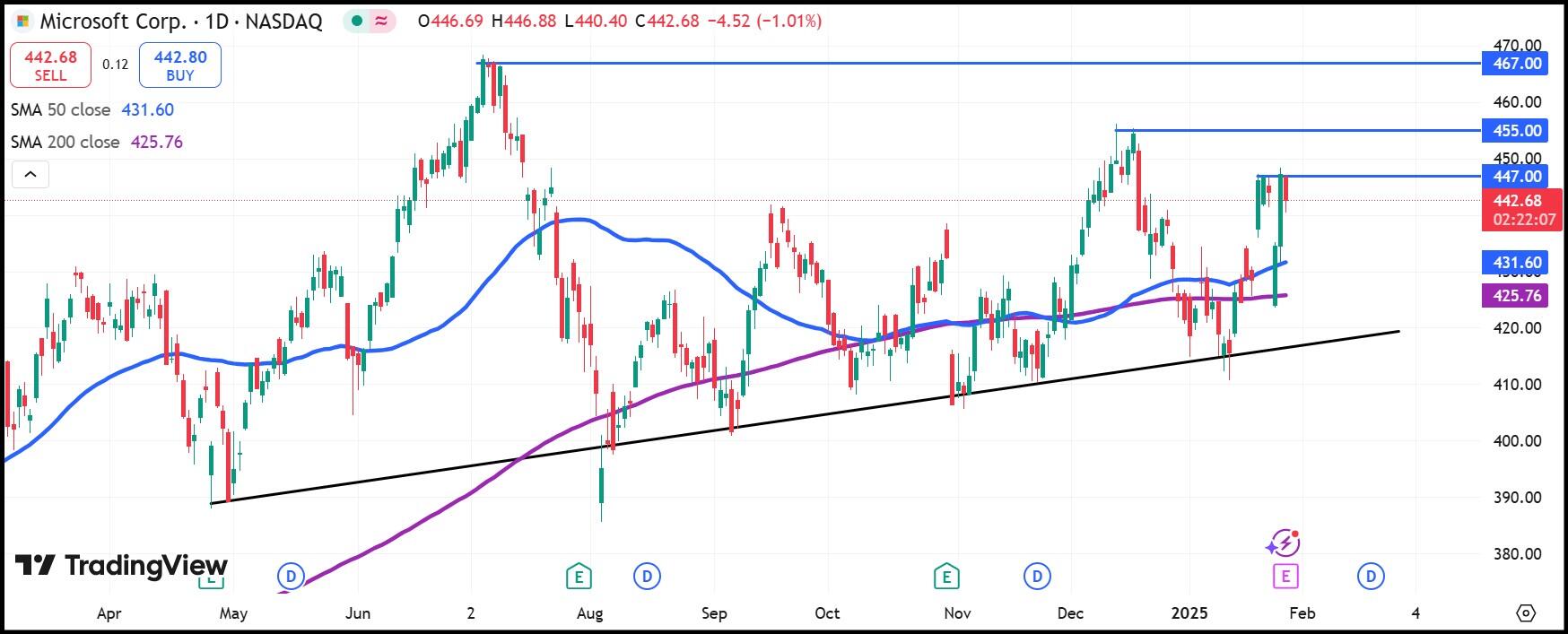
MSFT daily stock chart
Author

Clay Webster
FXStreet
Clay Webster grew up in the US outside Buffalo, New York and Lancaster, Pennsylvania. He began investing after college following the 2008 financial crisis.