Mexican Peso edges higher against USD after release of mixed US data
- The Mexican Peso rebounds against the Greenback after the release of US inflation data and jobs' data.
- Although inflation guages rose in September, Jobless Claims data showed weaknesses emerging in the US labor market.
- The data indicates the Federal Reserve (Fed) will probably go ahead with cutting interest rates in November, weakening USD.

The Mexican Peso (MXN) edges higher against the US Dollar (USD) on Thursday after the release of mixed US data. A higher-than-expected inflation print was overhsadowed by weak US Jobless Claims data for the first week in October.
Given the US Federal Reserve's (Fed) prioratisation of protecting the labor market from shocks over fighting inflation, the data ended up weakening the US Dollar. It suggests an increased chance the Fed will cut interest rates in November and lower interest rates are negative for USD because they reduce foreign capital inflows.
Mexican Peso rebounds against USD following mixed data
The Mexican Peso rose against the US Dollar on Thursday after an initial dip, which came as a consequence of the release of data showing the US Consumer Price Index (CPI) rising 2.4% annually in September – lower than the 2.5% in August but higher than expectations of 2.3%.
The CPI ex Food & Energy rose 3.3% annually in September, which was higher than the 3.2% in August and beat expectations of 3.2%.
US Initial Jobless Claims, however, weakened in the week to October 8, putting pressure on the Greenback. Initial claims rose 258K, which was above the 225K of the previous week and expectations of 230K.
Continuing Claims for week ending September 27 stood at 1.861 million, which was higher than the revised down 1.819M and the 1.83M expected.
Mexican Peso could find support from new wage laws
The Mexican Peso might gain further support from new wage laws passed on Wednesday which enshrine in the constitution workers rights to see their wages rise in line with inflation.
“With 124 votes in favor, the Senate of the Republic approved in general and in particular the reform to establish the annual fixing of general or professional minimum wages, as well as their revision, and that they never be below inflation,” reported El Financiero.
“The purpose of the reform is to ensure that Mexicans' income does not fall below inflation, which will favor their purchasing power. Therefore, year after year, increases or adjustments could be made based on inflation,” the report went on.
The benchmarking of wages to inflation could slow the disinflationary trend, if workers continue spending at current rates. In addition, if businesses pass on inflation-linked employee wage costs to consumers this will also maintain inflation.
Continued elevated inflation would, in turn, delay any cuts to interest rates planned by Banxico – or make the reductions more gradual – with the side-effect of propping up the Mexican Peso.
Sheinbaum takes control of Mexican Oil
The Mexican Peso has seen volatility due to rising political risk premia since the re-election of the Morena-led government in June and this could revive as foreign investors digest the news that President Claudia Sheinbaum is moving to take greater control of Mexico’s Oil state-backed industry.
On Wednesday, Mexico’s Congress debated the reclassification of two of Mexico’s largest Oil producers, Pemex and the Federal Electricity Commission (FEC) with a view to increasing their control of the companies and renaming them as “public enterprises.” The change “would force them to prioritize the government's social and economic objectives over corporate profits,” according to El Financiero.
The reform was initially proposed by Sheinbaum's mentor and predecessor, former President Andrés Manuel López Obrador (AMLO), and is expected to win the approval of the ruling coalition's decisive majority in Congress.
Technical Analysis: USD/MXN starts rising from base of channel
USD/MXN edges lower after recovering from support at the base of a medium-term rising channel.
USD/MXN Daily Chart
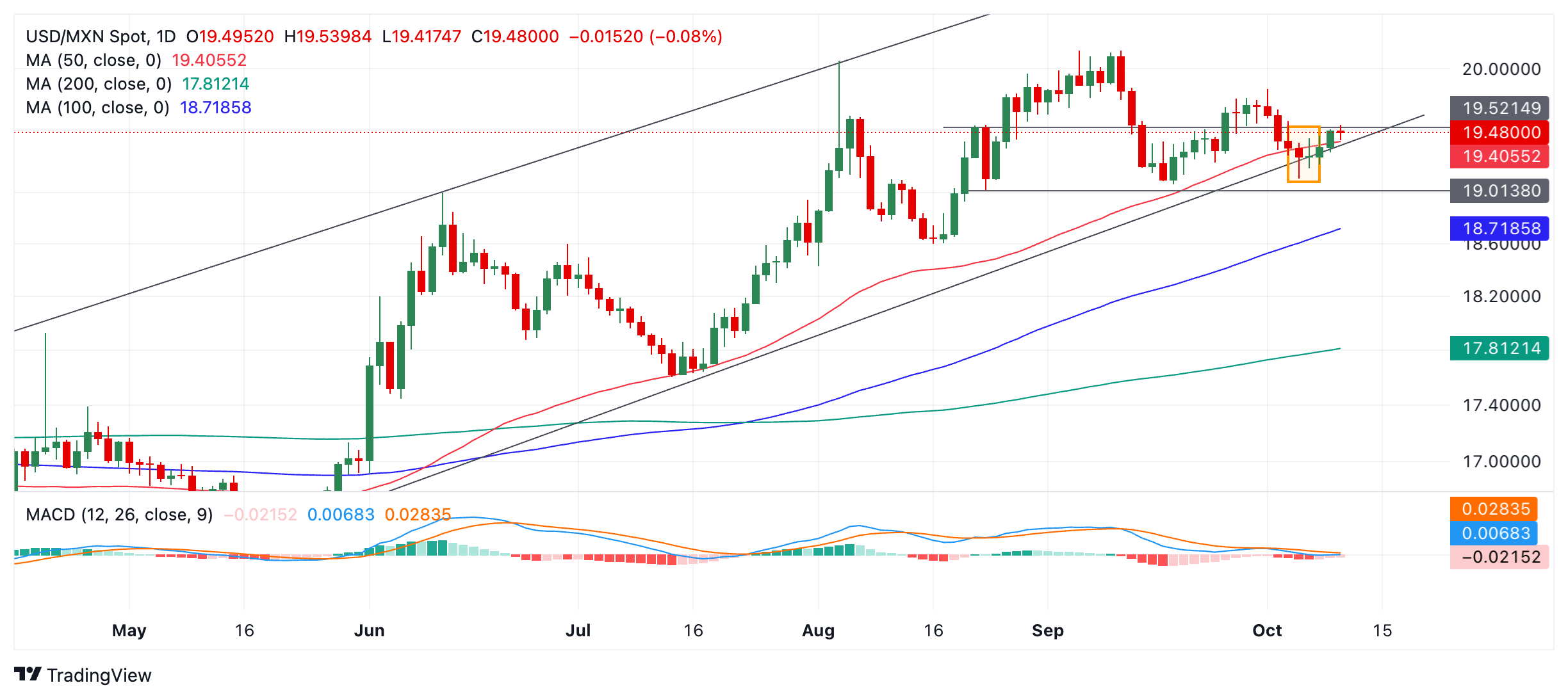
USD/MXN is probably starting a new uptrending leg within its ascending channel. The medium and longer-term trends are bullish, and given the technical analysis principle that “the trend is your friend,” this favors a continuation higher.
On October 4 the pair formed a bullish Japanese Hammer candlestick pattern at the base of the channel (orange rectangle on the chart). This was followed by a slightly bullish Japanese Doji candlestick and then two green up candles. This configuration marks the reversal of the short-term trend which is now technically bullish.
USD/MXN has just reached resistance at 19.51 (August 22 high) if it can break above 19.57 it will signal a clearance of this resistance and a probable continuation higher to the next upside target at around 19.83 (October 1 high).
Economic Indicator
Initial Jobless Claims
The Initial Jobless Claims released by the US Department of Labor is a measure of the number of people filing first-time claims for state unemployment insurance. A larger-than-expected number indicates weakness in the US labor market, reflects negatively on the US economy, and is negative for the US Dollar (USD). On the other hand, a decreasing number should be taken as bullish for the USD.
Read more.Last release: Thu Oct 10, 2024 12:30
Frequency: Weekly
Actual: 258K
Consensus: 230K
Previous: 225K
Source: US Department of Labor
Every Thursday, the US Department of Labor publishes the number of previous week’s initial claims for unemployment benefits in the US. Since this reading could be highly volatile, investors may pay closer attention to the four-week average. A downtrend is seen as a sign of an improving labour market and could have a positive impact on the USD’s performance against its rivals and vice versa.
Author
Joaquin Monfort
FXStreet
Joaquin Monfort is a financial writer and analyst with over 10 years experience writing about financial markets and alt data. He holds a degree in Anthropology from London University and a Diploma in Technical analysis.