Mexican Peso falls after Trump assassination attempt
- The Mexican Peso has lost ground in its major pairs after the assassination attempt on Donald Trump.
- Trump’s poll ratings improved after the incident and if he wins the election he is likely to bring in trade tariffs.
- USD/MXN is showing signs of reversing its recent decline from the June highs.

The Mexican Peso (MXN) dips in its most traded pairs on Tuesday. The Peso’s weakness comes on the back of the news that former US President Donald Trump was wounded in an assassination attempt at a rally in Pennsylvania on Saturday. This has led to sudden rise in US Treasury yields and the US Dollar (USD), but has weakened MXN.
Although the attack harmed Trump physically it improved his poll ratings by several points. This is negative for the Mexican Peso since a Trump presidency would probably lead to increased tariffs on foreign imports including those from Mexico, negatively impacting US-Mexico trade. Further, on Tuesday Trump picked Senator for Ohio J.D Vance as his running mate and Vance is known for for his staunch anti-China trade stance, which probably also goes for all foreign trade.
At the time of writing, one US Dollar (USD) buys 17.73 Mexican Pesos, EUR/MXN trades at 19.33, and GBP/MXN at 23.00.
Mexican Peso reacts to Banxico dissenter’s comment
The Mexican Peso made back some of its losses on Monday as a result of comments from the Deputy Governor of the Bank of Mexico (Banxico), Omar Mejia which supported the Mexican currency. Mejia was the only person on the Banxico board who voted to cut interest rates at the Banxico’s last June meeting, according to the Minutes which were released last week.
In his comments, Mejia qualified his decision to vote for a 0.25% rate cut by saying that cuts should be implemented gradually, and one interest-rate cut would not imply the beginning of an easing cycle.
The Banxico’s policy interest rate currently stands at 11.00%, one of the highest in a developing country. It is the main reason for the Peso’s show of strength since 2020, when it traded at a low of 25.79 against the US Dollar, only to rise over the following four years to a high of 16.26 in April 2024.
Currencies in countries with high interest rates tend to appreciate because they benefit from greater capital inflows.
Technical Analysis: USD/MXN shows signs of bullish reversal
USD/MXN is showing signs of reversing its recent decline from the June 12 high.
It found support at the 50-day Simple Moving Average (SMA) at 17.65 and formed a green up day on Monday after the long, red down day on Friday (shaded blue rectangle in chart below). This pattern is similar to a two-day reversal pattern and could be a sign the pair is about to start a more bullish phase.
USD/MXN Daily Chart
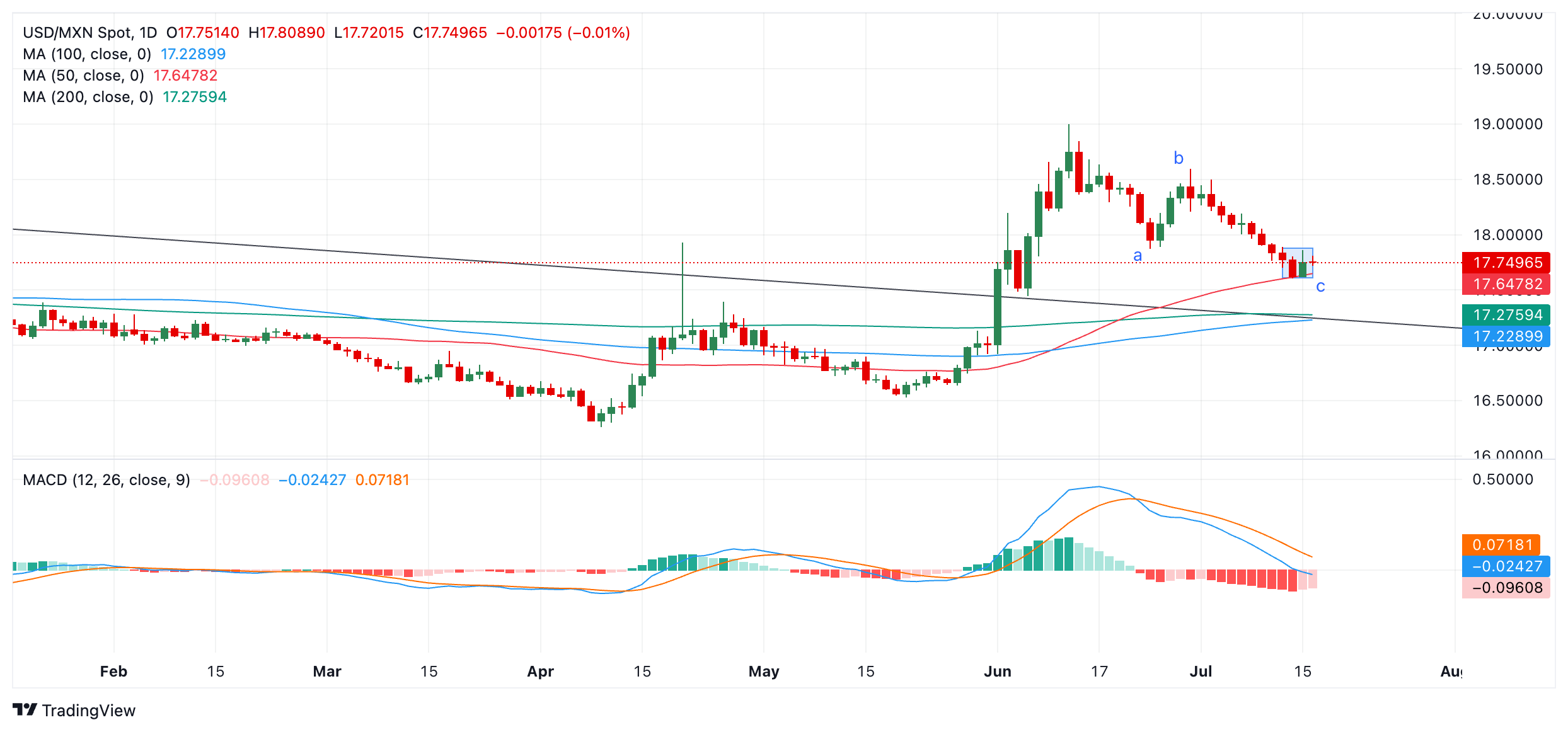
Another bullish sign is that USD/MXN might also have completed a Measured Move (MM) pattern.
MMs are large, three-wave zig-zags, with waves labeled A,B and C. The end of wave C can be estimated using the length of wave A as a guide. C is usually equal to A or, at least, a Fibonacci ratio of A. C is now roughly the same length as A and is more than the Fibonacci 0.618 ratio of A, suggesting the pattern could be complete.
Although it is too early to be sure, the pair could be reversing course and beginning a short-term uptrend.
A break below the 50-day Simple Moving Average (SMA) at 17.60, however, would reconfirm the dominant short-term downtrend and lead to a probable decline to 17.27 at the level of the 200-day SMA and a major multi-month trendline.
Meanwhile, the direction of the medium and long-term trends remain in doubt.
Mexican Peso FAQs
The Mexican Peso (MXN) is the most traded currency among its Latin American peers. Its value is broadly determined by the performance of the Mexican economy, the country’s central bank’s policy, the amount of foreign investment in the country and even the levels of remittances sent by Mexicans who live abroad, particularly in the United States. Geopolitical trends can also move MXN: for example, the process of nearshoring – or the decision by some firms to relocate manufacturing capacity and supply chains closer to their home countries – is also seen as a catalyst for the Mexican currency as the country is considered a key manufacturing hub in the American continent. Another catalyst for MXN is Oil prices as Mexico is a key exporter of the commodity.
The main objective of Mexico’s central bank, also known as Banxico, is to maintain inflation at low and stable levels (at or close to its target of 3%, the midpoint in a tolerance band of between 2% and 4%). To this end, the bank sets an appropriate level of interest rates. When inflation is too high, Banxico will attempt to tame it by raising interest rates, making it more expensive for households and businesses to borrow money, thus cooling demand and the overall economy. Higher interest rates are generally positive for the Mexican Peso (MXN) as they lead to higher yields, making the country a more attractive place for investors. On the contrary, lower interest rates tend to weaken MXN.
Macroeconomic data releases are key to assess the state of the economy and can have an impact on the Mexican Peso (MXN) valuation. A strong Mexican economy, based on high economic growth, low unemployment and high confidence is good for MXN. Not only does it attract more foreign investment but it may encourage the Bank of Mexico (Banxico) to increase interest rates, particularly if this strength comes together with elevated inflation. However, if economic data is weak, MXN is likely to depreciate.
As an emerging-market currency, the Mexican Peso (MXN) tends to strive during risk-on periods, or when investors perceive that broader market risks are low and thus are eager to engage with investments that carry a higher risk. Conversely, MXN tends to weaken at times of market turbulence or economic uncertainty as investors tend to sell higher-risk assets and flee to the more-stable safe havens.
Author

Joaquin Monfort
FXStreet
Joaquin Monfort is a financial writer and analyst with over 10 years experience writing about financial markets and alt data. He holds a degree in Anthropology from London University and a Diploma in Technical analysis.















