Mexican Peso depreciates after Sheinbaum confirms reform of judiciary
- The Mexican Peso resumes weakening after President-elect Sheinbaum gives the green light to judicial reforms.
- Markets also fear President Obrador using his last month in office to push through the reforms himself.
- USD/MXN pushes back up against key October 2023 highs at 18.49 as it resumes the march higher.

The Mexican Peso (MXN) trades roughly a percent lower in its key pairs on Tuesday after a press conference by President-elect Claudia Sheinbaum. In it, Sheinbaum confirmed she would be pushing ahead with reforms to the judiciary, which have raised concerns amongst investors and contributed to an over 8.0% devaluation of the Peso since the election on June 2.
At the time of writing USD/MXN is exchanging hands at 18.44, EUR/MXN is trading at 19.82 and GBP/MXN at 23.47.
Mexican Peso weakens after Sheinbaum presses
The Mexican Peso started depreciating again on Monday during a press conference given by Sheinbaum, at which she confirmed she would be prioritizing controversial reforms of the judiciary that investors fear could negatively impact the business climate in the country, according to Reuters.
Up until then, Mexico’s first woman President had avoided giving a clear commitment to the reforms, which were first proposed by the present incumbent, President Andrés Manuel López Obrador (AMLO), as part of a sweeping list of changes back in February.
In a press conference at the presidential palace on Monday, however, Sheinbaum said that after she elects her cabinet next week the “constitutional reform of the judiciary would be among the first reforms to be approved.” When asked if these would weaken the Mexican Peso, Sheinbaum said she did not believe they would impact financial markets. Other reforms that the President-elect said she would be prioritizing were those to social benefits, she added.
The reform to the judiciary seeks to replace the current system, in which Supreme Court judges are appointed, with judges elected by popular vote. The policy also encompasses the heads of bar associations, law schools and some lower court judges. The reforms stem from criticisms of the current system which it is argued enables corruption and cronyism.
To be pushed through, they require amendments to the constitution, for which a supermajority in both houses (over two-thirds of the seats) is necessary. Unlike AMLO, Sheinbaum’s coalition has a supermajority in the Congress and is only two seats short in the Senate.
In her press conference, Sheinbaum also said that she would be meeting a delegation sent by US President Joe Biden on Wednesday.
Fear of AMLO
Investors are further concerned by the possibility that AMLO himself may use the supermajority to push through the reforms before he retires on October 1.
“Congress is expected to convene on September 1, potentially giving Lopez Obrador a one-month window to push through reforms before retiring,” said a report from AFP News on Barron’s.
Technical Analysis: USD/MXN penned in by October 2023 highs
USD/MXN – the value of one US Dollar in Mexican Pesos – retains an upside bias as it pushes back up to resistance at 18.49 (October 2023 high).
USD/MXN Daily Chart
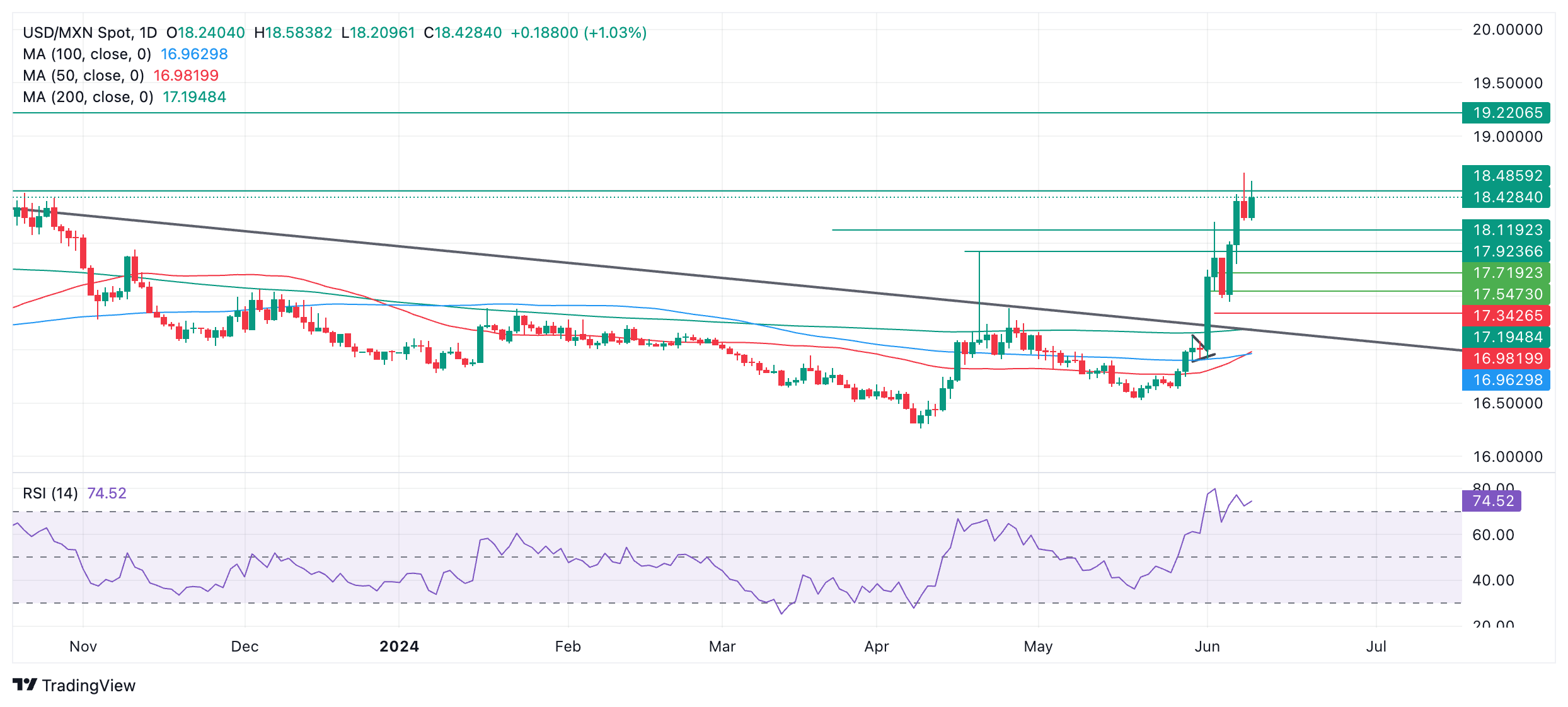
The rally in June means the pair is probably in a short and intermediate-term uptrend, and given that “the trend is your friend,” the odds favor price continuing higher.
The Relative Strength Index (RSI) is in the overbought zone, however, suggesting traders should not add to their long positions. It also increases the possibility of a pullback developing, although the established uptrend is likely to eventually resume after that.
A break above the October high would probably confirm prices going even higher, with the next target potentially situated at 19.22 (March 2023 high).
The long-term trend is probably still bearish, however, suggesting moderate background risks continue.
Banxico FAQs
The Bank of Mexico, also known as Banxico, is the country’s central bank. Its mission is to preserve the value of Mexico’s currency, the Mexican Peso (MXN), and to set the monetary policy. To this end, its main objective is to maintain low and stable inflation within target levels – at or close to its target of 3%, the midpoint in a tolerance band of between 2% and 4%.
The main tool of the Banxico to guide monetary policy is by setting interest rates. When inflation is above target, the bank will attempt to tame it by raising rates, making it more expensive for households and businesses to borrow money and thus cooling the economy. Higher interest rates are generally positive for the Mexican Peso (MXN) as they lead to higher yields, making the country a more attractive place for investors. On the contrary, lower interest rates tend to weaken MXN. The rate differential with the USD, or how the Banxico is expected to set interest rates compared with the US Federal Reserve (Fed), is a key factor.
Banxico meets eight times a year, and its monetary policy is greatly influenced by decisions of the US Federal Reserve (Fed). Therefore, the central bank’s decision-making committee usually gathers a week after the Fed. In doing so, Banxico reacts and sometimes anticipates monetary policy measures set by the Federal Reserve. For example, after the Covid-19 pandemic, before the Fed raised rates, Banxico did it first in an attempt to diminish the chances of a substantial depreciation of the Mexican Peso (MXN) and to prevent capital outflows that could destabilize the country.
Author
Joaquin Monfort
FXStreet
Joaquin Monfort is a financial writer and analyst with over 10 years experience writing about financial markets and alt data. He holds a degree in Anthropology from London University and a Diploma in Technical analysis.

















