Mexican Peso surges despite hawkish Fed stance

Most recent article: Mexican Peso extends rally unfazed by economic contraction
- Mexican Peso recovers as US Fed holds rates, Powell highlights non-restrictive policy.
- Mexico's labor market strengthens with lower December Unemployment Rate, hinting at possible Banxico easing.
- US trade policy concerns pressure Peso, with looming tariffs threatening economic stability.
The Mexican Peso (MXN) appreciates against the Greenback after the US Federal Reserve (Fed) decided to held rates unchanged. The USD/MXN trades at 20.51, down 0.14%, at the time of writing.
Following the Fed’s decision, its Chairman, Jerome Powell, took the stance. He commented that monetary policy is less restrictive than it was, adding that the labor market remains robust and the economy expands solidly. He added that the Central Bank is in no rush to lower interest rates and reassured that they don’t have a pre-set path regarding monetary policy.
In the meantime, data from Mexico revealed that the December Unemployment Rate dipped, indicating the labor market's strength. Recently, Banco de Mexico (Banxico) Deputy Governor Omar Mejia Castelazo said on Banorte’s podcast that Banxico has enough margin to carry out a “process of calibration” at upcoming monetary policy meetings. He hinted that the central bank will likely continue to ease policy.
When asked about challenges from Trump’s trade policies in the US, Mejia added that Mexico had “solid macro-economic fundamentals.”
Despite this, the Mexican currency has been pressured during the week, depreciating over 1.89% on Monday against the Greenback due to President Trump’s trade policy threats to Colombia. At the same time, the White House reiterated that 25% tariffs to Mexico would be applied on February 1, according to Karoline Leavitt, the Press Secretary.
Regarding this, David A. Meier, an economist at Julius Baer, said: “Our view is that these threats are intended to put pressure on Mexico and Canada on drug and immigration issues, as well as to reopen the USMCA negotiations before 2026.”
Meier warned of the potential economic consequences if the threats materialize. He added that Mexican exports would reduce and remittances would take a hit, which opens the door for further depreciation of the Mexican Peso.
In addition, Mexico’s economic docket will feature the release of preliminary Q4 2024 Gross Domestic Product (GDP) figures.
Daily digest market movers: Mexican Peso holds firmly around 20.50 after Fed’s decision
- The Federal Reserve unanimously voted to keep interest rates steady at 4.25% - 4.50% and removed key inflation language, signaling to traders that rates could stay elevated for longer.
- The statement highlighted solid economic growth, a stable unemployment rate, and resilient labor market conditions while reaffirming the Fed’s commitment to balancing both sides of its dual mandate.
- The Fed’s monetary policy decision was unanimous.
- The Institutio Nacional de Estadistica Geografia e Informatica (INEGI) revealed that Mexico's Unemployment Rate in December was 2.4%, down from 2.6% in November. Seasonally adjusted figures were 2.6%.
- According to Reuters, Mexico President Claudia Sheinbaum said she “doesn't believe the United States will impose tariffs on Feb. 1.”
- Money market futures have priced in 50 bps of Fed rate cuts in 2025, according to CME FedWatch Tool data.
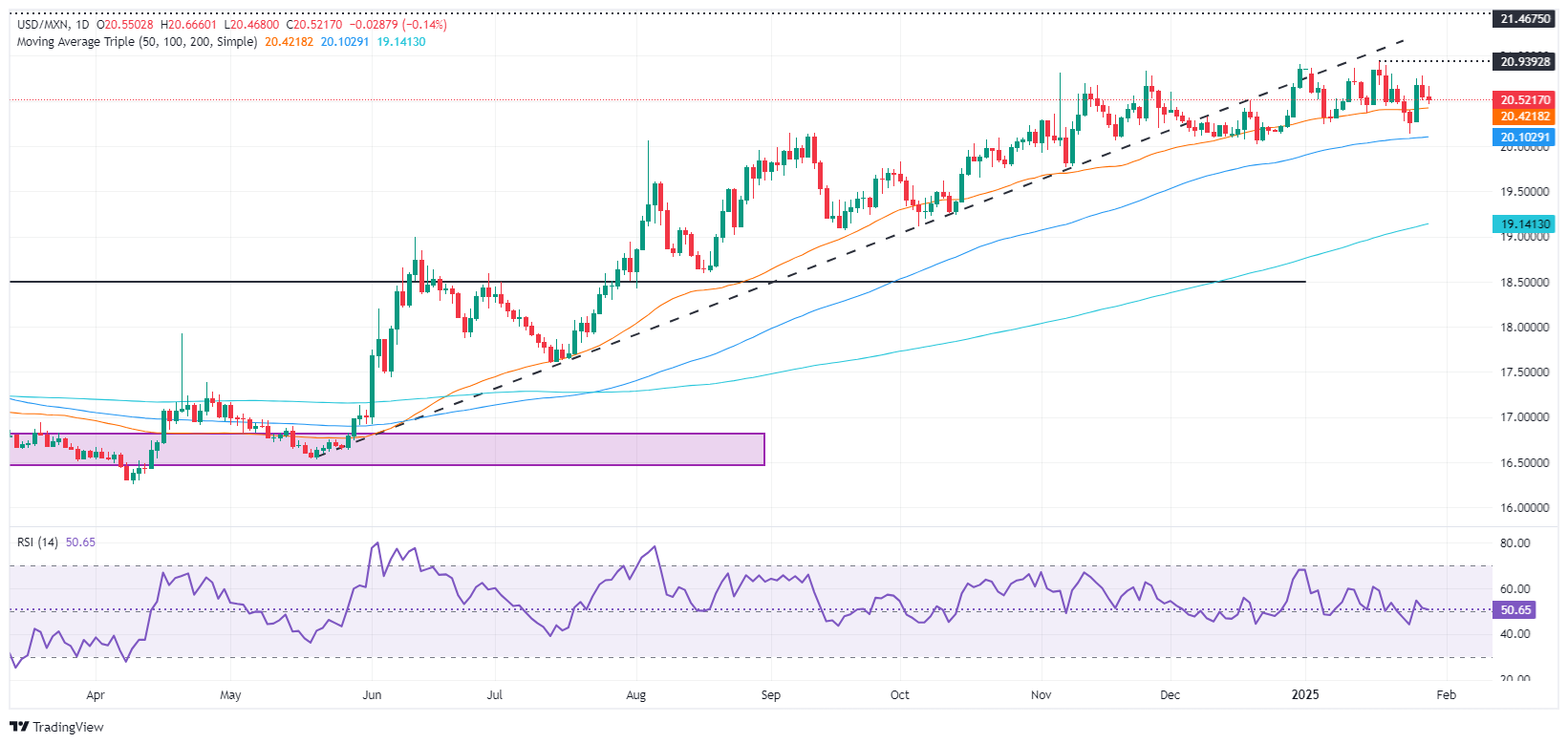
USD/MXN technical outlook: Mexican Peso surges as USD/MXN drops to 20.50
The USD/MXN consolidates near the 20.50 figure for the second straight day, with traders reluctant to push prices above the year-to-date (YTD) high of 20.90. Since November, the exotic pair has remained within the 20.20 – 20.90 range, capped on the downside by the 50 and 100-day Simple Moving Averages (SMAs), each at 20.38 and 20.07.
For a bullish continuation, buyers must clear the YTD peak and the 21.00 figure, which could open the door to test the March 8, 2022, daily high of 21.46, followed by the 22.00 psychological level.
On the other hand, if sellers push prices below the 100-day SMA, the next support would be 20.00, followed by the October 18, 2024 swing low of 19.64.
Mexican Peso FAQs
The Mexican Peso (MXN) is the most traded currency among its Latin American peers. Its value is broadly determined by the performance of the Mexican economy, the country’s central bank’s policy, the amount of foreign investment in the country and even the levels of remittances sent by Mexicans who live abroad, particularly in the United States. Geopolitical trends can also move MXN: for example, the process of nearshoring – or the decision by some firms to relocate manufacturing capacity and supply chains closer to their home countries – is also seen as a catalyst for the Mexican currency as the country is considered a key manufacturing hub in the American continent. Another catalyst for MXN is Oil prices as Mexico is a key exporter of the commodity.
The main objective of Mexico’s central bank, also known as Banxico, is to maintain inflation at low and stable levels (at or close to its target of 3%, the midpoint in a tolerance band of between 2% and 4%). To this end, the bank sets an appropriate level of interest rates. When inflation is too high, Banxico will attempt to tame it by raising interest rates, making it more expensive for households and businesses to borrow money, thus cooling demand and the overall economy. Higher interest rates are generally positive for the Mexican Peso (MXN) as they lead to higher yields, making the country a more attractive place for investors. On the contrary, lower interest rates tend to weaken MXN.
Macroeconomic data releases are key to assess the state of the economy and can have an impact on the Mexican Peso (MXN) valuation. A strong Mexican economy, based on high economic growth, low unemployment and high confidence is good for MXN. Not only does it attract more foreign investment but it may encourage the Bank of Mexico (Banxico) to increase interest rates, particularly if this strength comes together with elevated inflation. However, if economic data is weak, MXN is likely to depreciate.
As an emerging-market currency, the Mexican Peso (MXN) tends to strive during risk-on periods, or when investors perceive that broader market risks are low and thus are eager to engage with investments that carry a higher risk. Conversely, MXN tends to weaken at times of market turbulence or economic uncertainty as investors tend to sell higher-risk assets and flee to the more-stable safe havens.
Author

Christian Borjon Valencia
FXStreet
Markets analyst, news editor, and trading instructor with over 14 years of experience across FX, commodities, US equity indices, and global macro markets.















