Mexican Peso shakes off inflation data, soars on Fed rate cut
- Mexican Peso posts four consecutive days of gains; USD/MXN tumbles below 20.00.
- Mixed Mexican data as inflation rises, but core inflation dips, potentially allowing further Banxico easing.
- Supreme Court dismisses judicial reform challenge, easing Mexico’s political tensions.
- Fed cuts rates by 25 bps; signals balanced risks but cautious outlook.

The Mexican Peso held gains against the US Dollar on Thursday after the Federal Reserve decided to lower interest rates by 25 basis points. Meanwhile, Fed Chair Jerome Powell addressed the media, saying that the emerging market currency might fluctuate sharply. At the time of writing, the USD/MXN trades at 19.78, down 1.42%.
According to the Fed’s statement, officials see a solid economy even though the job market has eased somewhat. The committee acknowledged that inflation made progress toward the central bank’s 2% goal but added that it remains elevated.
Fed policymakers added that the risks of achieving its dual mandate “are roughly in balance,” and that they would remain attentive to the risks of both sides of the dual mandate.
Regarding the balance sheet, they would continue to reduce their holdings of Treasury securities, agency debt, and agency mortgage‑backed securities.
When making future decisions, the FOMC will consider incoming data, the evolving outlook, and the balance of risks. It is worth noting that the decision was unanimous, as Governor Michelle Bowman supported the rate cut.
Earlier, the Instituto Nacional de Estadística Geografía e Informatica (INEGI) revealed that headline inflation for Mexico in October rose above estimates, but core dipped, clearing the way for further easing by the Bank of Mexico (Banxico).
Meanwhile, political turmoil faded after the Supreme Court dismissed Judge Juan Luis González Alcántara Carranca's proposal to invalidate some parts of the judicial reform bill approved in September.
President Claudia Sheinbum said she spoke with presumptive US President Donald Trump. “We had a very cordial call with President-elect Donald Trump in which we talked about the good relationship that there will be between Mexico and the United States,” she published on her X account.
Across the border, the US Bureau of Labor Statistics (BLS) revealed that the number of Americans applying for unemployment benefits rose above the prior week’s report, as expected.
Daily digest market movers: Mexican Peso clibmbs after Fed's decision
- The USD/MXN will likely remain volatile after the US elections. Trump’s harsh rhetoric against Mexico and threats of imposing tariffs could increase the action. Traders should be aware of everything he says or tweets.
- Mexico’s Inflation in October rose from 4.58% to 4.76% YoY, exceeding estimates of 4.72%. Underlying prices dumped from 3.91% to 3.80% YoY, below forecasts of 3.85%.
- Automobile Exports rose from 4.8% to 5% YoY. Meanwhile, production dropped from 11.7% to 1.1%, hinting at the ongoing deceleration in the manufacturing sector.
- The BLS revealed that US Initial Jobless Claims for the week ending November 2 increased from 218K to 221K as widely expected.
- On Tuesday, the US economic schedule revealed that the Balance of Trade deficit widened while business activity cooled slightly.
- S&P Global revealed that October’s service activity dipped, while the Institute for Supply Management’s (ISM) Services PMI improved for the same period.
- Data from the Chicago Board of Trade, via the December fed funds rate futures contract, shows investors estimate 49 bps of Fed easing by the end of the year.
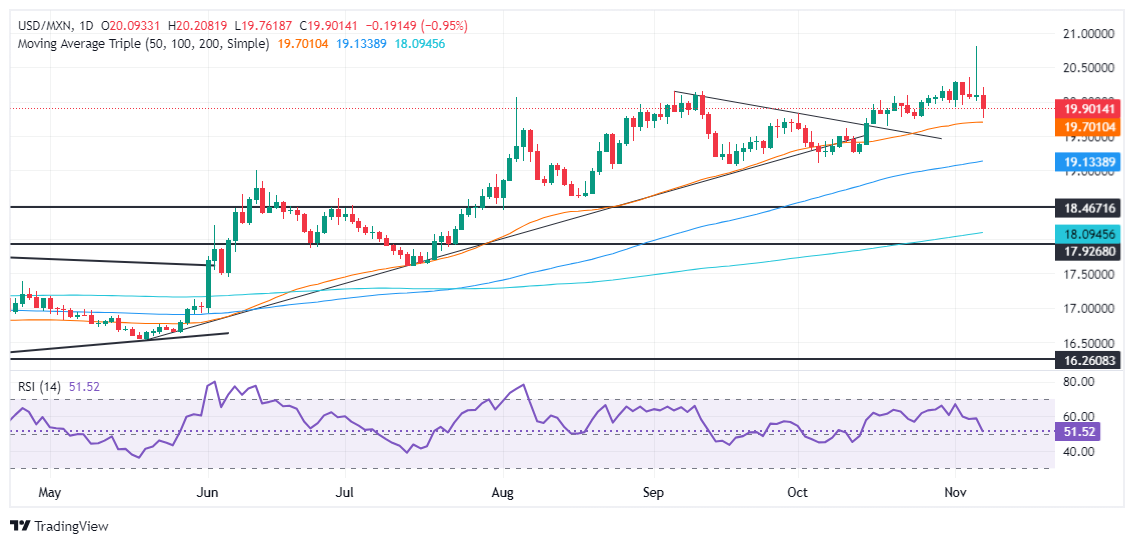
USD/MXN technical outlook: Mexican Peso’s offensive continues as USD/MXN drops under 20.00
The USD/MXN uptrend remains intact after the pair trimmed all of its November 6 gains. This saw the Peso depreciate toward 20.80 before staging a comeback as the pair drifted below the 20.00 figure.
If sellers want to remain in charge, they need to push the exchange rate below the five-month lower support trendline at 19.76, which would expose the 50-day Simple Moving Average (SMA) at 19.68. On further weakness, the next stop would be the psychological figures of 19.50, followed by the October 14 low of 19.23.
On the upside, USD/MXN must surpass the 20-day SMA at 19.89. This would shift the intraday bias to bullish, exacerbating a move toward the 20.00 figure. A breach of the latter will expose the August 5 high at 20.22, followed by the two-year high at 20.80.
Mexican Peso FAQs
The Mexican Peso (MXN) is the most traded currency among its Latin American peers. Its value is broadly determined by the performance of the Mexican economy, the country’s central bank’s policy, the amount of foreign investment in the country and even the levels of remittances sent by Mexicans who live abroad, particularly in the United States. Geopolitical trends can also move MXN: for example, the process of nearshoring – or the decision by some firms to relocate manufacturing capacity and supply chains closer to their home countries – is also seen as a catalyst for the Mexican currency as the country is considered a key manufacturing hub in the American continent. Another catalyst for MXN is Oil prices as Mexico is a key exporter of the commodity.
The main objective of Mexico’s central bank, also known as Banxico, is to maintain inflation at low and stable levels (at or close to its target of 3%, the midpoint in a tolerance band of between 2% and 4%). To this end, the bank sets an appropriate level of interest rates. When inflation is too high, Banxico will attempt to tame it by raising interest rates, making it more expensive for households and businesses to borrow money, thus cooling demand and the overall economy. Higher interest rates are generally positive for the Mexican Peso (MXN) as they lead to higher yields, making the country a more attractive place for investors. On the contrary, lower interest rates tend to weaken MXN.
Macroeconomic data releases are key to assess the state of the economy and can have an impact on the Mexican Peso (MXN) valuation. A strong Mexican economy, based on high economic growth, low unemployment and high confidence is good for MXN. Not only does it attract more foreign investment but it may encourage the Bank of Mexico (Banxico) to increase interest rates, particularly if this strength comes together with elevated inflation. However, if economic data is weak, MXN is likely to depreciate.
As an emerging-market currency, the Mexican Peso (MXN) tends to strive during risk-on periods, or when investors perceive that broader market risks are low and thus are eager to engage with investments that carry a higher risk. Conversely, MXN tends to weaken at times of market turbulence or economic uncertainty as investors tend to sell higher-risk assets and flee to the more-stable safe havens.
Author

Christian Borjon Valencia
FXStreet
Markets analyst, news editor, and trading instructor with over 14 years of experience across FX, commodities, US equity indices, and global macro markets.