Mexican Peso finds higher ground on Monday, but gains remain slim

Most recent article: Mexican Peso stalls in uptrend on rumors of carry trade unwinding
- The Mexican Peso gave back 0.6% against the US Dollar on Monday.
- Mexico has limited representation on the economic calendar this week.
- Jackson Hole looms large in the week ahead alongside US PMI figures.
The Mexican Peso (MXN) returned one quarter of one percent to Greenback bidders on Monday, paring back recent gains as Peso bulls took a breather. The US Dollar is broadly softer across the board to kick off the new trading week, but recent Peso-positive flows have briefly reversed direction.
Mexico has a scant release schedule on this week’s data docket, and all figures slated to print this week on the Peso side are strictly low-tier numbers. Mexican Retail Sales for the year ended in June are due on Tuesday, and are expected to contract by 1.8% YoY compared to the previous 0.3% growth.
Fortnightly headline and core Mexico inflation figures are due on Thursday. Core Inflation is forecast to tick up slightly to 0.19% from 0.18% in the first half of August, while headline Inflation is forecast to slump to 0.13% over the same period, down sharply from the previous 0.71%.
Daily digest market movers: Greenback goes belly up, but Peso flows need a breather
- Peso bidding has reversed course on Monday, paring back the MXN against the US Dollar.
- Despite a brief easing in buying pressure, the MXN is still up 6.6% against the USD as the Peso recovers from a 22-month low.
- Markets are broadly looking ahead to this week’s kick-off of the Jackson Hole Economic Symposium, where rate-cut-hungry investors will be hanging on every word from Federal Reserve (Fed) policymakers.
- Recent bets of a double cut in September have eased significantly after reaching a peak of 70% two weeks ago. According to the CME’s FedWatch Tool, rate markets are pricing in a scant one-in-five chance of a 50 bps cut on September 18.
- Overall, markets still have a 25 bps cut in September fully priced in, with three or four quarter-point cuts expected by the end of the year.
Mexican Peso price forecast: Pullback leaves Peso bidders primed for another leg, but technical limits remain
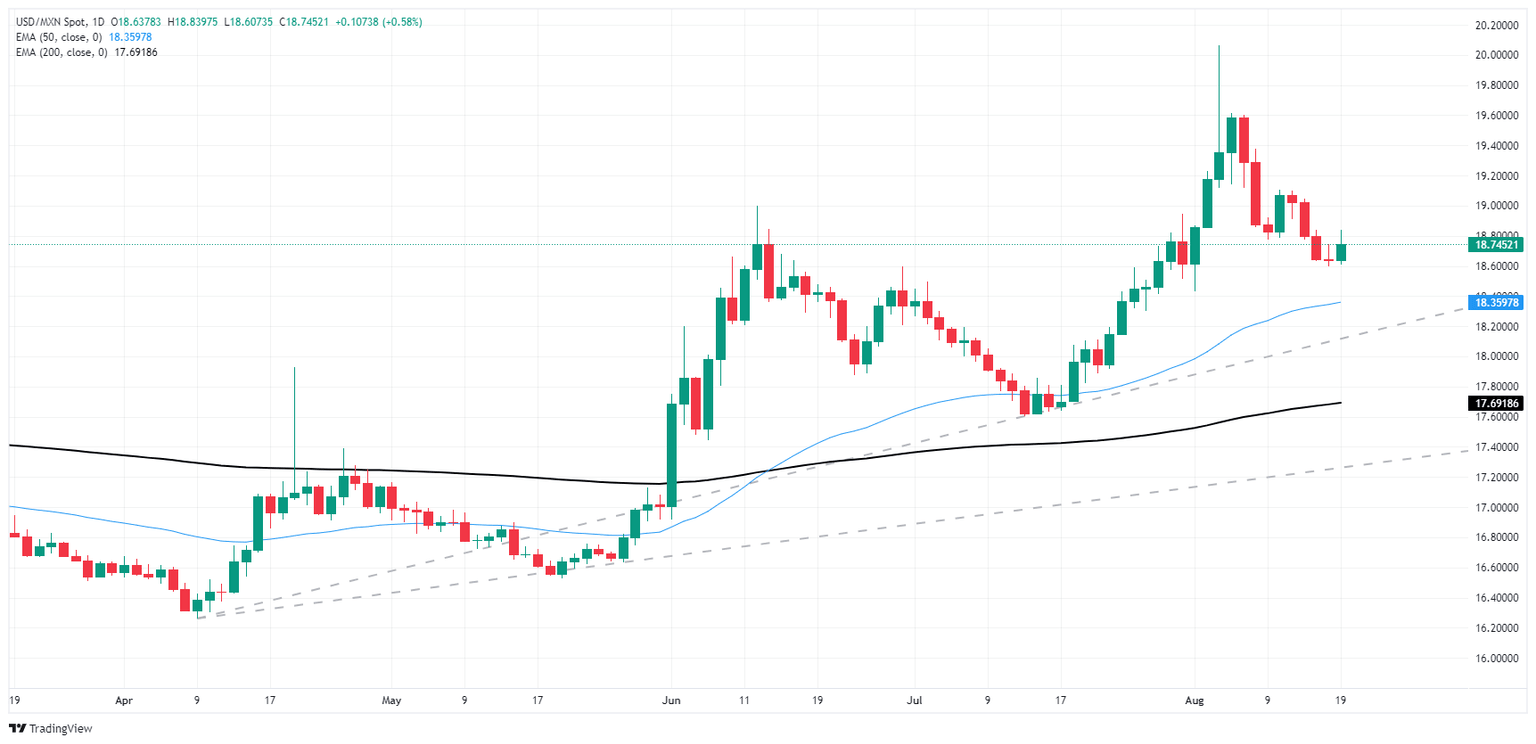
The Mexican Peso’s recent recovery against the US Dollar has sent USD/MXN bids skidding toward 18.50. Still, a long-run bullish trend in the chart leaves Peso bidders grappling with an accelerating pattern of higher lows as the Greenback trends higher against the MXN.
Price action is poised for a continued decline into the 50-day Exponential Moving Average (EMA) at 18.35, with a hard floor priced in at the rising trendline drawn from April’s lows near 16.25.
USD/MXN daily chart
Mexican Peso FAQs
The Mexican Peso (MXN) is the most traded currency among its Latin American peers. Its value is broadly determined by the performance of the Mexican economy, the country’s central bank’s policy, the amount of foreign investment in the country and even the levels of remittances sent by Mexicans who live abroad, particularly in the United States. Geopolitical trends can also move MXN: for example, the process of nearshoring – or the decision by some firms to relocate manufacturing capacity and supply chains closer to their home countries – is also seen as a catalyst for the Mexican currency as the country is considered a key manufacturing hub in the American continent. Another catalyst for MXN is Oil prices as Mexico is a key exporter of the commodity.
The main objective of Mexico’s central bank, also known as Banxico, is to maintain inflation at low and stable levels (at or close to its target of 3%, the midpoint in a tolerance band of between 2% and 4%). To this end, the bank sets an appropriate level of interest rates. When inflation is too high, Banxico will attempt to tame it by raising interest rates, making it more expensive for households and businesses to borrow money, thus cooling demand and the overall economy. Higher interest rates are generally positive for the Mexican Peso (MXN) as they lead to higher yields, making the country a more attractive place for investors. On the contrary, lower interest rates tend to weaken MXN.
Macroeconomic data releases are key to assess the state of the economy and can have an impact on the Mexican Peso (MXN) valuation. A strong Mexican economy, based on high economic growth, low unemployment and high confidence is good for MXN. Not only does it attract more foreign investment but it may encourage the Bank of Mexico (Banxico) to increase interest rates, particularly if this strength comes together with elevated inflation. However, if economic data is weak, MXN is likely to depreciate.
As an emerging-market currency, the Mexican Peso (MXN) tends to strive during risk-on periods, or when investors perceive that broader market risks are low and thus are eager to engage with investments that carry a higher risk. Conversely, MXN tends to weaken at times of market turbulence or economic uncertainty as investors tend to sell higher-risk assets and flee to the more-stable safe havens.
Author
Joshua Gibson
FXStreet
Joshua joins the FXStreet team as an Economics and Finance double major from Vancouver Island University with twelve years' experience as an independent trader focusing on technical analysis.