Mexican Peso weakens after retail sales shows shoppers tightening their belts
- The Mexican Peso weakens after Retail Sales data shows a steep decline in sales in June.
- The Peso had been pulling back in an uptrend on rumors of the carry trade unwinding.
- From a technical perspective, USD/MXN is unfolding a down leg within a rising channel.
The Mexican Peso (MXN) steepens its broad decline on Tuesday after the release of Retail Sales data shows shopper tightened their belts in June. The data suggests the economy could be cooling with implications for inflation and monetary policy that are negative for MXN. The Peso had already been weakening on the back of rumors that the carry trade – which had hitherto been favorable for the Peso – was unwinding.
Mexican Retail Sales fell by 3.9% in June YoY after rising by 0.3% YoY in May, according to data from INEGI. This was lower than the expected 1.8% decline forecast by economists.
On a month-over-month basis retail sales fell by 0.5% in june after rising 0.1% in May. The data suggests the economy may be slowing down, which, in turn, is likely to pass through into lower inflation and lead the Banco de Mexico (Banxico) to lower interest rates. These, in turn, are negative for the Peso as they reduce foreign capital inflows.
Mexican peso hit by flight from carry
The Mexican Peso is trending lower as investors unwind their long carry trade positions in MXN.
Interest rates in Mexico are relatively high at 10.75%, which attracts demand from the carry trade – an operation in which traders borrow in a currency with low interest rates, like the Japanese Yen (JPY) and use the money to buy higher-interest paying currencies such as the Mexican Peso. The profit from the trade is the difference between the interest paid on the loan and the interest earned on the investment, minus any currency depreciation.
The buzz in social media seems to be that the carry trade is unwinding, however, and flows that were going into the Peso are drying up. This has been put forward as one factor in the recent appreciation of the Japanese Yen. If so, and the influence of the carry trade is decreasing, the implications for the Peso will be negative. Given the still-wide interest-rate differential between Mexico and Japan, however, it seems unlikely the carry trade will completely cease.
At the time of writing, one US Dollar (USD) buys 18.85 Mexican Pesos, EUR/MXN trades at 20.93, and GBP/MXN at 24.54.
Mexican Peso: Domestic data, geopolitical risks to drive valuation
The Mexican Peso could be impacted by Mexican Retail Sales data for June – which will be released at 12:00 GMT on Tuesday – with analysts forecasting a 1.8% decline on a year-over-year basis. Whilst not usually a market moving release, a stronger-than-expected figure might support the Peso by lending credence to the view that the Banco de Mexico (Banxico) will take a more gradual approach to lowering interest rates than is currently expected. The expectation that interest rates might remain elevated for longer would be positive for the Peso as high interest rates attract greater foreign capital inflows.
Headline inflation in Mexico remains elevated at 5.57% and this could be further supported by stubbornly high dwelling inflation, according to research by Capital Economics, who expect the Banco de Mexico (Banxico) to take a gradual approach to cutting interest rates .
Trump risk reduces
The steadily decreasing chance of former-president Donald Trump winning the US presidential election in November and instituting higher tariffs on foreign imported goods, many of which come from Mexico, is a further supportive factor for the Peso. A recent poll on polling website FiveThirtyEight.com shows Harris leading Trump by two and a half points, according to a report in the Independent.
The Peso is sensitive to changes in global risk appetite and could also be impacted by a breakdown in peace talks in the Middle East. US Secretary of State Anthony Blinken is currently trying to broker a peace deal between Israel and Hammas, but he has not been able to gain the agreement of all parties, according to Reuters. The threat of the war escalating and involving Iran would cause an increase in market volatility which would probably be detrimental to the Peso.
Technical Analysis: USD/MXN unfolding C wave of correction
USD/MXN consolidates within a bearish leg of a rising channel. The pair posted a bearish Shooting Star Japanese candlestick pattern on Monday and, if Tuesday ends as a red candle, it will provide added confirmation of an extension of the leg down towards the lower channel line and the 50-day Simple Moving Average (SMA) at 18.42 nearby.
USD/MXN Daily Chart
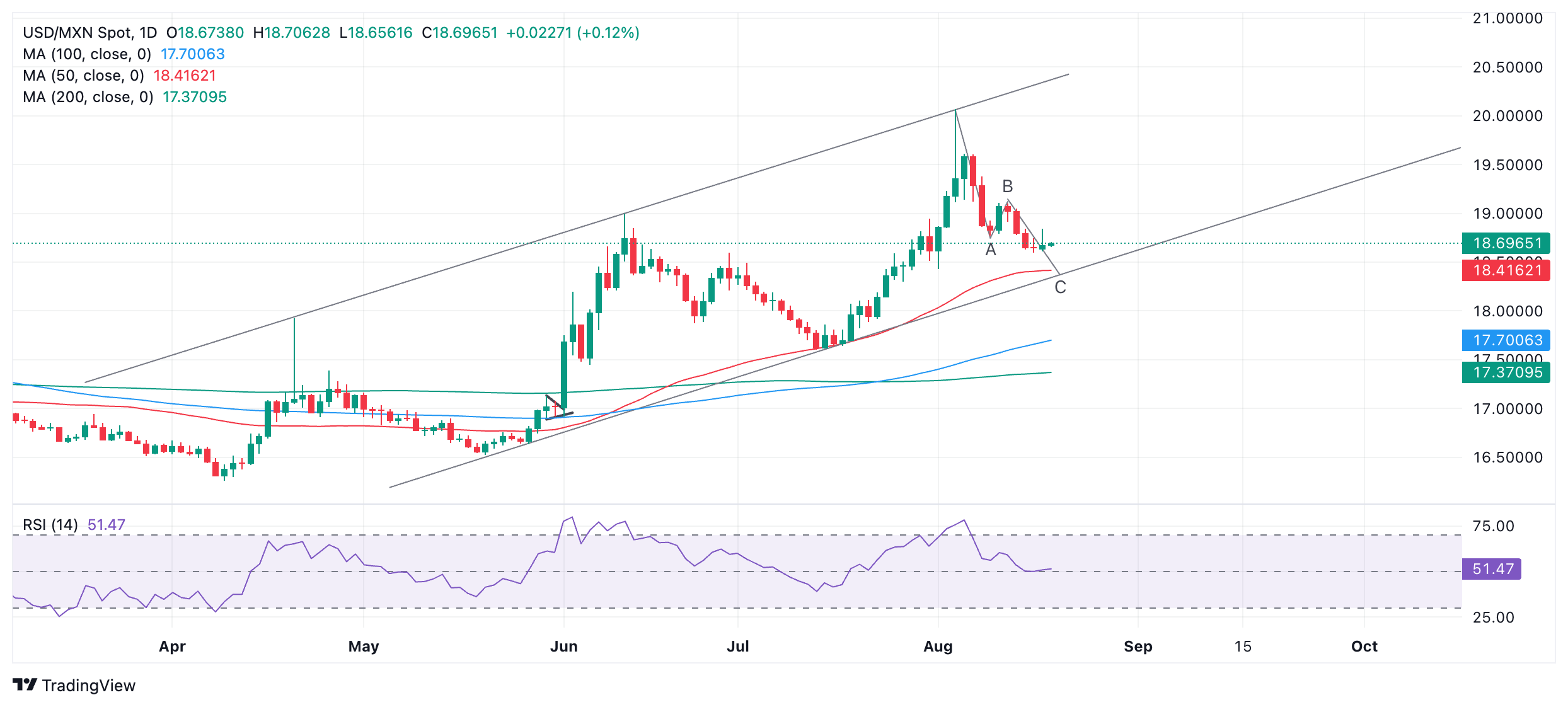
USD/MXN looks to be unfolding in a bearish ABC pattern down leg within its rising channel. If so, it looks like wave C is currently unfolding and is likely to be of a similar length to wave A or a Fibonacci ratio thereof. This suggests the move lower still probably has further to go.
The overall trend on the medium and longer-term time frames is arguably bullish, however, so once complete there is a good chance the channel will continue rising higher as these longer-term trends extend.
Banxico FAQs
The Bank of Mexico, also known as Banxico, is the country’s central bank. Its mission is to preserve the value of Mexico’s currency, the Mexican Peso (MXN), and to set the monetary policy. To this end, its main objective is to maintain low and stable inflation within target levels – at or close to its target of 3%, the midpoint in a tolerance band of between 2% and 4%.
The main tool of the Banxico to guide monetary policy is by setting interest rates. When inflation is above target, the bank will attempt to tame it by raising rates, making it more expensive for households and businesses to borrow money and thus cooling the economy. Higher interest rates are generally positive for the Mexican Peso (MXN) as they lead to higher yields, making the country a more attractive place for investors. On the contrary, lower interest rates tend to weaken MXN. The rate differential with the USD, or how the Banxico is expected to set interest rates compared with the US Federal Reserve (Fed), is a key factor.
Banxico meets eight times a year, and its monetary policy is greatly influenced by decisions of the US Federal Reserve (Fed). Therefore, the central bank’s decision-making committee usually gathers a week after the Fed. In doing so, Banxico reacts and sometimes anticipates monetary policy measures set by the Federal Reserve. For example, after the Covid-19 pandemic, before the Fed raised rates, Banxico did it first in an attempt to diminish the chances of a substantial depreciation of the Mexican Peso (MXN) and to prevent capital outflows that could destabilize the country.
Author

Joaquin Monfort
FXStreet
Joaquin Monfort is a financial writer and analyst with over 10 years experience writing about financial markets and alt data. He holds a degree in Anthropology from London University and a Diploma in Technical analysis.