Mexican Peso recovers, rises on upbeat market mood
- Mexican Peso gains 0.55%, trading at 17.92, after better-than-expected Economic Activity data.
- INEGI reports strong economic activity for May, offsetting slow retail sales growth.
- US political developments with Biden's withdrawal and endorsement of Harris impact market sentiment, favoring high-beta currencies.

The Mexican Peso recovered on Monday after ending the week with more than 2.30% losses. Mexico’s economic data was mixed, though the Economic Activity indicator, which measures growth, was better than expected and bolstered the Mexican currency. Therefore, the USD/MXN drops below the 18.00 figure and trades with gains of 0.55% at around 17.92.
The Mexican National Statistics Agency (INEGI) revealed that economic activity in May exceeded estimates and April's data on a monthly and annual basis. This helped the Peso, which remains appreciating against the US Dollar. Contrarily, Retail Sales for the same period increased slowly, hinting that Government infrastructure projects drive the economy.
Across the border, breaking news emerged on Sunday that US President Joe Biden dropped from the Presidential race and endorsed the current Vice President Kamala Harris to obtain the ticket of the Democrats and compete against former President Donald Trump.
After that, US equity futures opened higher during the Asian session, while Wall Street traded in the green. This undermined the Greenback and favored high-beta currencies like the Mexican Peso.
Last week, Trump’s comments put Mexico in the spotlight, commenting that he will end illegal immigration “by closing the border and completing the wall.” He added, “China and Mexico have taken 68 percent of our automotive industry, but we are going to get it back.”
The remarks threaten to prevent companies from relocating to Mexico, which could weaken the Mexican Peso.
The US Dollar Index (DXY), which tracks the buck’s value against the other six currencies, stays virtually unchanged at around 104.30.
Daily digest market movers: Mexican Peso recovers some ground
- Mexico’s Economic Activity in May increased by 0.7%, exceeding April’s -0.6% MoM contraction. On an annual basis, it slowed from 5.4% to 1.6%.
- May Retail Sales were worse than April’s, rising 0.1% MoM, trailing a 0.5% increase, and 0.3% YoY, down from 3.2%.
- The International Monetary Fund (IMF) adjusted Mexico’s Gross Domestic Product (GDP) expectations for 2024 from 2.4% to 2.2% due to the country’s economic slowdown and the US economic downturn.
- Fitch Ratings reaffirmed Mexico’s BBB- rating with a stable outlook but noted that the proposed judicial reform could impact the country. The credit rating agency expressed uncertainty about the upcoming administration's ability to narrow the fiscal deficit, anticipated a slight economic downturn in 2025, and mentioned that trade tensions with the US could leave Mexico vulnerable.
- The CME FedWatch Tools show that the chances of a quarter-percentage-rate cut to the federal funds rate in September are at 94%.
- June consumer inflation figures were lower than expected in the United States, increasing the chances that the Federal Reserve would lower borrowing costs in 2024 by at least 48 basis points, according to the December 2024 fed funds rate futures contract.
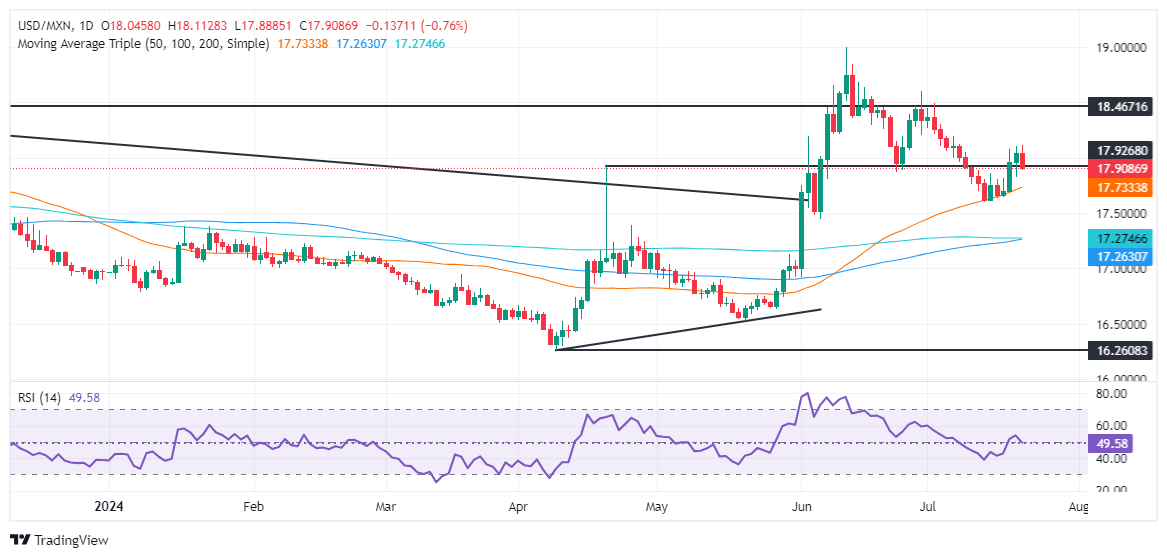
Technical analysis: Mexican Peso surges as USD/MXN slumps below 18.00
The USD/MXN retreated beneath 18.00; it seems to be poised to edge lower and test key support levels, the 50-day Simple Moving Average (SMA) at 17.72, the first support level.
Momentum shifted bearishly, as depicted by the Relative Strength Index (RSI), though it meanders around the 50-neutral line. That said, in the short term, the USD/MXN could be headed for a correction before resuming upwards.
If USD/MXN drops below the 50-day SMA, the next support would be the latest cycle low of 17.58; the July 12 high turned support. A breach of the latter will expose the January 23 peak at 17.38.
If USD/MXN extends its gains above the psychological 18.00 figure, that will expose key resistance levels. Once breached, the next stop would be the July 5 high at 18.19, followed by the June 28 high of 18.59, allowing buyers to aim for the YTD high at 18.99.
Mexican Peso FAQs
The Mexican Peso (MXN) is the most traded currency among its Latin American peers. Its value is broadly determined by the performance of the Mexican economy, the country’s central bank’s policy, the amount of foreign investment in the country and even the levels of remittances sent by Mexicans who live abroad, particularly in the United States. Geopolitical trends can also move MXN: for example, the process of nearshoring – or the decision by some firms to relocate manufacturing capacity and supply chains closer to their home countries – is also seen as a catalyst for the Mexican currency as the country is considered a key manufacturing hub in the American continent. Another catalyst for MXN is Oil prices as Mexico is a key exporter of the commodity.
The main objective of Mexico’s central bank, also known as Banxico, is to maintain inflation at low and stable levels (at or close to its target of 3%, the midpoint in a tolerance band of between 2% and 4%). To this end, the bank sets an appropriate level of interest rates. When inflation is too high, Banxico will attempt to tame it by raising interest rates, making it more expensive for households and businesses to borrow money, thus cooling demand and the overall economy. Higher interest rates are generally positive for the Mexican Peso (MXN) as they lead to higher yields, making the country a more attractive place for investors. On the contrary, lower interest rates tend to weaken MXN.
Macroeconomic data releases are key to assess the state of the economy and can have an impact on the Mexican Peso (MXN) valuation. A strong Mexican economy, based on high economic growth, low unemployment and high confidence is good for MXN. Not only does it attract more foreign investment but it may encourage the Bank of Mexico (Banxico) to increase interest rates, particularly if this strength comes together with elevated inflation. However, if economic data is weak, MXN is likely to depreciate.
As an emerging-market currency, the Mexican Peso (MXN) tends to strive during risk-on periods, or when investors perceive that broader market risks are low and thus are eager to engage with investments that carry a higher risk. Conversely, MXN tends to weaken at times of market turbulence or economic uncertainty as investors tend to sell higher-risk assets and flee to the more-stable safe havens.
Author

Christian Borjon Valencia
FXStreet
Markets analyst, news editor, and trading instructor with over 14 years of experience across FX, commodities, US equity indices, and global macro markets.