US Dollar retreats with Trump's tariff flagship stalling on first day in office
- The US Dollar slides 1% in the US Dollar Index, measured against six major currencies.
- The WSJ issues a piece that first a task force needs to be formed on tariffs.
- The US Dollar Index (DXY) snaps 109.00 and heads towards 108.00
The US Dollar Index (DXY), which tracks the Greenback’s value against six major currencies, is sinking 1% just hours ahead of President-elect Donald Trump’s inauguration as the 47th President of the United States (US). Several asset classes in the US will remain closed, such as the Wall Street trading floor and US bond trading, in observance of Martin Luther King’s Day. The first seismic shock in the DXY comes after headlines emerged form the Wall Street Journal that tariffs are not a part of the executive orders that President Donald Trump will issue on his first day in office, and need to be discussed further before being implemented.
All eyes will be on the aftermath of the inauguration, where President-elect Donald Trump has already confirmed in a rally on Sunday that a whole battery of new measures and executive orders will be issued. The main ones are, of course, more tariffs, mass deportation starting in Chicago, and issuing state of emergencies for energy and border security, Bloomberg reported. By issuing those last two, the upcoming President Trump can give the green light for massive drilling and mass deporting illegal immigrants without having to pass through Congress and the House of Representatives.
Daily digest market movers: Watch out for the boomerang
- The Wall Street Journal issues a headline that confirms the Trump administration to form a task group first to discuss proper impacts from tariffs on China, Canada and Mexico before considering to issue them.
- At 17:00 GMT, the Presidential Inauguration will take place, with Donald Trump being sworn in as the 47th President of the United States.
- Due to Martin Luther King’s Day, several trading floors in the US will remain closed throughout the day.
- Equities are very happy with the softer US Dollar. All European equities and US futures are off to a good start for this week.
- The CME FedWatch tool projects a 55.6% chance that interest rates will remain unchanged at current levels in the May meeting, suggesting a rate cut in June. Expectations are that the Federal Reserve (Fed) will remain data-dependent with uncertainties that could influence inflation during President-elect Donald Trump’s term.
- The US 10-year yield is trading around 4.627% and will remain at that level this Monday, as bond trading in the US is closed due to the Martin Luther King’s bank holiday.
US Dollar Index Technical Analysis: Look at the bigger picture
The US Dollar Index (DXY) sees a split division between bears and bulls. The new Trump administration is set to unleash a large number of executive orders, making it hard for markets to assess the impact. With several topics being addressed and communicated in advance, it looks like markets have already priced in a fair bit of inflationary pressure from Trumponomics. The question now will be if the markets are correct and if the DXY index will ease further from current levels on the back of an overestimation of the actual impact of the measures being imposed.
On the upside, the 110.00 psychological level remains the key resistance to beat. Further up, the next big upside level to hit before advancing any further remains at 110.79 (September 7, 2022, high). Once beyond there, it is quite a stretch to 113.91, a double top from October 2022.
On the downside, the DXY is trading alongside the ascending trend line coming from December 2023, which currently comes in around 109.10 as nearby support. In case of more downside, the next support is 107.35 (October 3, 2023, high). Further down, the 55-day Simple Moving Average (SMA) at 107.29 should catch any falling knives.
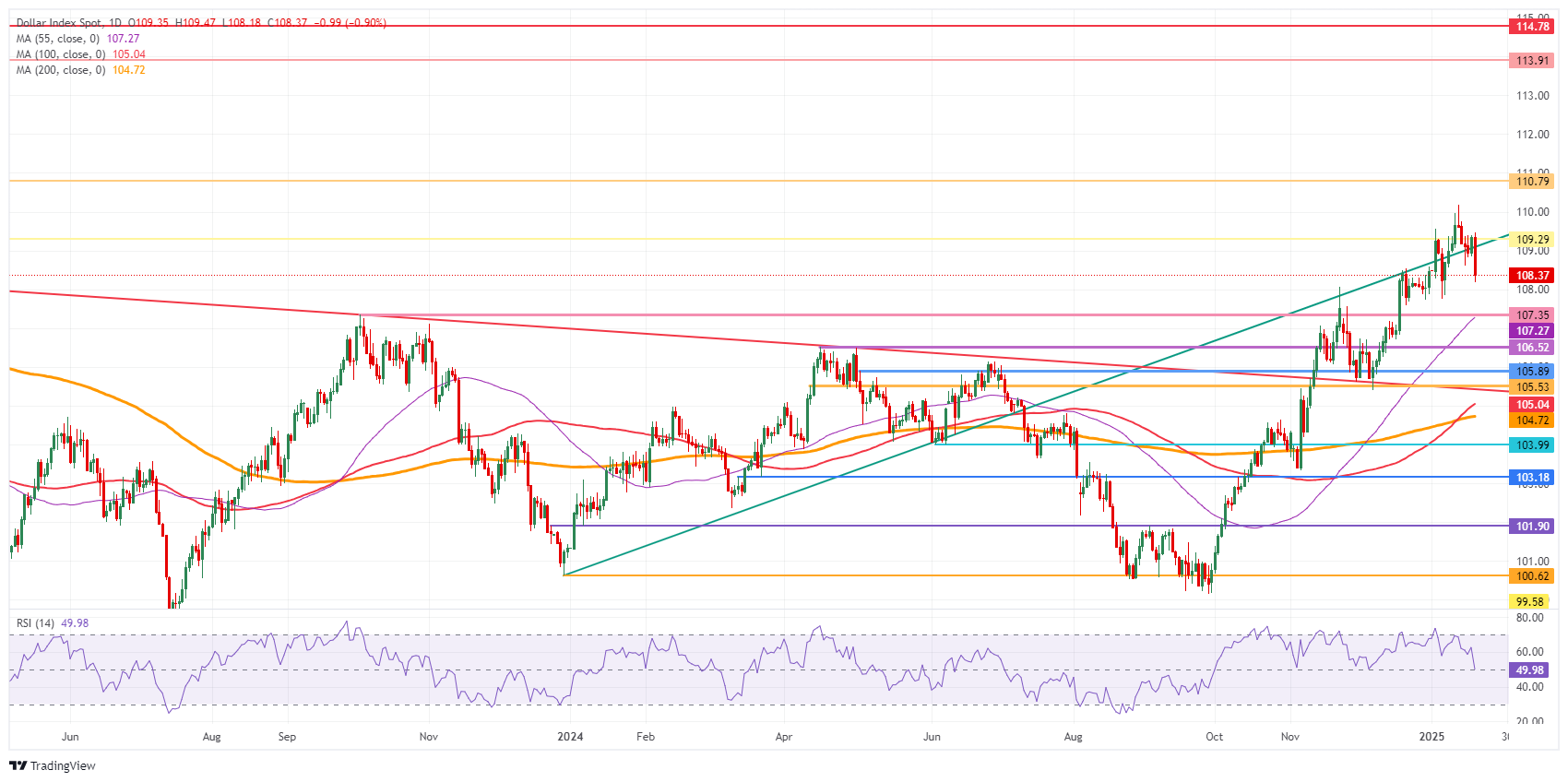
US Dollar Index: Daily Chart
Interest rates FAQs
Interest rates are charged by financial institutions on loans to borrowers and are paid as interest to savers and depositors. They are influenced by base lending rates, which are set by central banks in response to changes in the economy. Central banks normally have a mandate to ensure price stability, which in most cases means targeting a core inflation rate of around 2%. If inflation falls below target the central bank may cut base lending rates, with a view to stimulating lending and boosting the economy. If inflation rises substantially above 2% it normally results in the central bank raising base lending rates in an attempt to lower inflation.
Higher interest rates generally help strengthen a country’s currency as they make it a more attractive place for global investors to park their money.
Higher interest rates overall weigh on the price of Gold because they increase the opportunity cost of holding Gold instead of investing in an interest-bearing asset or placing cash in the bank. If interest rates are high that usually pushes up the price of the US Dollar (USD), and since Gold is priced in Dollars, this has the effect of lowering the price of Gold.
The Fed funds rate is the overnight rate at which US banks lend to each other. It is the oft-quoted headline rate set by the Federal Reserve at its FOMC meetings. It is set as a range, for example 4.75%-5.00%, though the upper limit (in that case 5.00%) is the quoted figure. Market expectations for future Fed funds rate are tracked by the CME FedWatch tool, which shapes how many financial markets behave in anticipation of future Federal Reserve monetary policy decisions.
Author

Filip Lagaart
FXStreet
Filip Lagaart is a former sales/trader with over 15 years of financial markets expertise under its belt.
















