Johnson & Johnson stock reaches 52-week low as markets fall
- JNJ stock is trading at its lowest level since November 2020.
- The new 52-week low comes after Johnson & Johnson stock sees Death Cross pattern.
- Johnson & Johnson receives Fast Track status from FDA for another Alzheimer's drug.
- More positive US labor market data points to less need for Fed rate cuts.

Johnson & Johnson (JNJ) stock descended to its lowest price level in over four years on Wednesday as the broad stock market indices fell on an increased sense that Federal Reserve (Fed) interest rate cuts may halt due to the strong labor market.
JNJ stock hit a 52-week low of $141.44 in the morning session before recouping some of that sell-off to trade 2.3% lower, while its primary index, the Dow Jones Industrial Average (DJI), sank 0.35% at the time of writing.
In focus are recent economic data showing a strong US economy, which is leading the market to expect the central bank to hold interest rates flat until it is more certain that inflation is falling toward its 2% goal. Initial Jobless Claims reported on Wednesday came in well below expectations, and on Tuesday the JOLTs Job Openings survey showed an uptick of roughly a quarter million more open positions in November than October. The ISM Services PMI for December unveiled an expanding sector.
"[I]t's all about yields at the moment with some big or landmark moves again yesterday in a period where there continue to be doubts about whether the Fed can cut rates in 2025," Deutsche Bank's Jim Reid said to another news outlet.
Johnson & Johnson stock news
The timing for reaching a new 52-week low is interesting since Johnson & Johnson announced it had received Fast Track status from the Food & Drug Administration for its posdinemab drug that treats early-stage Alzheimer's disease in its phase-2 AuTonomy study.
Posdinemab is a “phosphorylated tau-directed monoclonal antibody” that slow disease-related phosphorylated tau in cerebrospinal fluid. Early models show it may be effective in reducing the spread of tau aggregates.
Johnson & Johnson’s JNJ-2056 immunotherapy for treating Alzheimer’s also received Fast Track status in July 2024.
"Posdinemab has the potential to slow the spread of tau pathology in the brain - which may slow cognitive decline,” said Bill Martin, the Global Therapeutic Area Head of Neuroscience at Johnson & Johnson Innovative Medicine. “The FDA's Fast Track designation reflects the urgent unmet need for new treatment options for the millions living with AD."
Johnson & Johnson stock chart
JNJ stock has been trending lower since early September. By October, it had become obvious that JNJ was fulfilling a Head-and-Shoulders pattern. However, JNJ shares have since dropped below the target downside level around $148 from that pattern, and on Wednesday they momentarily fell below the April 18, 2024 yearly low.
Just before Christmas, Johnson & Johnson’s 50-day Simple Moving Average (SMA) dropped below its 200-day counterpart. This is the dreaded Death Cross that usually predicts a much longer downtrend.
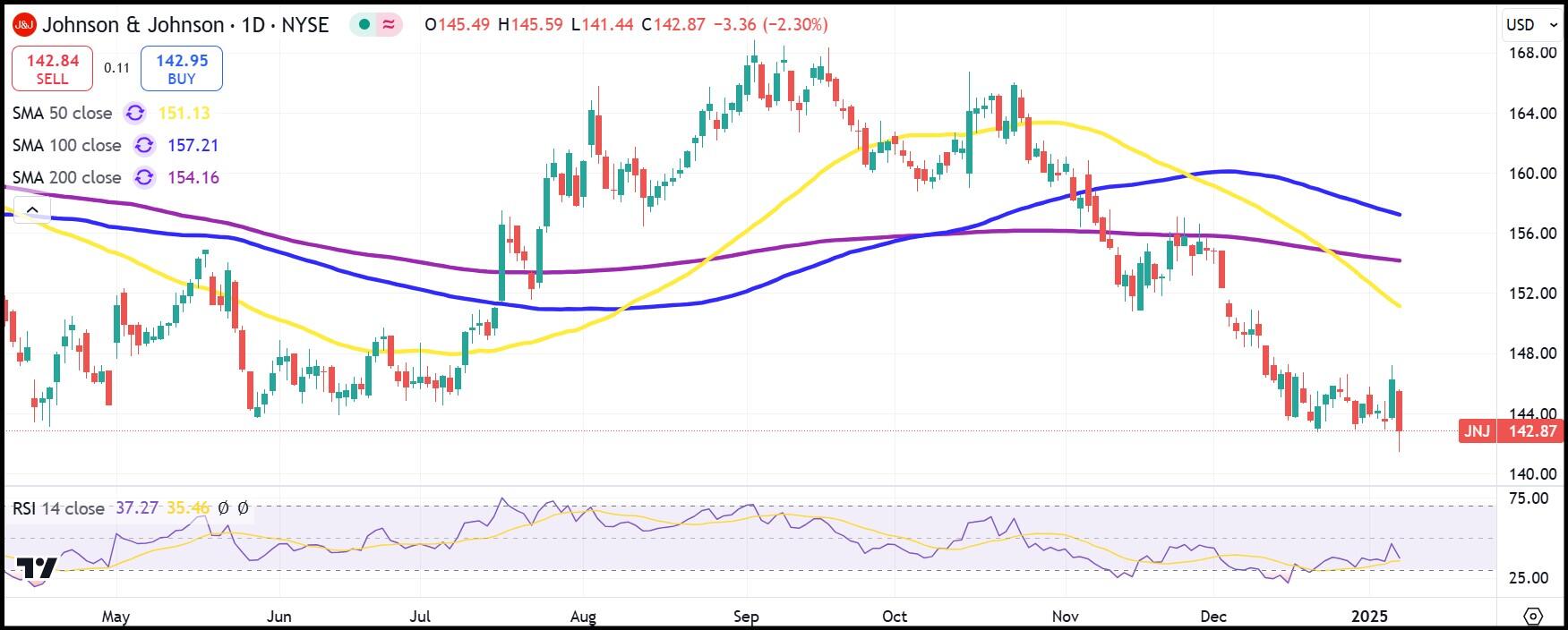
JNJ daily stock chart
Author

Clay Webster
FXStreet
Clay Webster grew up in the US outside Buffalo, New York and Lancaster, Pennsylvania. He began investing after college following the 2008 financial crisis.

















