Japanese Yen bears have the upper hand amid fading December BoJ rate hike bets
- The Japanese Yen attracts fresh sellers amid reports that the BoJ will keep rates steady next week.
- The prevalent risk-on mood and rising US bond yields further undermine the lower-yielding JPY.
- A modest USD weakness keeps a lid on the USD/JPY pair ahead of the US PPI and Jobless Claims.

The Japanese Yen (JPY) attracts fresh sellers following an intraday uptick and slides back closer to a two-week low against its American counterpart heading into the European session. Investors remain sceptic about the Bank of Japan's (BoJ) intention to tighten its monetary policy further, which continues to weigh the JPY. Furthermore, rising US Treasury bond yields, bolstered by bets that the Federal Reserve (Fed) will adopt a cautious stance on cutting interest rates, contribute to driving flows away from the lower-yielding JPY.
Apart from this, a generally positive tone around the equity markets turns out to be another factor undermining the safe-haven JPY. The JPY bears, seem reluctant to place aggressive bets and opt to wait for the crucial BoJ policy meeting next week. This, along with a modest US Dollar (USD) weakness, fails to assist the USD/JPY pair in building on its intraday bounce from sub-152.00 levels. Traders now look forward to the US Producer Price Index (PPI) and Weekly Initial Jobless Claims for short-term opportunities.
Japanese Yen draws some support from weaker USD; not out of the woods yet
- A Bloomberg report on Wednesday said that the Bank of Japan (BoJ) sees little cost to wait before raising interest rates again, though officials are still open to a hike next week depending on data and market developments.
- Moreover, mixed signals from BoJ officials suggest that the central bank is in no hurry to tighten its policy, dragging the Japanese Yen to a two-week trough against its American counterpart on Wednesday.
- Adding to this, Reuters, citing five sources familiar with the BoJ's thinking, reported this Thursday that the Japanese central bank is considering to keeping interest rates steady at its upcoming policy meeting.
- Meanwhile, Japan's economy is expanding moderately, while wages are rising steadily and inflation remains above BoJ's 2% target. This indicates that conditions for another interest rate hike are falling in place.
- Traders, however, might refrain from placing aggressive directional bets around the Japanese Yen ahead of the BoJ decision next week, just hours after that of the Federal Reserve's expected interest rate cut.
- The US Bureau of Labor Statistics (BLS) reported on Wednesday that the headline Consumer Price Index rose 0.3% in November, marking the largest gain since April, and the yearly rate accelerated to 2.7%.
- Meanwhile, the core CPI, which excludes volatile food and energy prices, increased 0.3% during the reported month and was at 3.3% in the 12 months through November, in line with market expectations.
- According to the CME Group's FedWatch Tool, the Federal Reserve is still expected to deliver a third consecutive rate cut at the end of December meeting next week on the back of signs of a cooling labor market.
- Meanwhile, the US CPI report indicated that the progress in lowering inflation toward the Fed's 2% target has stalled, which might force the Fed to adopt a more cautious stance on cutting interest rates going forward.
- The markets are already anticipating that the Fed may hit the pause button as early as the January meeting amid the growing uncertainty surrounding US President-elect Donald Trump's policies and impending tariff plans.
- This, in turn, lifts the yield on the benchmark 10-year US government bond to a two-week high on Thursday, which should act as a tailwind for the US Dollar and continue to offer some support to the USD/JPY pair.
- Thursday's US economic docket features the release of the US Producer Price Index and the usual Weekly Initial Jobless Claims data, which might provide some impetus later during the North American session.
USD/JPY remains below 152.80 pivotal hurdle; 200-day SMA breakout in play
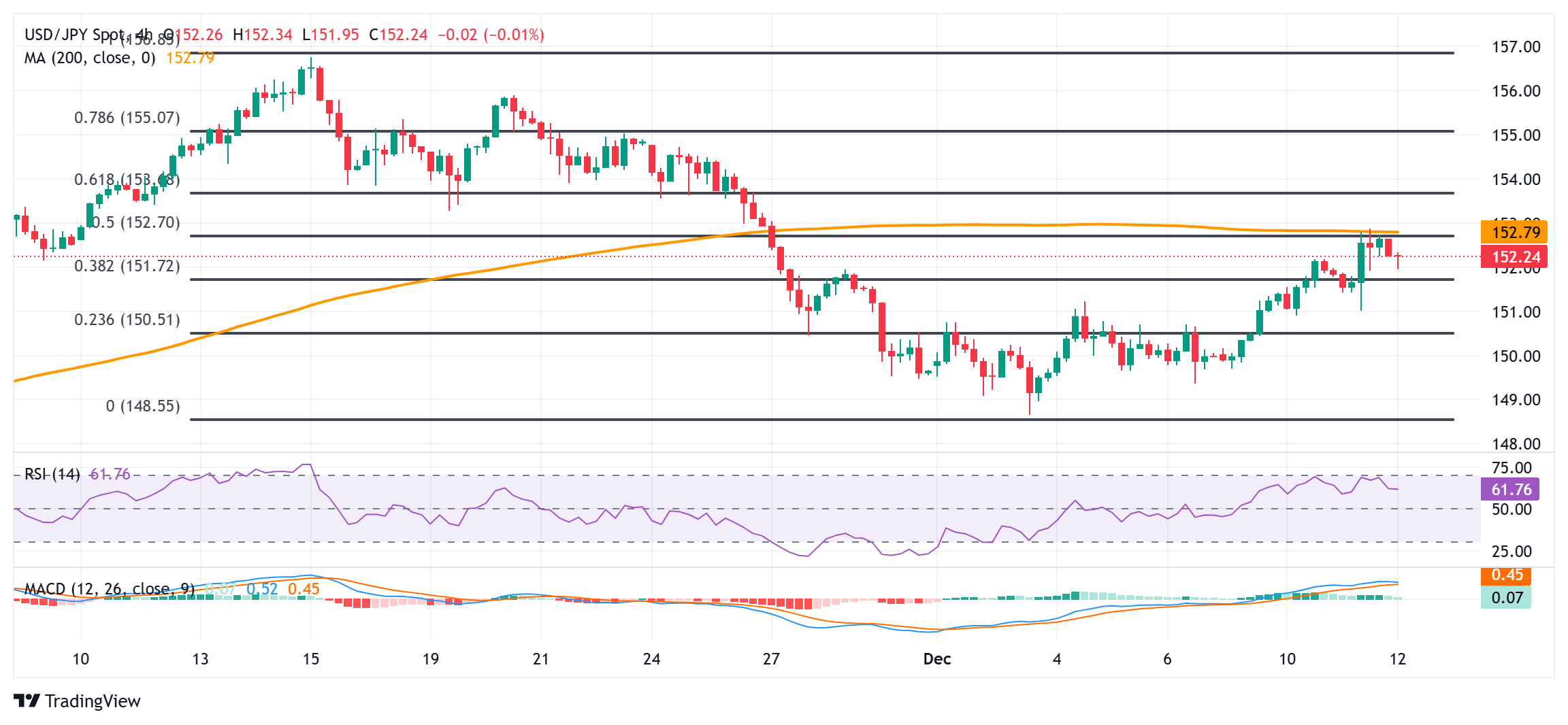
From a technical perspective, the overnight breakout through the 200-day Simple Moving Average (SMA), around the 152.00 mark, was seen as a fresh trigger for bullish traders. Moreover, oscillators on the daily chart are holding comfortably in the positive territory and are still away from being in the overbought zone, suggesting that the path of least resistance for the USD/JPY pair remains to the upside.
The subsequent move up, however, stalls near the 152.70-152.80 confluence, comprising the 200-period SMA on the 4-hour chart and the 50% retracement level of the recent pullback from the multi-month high. The said area might continue to act as an immediate hurdle, above which the USD/JPY pair could surpass the 153.00 mark and aim to test the next relevant hurdle near the 153.65 region, or the 61.8% Fibonacci retracement level.
On the flip side, weakness below the 152.00 mark might now find some support near the 151.75 area, or the 38.2% Fibo. level. Any further slide might continue to attract fresh buyers and remain limited near the 151.00 round figure. The latter should act as a key pivotal point, below which the USD/JPY pair could slide to the 150.50 intermediate support before eventually dropping to the 150.00 psychological mark.
Economic Indicator
Producer Price Index (YoY)
The Producer Price Index released by the Bureau of Labor statistics, Department of Labor measures the average changes in prices in primary markets of the US by producers of commodities in all states of processing. Changes in the PPI are widely followed as an indicator of commodity inflation. Generally speaking, a high reading is seen as positive (or bullish) for the USD, whereas a low reading is seen as negative (or bearish).
Read more.Next release: Thu Dec 12, 2024 13:30
Frequency: Monthly
Consensus: 2.6%
Previous: 2.4%
Source: US Bureau of Labor Statistics
Author

Haresh Menghani
FXStreet
Haresh Menghani is a detail-oriented professional with 10+ years of extensive experience in analysing the global financial markets.
















