Japanese Yen bears not ready to give up amid doubts over BoJ's rate-hike plan
- The Japanese Yen drops to a fresh monthly low against the USD on Friday.
- Fading hopes for a December BoJ rate hike continue to undermine the JPY.
- Elevated US bond yields offer support to the USD and the USD/JPY pair.

The Japanese Yen (JPY) trims a part of intraday losses against its American counterpart and recovers slightly from over a two-week low touched earlier this Friday. A slight deterioration in the global risk sentiment, along with geopolitical tensions and trade war fears, drives some haven flows and benefits the JPY. The US Dollar (USD), on the other hand, consolidates its weekly gains to the monthly peak and further contributes to capping any further appreciating move for the USD/JPY pair beyond the 153.00 mark.
That said, the growing market conviction that the Bank of Japan (BoJ) will not raise interest rates at its upcoming policy meeting next week might hold back the JPY bulls from placing aggressive bets. Furthermore, elevated US Treasury bond yields, bolstered by expectations that the Federal Reserve (Fed) will adopt a cautious stance on cutting rates, should act as a headwind for the lower-yielding JPY. Investors might also opt to move to the sidelines ahead of the FOMC and the BoJ policy meetings next week.
Japanese Yen draws support from cautious mood as focus shifts to FOMC/BoJ meetings next week
- The Bank of Japan's quarterly Tankan survey showed on Friday that the headline index measuring big manufacturers' business confidence rose to +14 during the September-December period, marking the highest reading since March 2022. Furthermore, firms expect inflation to rise 2.4% a year from now.
- Expectations that consumer prices in Japan will remain above the BoJ's 2% target, along with a moderately expanding economy and a rise in wages by the fastest rate since November 1992, give the BoJ another reason to hike interest rates. That said, media reports suggested that the BoJ may skip a rate hike this month.
- Reuters, citing sources familiar with the Bank of Japan's thinking, reported on Thursday that the central bank is leaning toward keeping interest rates steady next week. The report added that policymakers prefer to spend more time scrutinising overseas risks and clues on next year's wage outlook.
- A Bloomberg report on Wednesday said that BoJ officials see little cost to waiting before raising interest rates while still being open to a hike next week depending on data and market developments. This, along with mixed signals from BoJ officials, adds to uncertainty over the December policy decision.
- BoJ Governor Kazuo Ueda recently said that the timing of the next rate hike was approaching. In contrast, BoJ's dovish board member, Toyoaki Nakamura said that the central bank must move cautiously in raising rates. This continues to weigh on the Japanese Yen and lifts the USD/JPY pair to over a two-week high.
- The US Bureau of Labor Statistics reported on Thursday that the headline Producer Price Index (PPI) rose 0.4% in November, from the previous month's upwardly revised 0.3% gain. Moreover, the yearly rate accelerated from the 2.6% increase recorded in October to 3% during the reported month.
- The annual core PPI rose 0.2% in November and stood at 3.4% compared to the same time period last year, beating estimates. This comes on top of the US consumer inflation figures on Wednesday and signals that the progress in lowering inflation toward the Federal Reserve's 2% target has stalled.
- This might force the Fed to adopt a more cautious stance and point to fewer rate cuts coming at a slower pace than previously anticipated. This remains supportive of a further rise in the US Treasury bond yields high, pushing the US Dollar to a fresh monthly peak and also weighing on the lower-yielding JPY.
- The market attention now shifts to the key central bank event risks next week – the outcome of the highly-anticipated two-day FOMC monetary policy meeting and the crucial BoJ decision. In the meantime, traders might opt to move to the sidelines and refrain from placing aggressive directional bets.
USD/JPY is likely to attract some dip-buying and find decent support near the 152.00 round figure
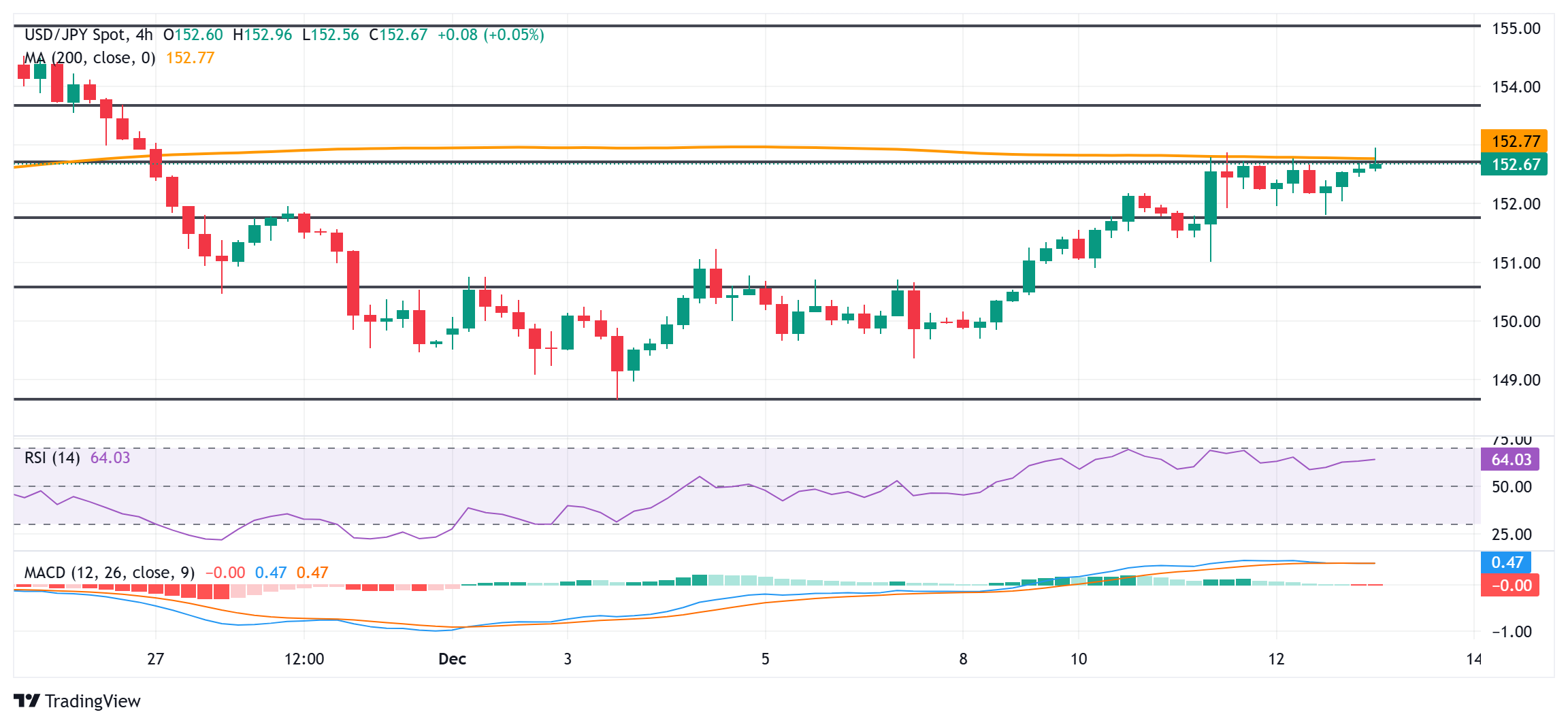
From a technical perspective, the lack of follow-through buying beyond the 152.70-152.80 confluence warrants some caution for bullish traders. The said area comprises the 200-period Simple Moving Average (SMA) on the 4-hour chart and the 50% retracement level of the recent pullback from the multi-month high. Given that oscillators on daily/4-hour charts are holding in positive territory, a sustained strength beyond could lift the USD/JPY pair to the 153.00 mark en route to the 153.65 region, or the 61.8% Fibonacci retracement level. The momentum could extend further and allow spot prices to reclaim the 154.00 mark.
On the flip side, weakness below the 152.00 mark might continue to find some support near the 151.75 area or the 38.2% Fibo. level. The said area nears the overnight swing low and should now act as a key pivotal point. Some follow-through selling could make the USD/JPY pair vulnerable to weaken further below the 151.00 round figure, towards the 150.50 intermediate support before eventually dropping to the 150.00 psychological mark.
Risk sentiment FAQs
In the world of financial jargon the two widely used terms “risk-on” and “risk off'' refer to the level of risk that investors are willing to stomach during the period referenced. In a “risk-on” market, investors are optimistic about the future and more willing to buy risky assets. In a “risk-off” market investors start to ‘play it safe’ because they are worried about the future, and therefore buy less risky assets that are more certain of bringing a return, even if it is relatively modest.
Typically, during periods of “risk-on”, stock markets will rise, most commodities – except Gold – will also gain in value, since they benefit from a positive growth outlook. The currencies of nations that are heavy commodity exporters strengthen because of increased demand, and Cryptocurrencies rise. In a “risk-off” market, Bonds go up – especially major government Bonds – Gold shines, and safe-haven currencies such as the Japanese Yen, Swiss Franc and US Dollar all benefit.
The Australian Dollar (AUD), the Canadian Dollar (CAD), the New Zealand Dollar (NZD) and minor FX like the Ruble (RUB) and the South African Rand (ZAR), all tend to rise in markets that are “risk-on”. This is because the economies of these currencies are heavily reliant on commodity exports for growth, and commodities tend to rise in price during risk-on periods. This is because investors foresee greater demand for raw materials in the future due to heightened economic activity.
The major currencies that tend to rise during periods of “risk-off” are the US Dollar (USD), the Japanese Yen (JPY) and the Swiss Franc (CHF). The US Dollar, because it is the world’s reserve currency, and because in times of crisis investors buy US government debt, which is seen as safe because the largest economy in the world is unlikely to default. The Yen, from increased demand for Japanese government bonds, because a high proportion are held by domestic investors who are unlikely to dump them – even in a crisis. The Swiss Franc, because strict Swiss banking laws offer investors enhanced capital protection.
Author

Haresh Menghani
FXStreet
Haresh Menghani is a detail-oriented professional with 10+ years of extensive experience in analysing the global financial markets.

















