Japanese Yen flirts with a break of 161.00, strengthening against the Greenback
- The Japanese Yen gains against the Greenback while US markets are closed.
- 30-year bond auction went smoothly despite concerns about the end of bond buying.
- The US Dollar Index took a hit on easing US economic data and traders softer, just above 105.00

The Japanese Yen (JPY) strengthens to around 161.00 against the US Dollar (USD) on Thursday while the US markets are closed for a public holiday. The move comes after a 30-year sovereign Japanese bond auction went extremely smoothly, while markets were concerned the government would have issues allocating it, with traders still concerned about the Bank of Japan (BoJ) ending its bond-buying program. Some positive news thus for the Japanese Yen which is trading higher against the US Dollar.
Meanwhile, the US Dollar Index (DXY) – which gauges the value of the US Dollar against a basket of six foreign currencies – took a hit on Wednesday with a very packed economic data calendar.. The main takeaway from all data was that nearly every data point came in a softer or below consensus view, which points to the US economy starting to slow down.
Daily digest market movers: Policy tweaking
- Bloomberg reports on a piece from RBC BlueBay Asset Management that sees a risk that the Bank of Japan could announce a bigger reduction in its bond purchases than markets expect. Add in there another rate hike, and a double whammy of hawkish forces could trigger a firmly higher Japanese Yen.
- Swap traders see swap rates on forward contracts swing higher, pointing to a higher possibility for another rate hike on July 31. The surge in swap points started on June 18, when Governor Kazuo Ueda alluded that another rate hike is in the cards.
- Equities are in the green across the board, led by the Japanese Topix and Nikkei 225, which both closed just below 1%. European and US equities are doing well despite lower volumes out of the US.
- The CME Fedwatch Tool is broadly backing a rate cut in September despite recent comments from Fed officials. The odds now stand at 67.3% for a 25-basis-point cut. A rate pause stands at a 26.5% chance, while a 50-basis-point rate cut has a slim 6.2% possibility.
- The Overnight indexed Swap curve for Japan shows a 48.2% chance of a rate hike on July 31, and a smaller 39.8% chance for a hike on September 20.
- The US 10-year benchmark rate trades at the lower end of this week’s range near 4.36%, and will remain there as the US bond markets are closed on Thursday.
- The benchmark 10-year Japan Treasury Note (JGB) trades around 1.08%, easing from the daily high of 1.097%.
USD/JPY Technical Analysis: BoJ helps out
The USD/JPY still has that sword of Damocles hanging over it, with that possible intervention from the Japanese Ministry of Finance. However, the research paper Bloomberg picked up from RBC might be an alternative approach. Should the Bank of Japan announce that it is hiking interest rates, while trimming or even completely closing down its bond buying program, markets would go cold-turkey on the double hawkish intervention. JPY would rally firmly across the board while yields would be spiking higher, and would see USD/JPY fall through the floor.
With the Relative Strength Index (RSI) now firmly overbought in the daily chart, a correction looks to be imminent. First support at 160.32 would already be a key level. Should that level breaks, a nosedive move would be inevitable with USD/JPY heading to either 157.03 (55-day Simple Moving Average) or the 100-day SMA at 154.26.
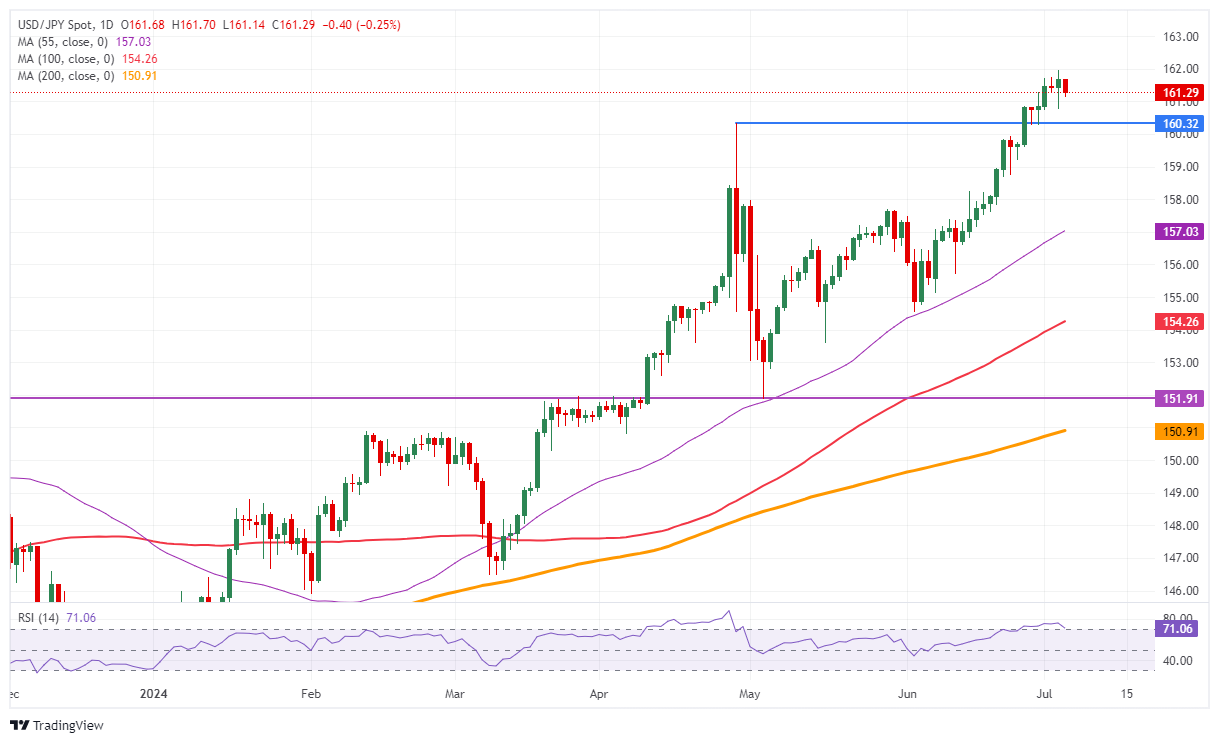
USD/JPY Daily Chart
Central banks FAQs
Central Banks have a key mandate which is making sure that there is price stability in a country or region. Economies are constantly facing inflation or deflation when prices for certain goods and services are fluctuating. Constant rising prices for the same goods means inflation, constant lowered prices for the same goods means deflation. It is the task of the central bank to keep the demand in line by tweaking its policy rate. For the biggest central banks like the US Federal Reserve (Fed), the European Central Bank (ECB) or the Bank of England (BoE), the mandate is to keep inflation close to 2%.
A central bank has one important tool at its disposal to get inflation higher or lower, and that is by tweaking its benchmark policy rate, commonly known as interest rate. On pre-communicated moments, the central bank will issue a statement with its policy rate and provide additional reasoning on why it is either remaining or changing (cutting or hiking) it. Local banks will adjust their savings and lending rates accordingly, which in turn will make it either harder or easier for people to earn on their savings or for companies to take out loans and make investments in their businesses. When the central bank hikes interest rates substantially, this is called monetary tightening. When it is cutting its benchmark rate, it is called monetary easing.
A central bank is often politically independent. Members of the central bank policy board are passing through a series of panels and hearings before being appointed to a policy board seat. Each member in that board often has a certain conviction on how the central bank should control inflation and the subsequent monetary policy. Members that want a very loose monetary policy, with low rates and cheap lending, to boost the economy substantially while being content to see inflation slightly above 2%, are called ‘doves’. Members that rather want to see higher rates to reward savings and want to keep a lit on inflation at all time are called ‘hawks’ and will not rest until inflation is at or just below 2%.
Normally, there is a chairman or president who leads each meeting, needs to create a consensus between the hawks or doves and has his or her final say when it would come down to a vote split to avoid a 50-50 tie on whether the current policy should be adjusted. The chairman will deliver speeches which often can be followed live, where the current monetary stance and outlook is being communicated. A central bank will try to push forward its monetary policy without triggering violent swings in rates, equities, or its currency. All members of the central bank will channel their stance toward the markets in advance of a policy meeting event. A few days before a policy meeting takes place until the new policy has been communicated, members are forbidden to talk publicly. This is called the blackout period.
Author

Filip Lagaart
FXStreet
Filip Lagaart is a former sales/trader with over 15 years of financial markets expertise under its belt.