Japanese Yen trims a part of intraday gains amid BoJ uncertainty, ahead of US CPI report
- The Japanese Yen strengthens slightly following the release of stronger PPI print from Japan.
- The uncertainty over how soon the BoJ could raise rates keeps the JPY bulls on the defensive.
- The USD preserves its recent gains and lends support to USD/JPY ahead of the US CPI report.


The Japanese Yen (JPY) sticks to modest intraday gains heading into the European session on Wednesday, though it lacks bullish conviction amid scepticism regarding the Bank of Japan's (BoJ) intention to hike interest rates again in December. Apart from this, a further recovery in the US Treasury bond yields contributes to capping the upside for the lower-yielding JPY.
Meanwhile, a stronger Producer Price Index (PPI) from Japan keeps the door open for further policy tightening by the BoJ. This, along with geopolitical risks and concerns about US President-elect Donald Trump's tariff plans, underpins the safe-haven JPY. Furthermore, subdued US Dollar (USD) price action keeps the USD/JPY pair depressed around the 151.65 region.
Investors now look forward to the release of the latest US consumer inflation figures, which might offer cues about the Fed's rate-cut path. This, in turn, will play a key role in influencing the USD and provide a fresh impetus to the USD/JPY pair. The market attention will then shift to next week's key central bank event risks – the FOMC and the BoJ policy meetings.
Japanese Yen struggles to capitalize on stronger PPI-inspired gains
- A preliminary report by the Bank of Japan revealed this Wednesday that Japan's Producer Price Index (PPI) increased by 0.3% in November and rose by 3.7% compared to the same time period last year.
- This comes on top of last Friday's wage growth figures, which showed that October base pay grew 2.7% YoY, or the fastest rate since November 1992 and gives the BoJ another reason to hike interest rates.
- Moreover, BoJ Governor Kazuo Ueda recently said that the timing of the next rate hike was approaching, though some media reports suggested the central bank may skip a rate hike later this month.
- Furthermore, BoJ's more dovish board member Toyoaki Nakamura said last week that the central bank must move cautiously in raising rates, fueling uncertainty about the BoJ’s December policy decision.
- The US Treasury bond yields ended at their highest levels in at least a week on Tuesday on the back of growing acceptance that the Federal Reserve will adopt a cautious stance on cutting interest rates.
- The US Dollar preserves its gains registered over the past three days and offers some support to the USD/JPY pair as traders keenly await the release of the latest US consumer inflation figures later today.
- The headline US Consumer Price Index (CPI) is expected to increase to 0.3% in November as compared to 0.2% in the previous month and rise to 2.7% on a year-over-year basis from 2.6% in October.
- Meanwhile, the core gauge (excluding food and energy prices) is forecast to remain unchanged at 0.3% for November and at a 3.3% YoY rate, raising concern over lingering inflationary pressures.
- The data won’t necessarily derail expectations for a rate cut by the Fed at next week’s meeting, though would suggest fewer rate cuts coming at a slower pace than many had been anticipating.
USD/JPY bulls await move beyond 152.00 before placing fresh bets
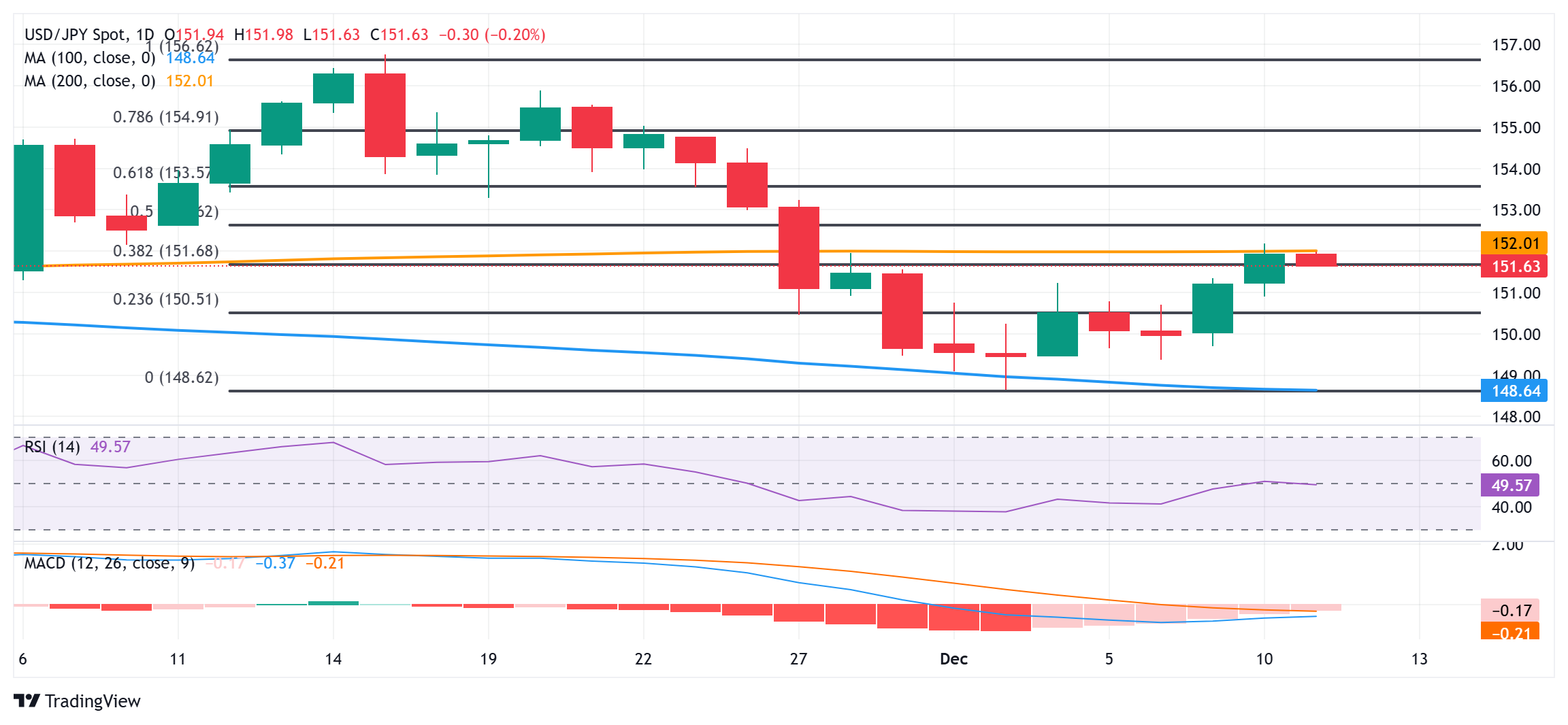
The overnight failure to find acceptance above the 152.00 mark, which coincides with the 200-day Simple Moving Average (SMA), warrants caution for bulls. Moreover, neutral oscillators on the daily chart make it prudent to wait for a sustained strength beyond the said barrier before positioning for an extension of the recent bounce from a near two-month low. The USD/JPY pair might then climb to the 152.70-152.75 region, or the 50% retracement level of the downfall from a multi-month top touched in November. This is followed by the 153.00 round figure, above which spot prices could extend the momentum towards the 61.8% Fibonacci level, around the 153.70 area.
On the flip side, weakness below the 151.55-151.50 region could be seen as a buying opportunity and find decent support near the 151.00 mark. Some follow-through selling, however, might expose the 150.00 psychological mark, with some intermediate support near the 23.6% Fibo. level, around the 150.50 area. Failure to defend the said support levels could drag the USD/JPY pair back towards the 149.55-149.50 region en route to the 149.00 round figure and 148.65 zone, or the lowest level since October 11 touched last week.
Economic Indicator
Consumer Price Index (YoY)
Inflationary or deflationary tendencies are measured by periodically summing the prices of a basket of representative goods and services and presenting the data as The Consumer Price Index (CPI). CPI data is compiled on a monthly basis and released by the US Department of Labor Statistics. The YoY reading compares the prices of goods in the reference month to the same month a year earlier.The CPI is a key indicator to measure inflation and changes in purchasing trends. Generally speaking, a high reading is seen as bullish for the US Dollar (USD), while a low reading is seen as bearish.
Read more.Next release: Wed Dec 11, 2024 13:30
Frequency: Monthly
Consensus: 2.7%
Previous: 2.6%
Source: US Bureau of Labor Statistics
The US Federal Reserve has a dual mandate of maintaining price stability and maximum employment. According to such mandate, inflation should be at around 2% YoY and has become the weakest pillar of the central bank’s directive ever since the world suffered a pandemic, which extends to these days. Price pressures keep rising amid supply-chain issues and bottlenecks, with the Consumer Price Index (CPI) hanging at multi-decade highs. The Fed has already taken measures to tame inflation and is expected to maintain an aggressive stance in the foreseeable future.
Author
Haresh Menghani
FXStreet
Haresh Menghani is a detail-oriented professional with 10+ years of extensive experience in analysing the global financial markets.