Japanese Yen bears turn cautious ahead of this week's central bank event risks
- The Japanese Yen drifts lower against its American counterpart for the sixth straight day.
- Expectations that the BoJ will keep rates steady this week continue to weigh on the JPY.
- Elevated US bond yields contribute to driving flows away from the lower-yielding JPY.

The Japanese Yen (JPY) bounces off after touching a three-week low against its American counterpart during the Asian session on Monday, though any meaningful recovery seems elusive. Investors now seem convinced that the Bank of Japan (BoJ) will not raise interest rates later this week, which has been a key factor undermining the JPY over the past week or so. Furthermore, bets for a less dovish Federal Reserve (Fed) remain supportive of elevated US Treasury bond yields and should contribute to capping the upside for the lower-yielding JPY.
Meanwhile, the JPY bulls failed to gain any respite from the better-than-expected release of Core Machinery Orders and flash Manufacturing PMI from Japan earlier today. That said, persistent geopolitical risks and concerns about US President-elect Donald Trump's tariff plans could offer some support to the safe-haven JPY. Apart from this, a softer US Dollar (USD), led by a modest pullback in the US bond yields, contributes to keeping a lid on the USD/JPY pair. Traders also seem reluctant ahead of the crucial Fed/BoJ policy meetings this week.
Japanese Yen remains on the back foot amid doubts over BoJ's rate-hike plan
- Government data released earlier this Monday showed that Japan's core machinery orders rose 2.1% in October and registered a strong growth of 5.6% on a year-on-year basis.
- The au Jibun Bank Japan Manufacturing Purchasing Managers’ Index (PMI) improved to 49.5 in December, though remained in contraction territory for the seventh straight month.
- Meanwhile, the gauge for the services sector rose to 51.4 in December from 50.5, while the composite PMI stood at 50.8 during the reported month, up from 50.1 in November.
- This comes after the Bank of Japan's Tankan survey showed on Friday that business confidence at Japan's large manufacturers improved during the three months to December.
- Moreover, expectations that consumer prices in Japan will remain above the BoJ's 2% target, a moderately expanding economy and a rise in wages give the BoJ reason to hike rates.
- Investors, however, remain sceptical regarding the BoJ's intention to tighten its monetary policy further, which continues to exert downward pressure on the Japanese Yen on Monday.
- The yield on the benchmark 10-year US government bond rose to a three-week high on Friday amid rising bets that the Federal Reserve will adopt a cautious stance on cutting rates.
- According to the CME Group's FedWatch Tool, traders are pricing in over a 93% chance that the US central bank will lower borrowing costs again, by 25 basis points on Wednesday.
- However, signs that the progress in lowering inflation toward the US central bank's 2% target has stalled raised the possibility of a slower pace of interest rate reductions next year.
- Monday's US economic docket features the release of the flash Manufacturing and Services PMIs, along with the Empire State Manufacturing Index, later during the US session.
- That said, the market focus remains glued to the crucial FOMC and the BoJ meetings this week, which will help in determining the near-term trajectory for the USD/JPY pair.
USD/JPY bulls await sustained move beyond 154.00 before placing fresh bets
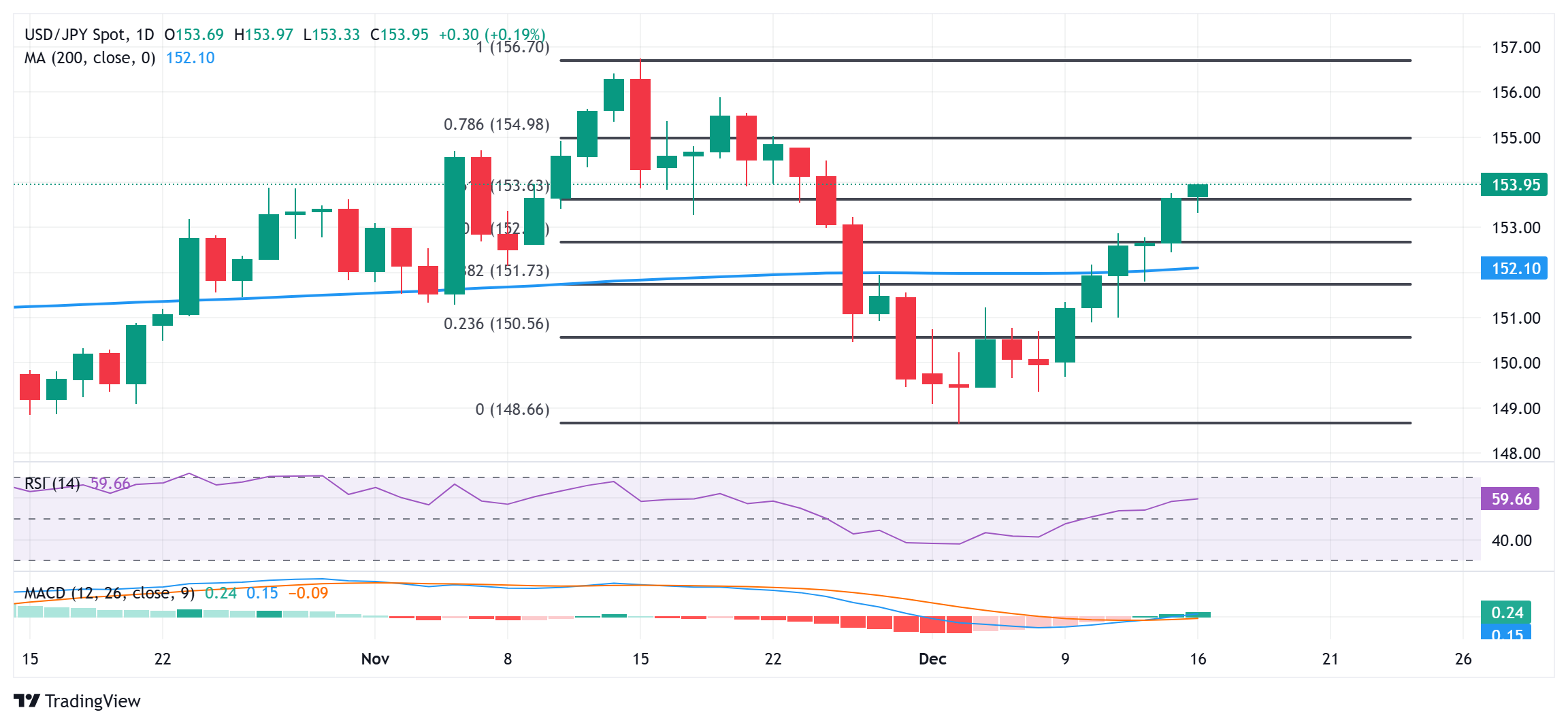
From a technical perspective, a sustained move and acceptance above the 61.8% Fibonacci retracement level of the November-December fall from a multi-month peak could be seen as a fresh trigger for bulls. Moreover, oscillators on the daily chart have just started gaining positive traction and suggest that the path of least resistance for the USD/JPY pair remains to the upside. Hence, some follow-through strength towards the next relevant hurdle, around the 154.55 region, en route to the 155.00 psychological mark, looks like a distinct possibility.
On the flip side, the Asian session low, around the 153.35-153.30 area, now seems to act as an immediate strong support ahead of the 153.00 mark. A convincing break below the latter might expose the very important 200-day Simple Moving Average (SMA) pivotal support near the 152.10-152.00 region. A convincing break below the latter might shift the bias in favor of bearish traders and drag the USD/JPY pair towards the 151.00 round figure en route to the 150.00 psychological mark.
Economic Indicator
Fed Interest Rate Decision
The Federal Reserve (Fed) deliberates on monetary policy and makes a decision on interest rates at eight pre-scheduled meetings per year. It has two mandates: to keep inflation at 2%, and to maintain full employment. Its main tool for achieving this is by setting interest rates – both at which it lends to banks and banks lend to each other. If it decides to hike rates, the US Dollar (USD) tends to strengthen as it attracts more foreign capital inflows. If it cuts rates, it tends to weaken the USD as capital drains out to countries offering higher returns. If rates are left unchanged, attention turns to the tone of the Federal Open Market Committee (FOMC) statement, and whether it is hawkish (expectant of higher future interest rates), or dovish (expectant of lower future rates).
Read more.Next release: Wed Dec 18, 2024 19:00
Frequency: Irregular
Consensus: 4.5%
Previous: 4.75%
Source: Federal Reserve
Author

Haresh Menghani
FXStreet
Haresh Menghani is a detail-oriented professional with 10+ years of extensive experience in analysing the global financial markets.

















