Gold stays bid during start of Powell testimony
- Gold trades higher despite Fed Chairman Powell's hawkish testimony to the Senate on Tuesday.
- The yellow metal sold off on Monday following the news the PBoC had stopped purchasing Gold for the second month in a row.
- The PBoC is one of the largest consumers of the precious metal and for 18 consecutive months until May accumulated Gold.

Gold (XAU/USD) is trading higher in the $2,360s on Tuesday – stabilizing after the heavy sell-off on Monday. The precious metal remains bid despite the hawkish start to Federal Reserve (Fed) Chairman Jerome Powell's testimony to the Senate Banking Committee on Tuesday. Powell said the Fed had no plans to cut interest rates yet and would be adopting a data-dependent approach, deciding on a "meeting-by-meeting basis" whether or not to cut interest rates.
Powell's commetnary strengthened the US Dollar but did not weigh too heavily on Gold despite promising higher interest rates for longer. Gold tends not to perform so well when interest rates are expected to remain elevated as it raises the opportunity cost of holding the precious metal.
Gold’s weakness at the start of the week came after the news that the People’s Bank of China (PBoC), one of the largest consumers of Gold in the world, had not bought any Gold for the second month in a row in June, after 18 consecutive months of reserve-building, according to data from the PBoC.
Gold declines on impact of Trump on bond markets
Gold has weakened recently as a result of the US Treasury bond market absorbing political risk from an increased chance that former President Donald Trump will win the US presidential election in November.
If Trump wins the presidency, he is expected to cut taxes and borrow, leading to a worsening fiscal position for the US. Critics say his fiscal profligacy will lead to higher inflation, which in turn will keep interest rates high. Gold is falling because it is a non-interest-bearing asset that becomes less attractive to investors when interest rates are high.
The possibility of a Trump presidency is pushing bond prices down and bond yields up, benefiting the US Dollar (USD) because of its high correlation with yields. This, in turn, weighs on the Gold price, which is primarily bought and sold in USD.
After a recent televised debate in Atlanta, in which President Biden struggled to answer several of the questions, critics raised doubts about his cognitive capacity given his advanced years and possible dementia. The upshot is that Trump has increased his lead in opinion polls. Additionally, if Biden steps down, his number two, Kamala Harris, is seen as unlikely to have Biden’s broad appeal.
Trump’s presidential challenge has further gained credibility after the US Supreme Court decided he had partial immunity from any responsibility for the uprising that followed his defeat at the 2020 election and led to his supporters storming Capitol Hill. Prior to the ruling, it was thought Trump’s various indictments might disrupt his campaign or prevent him from taking office.
Technical Analysis: Gold forms a two-bar reversal
Gold has formed a two-bar reversal pattern (green shaded rectangle) after climbing to a major resistance level at the June 7 high at $2,388. This pattern forms after a long green-up day is followed by a long red-down day of a similar length and size. When this occurs at a market top, it can be a short-term reversal sign.
XAU/USD Daily Chart
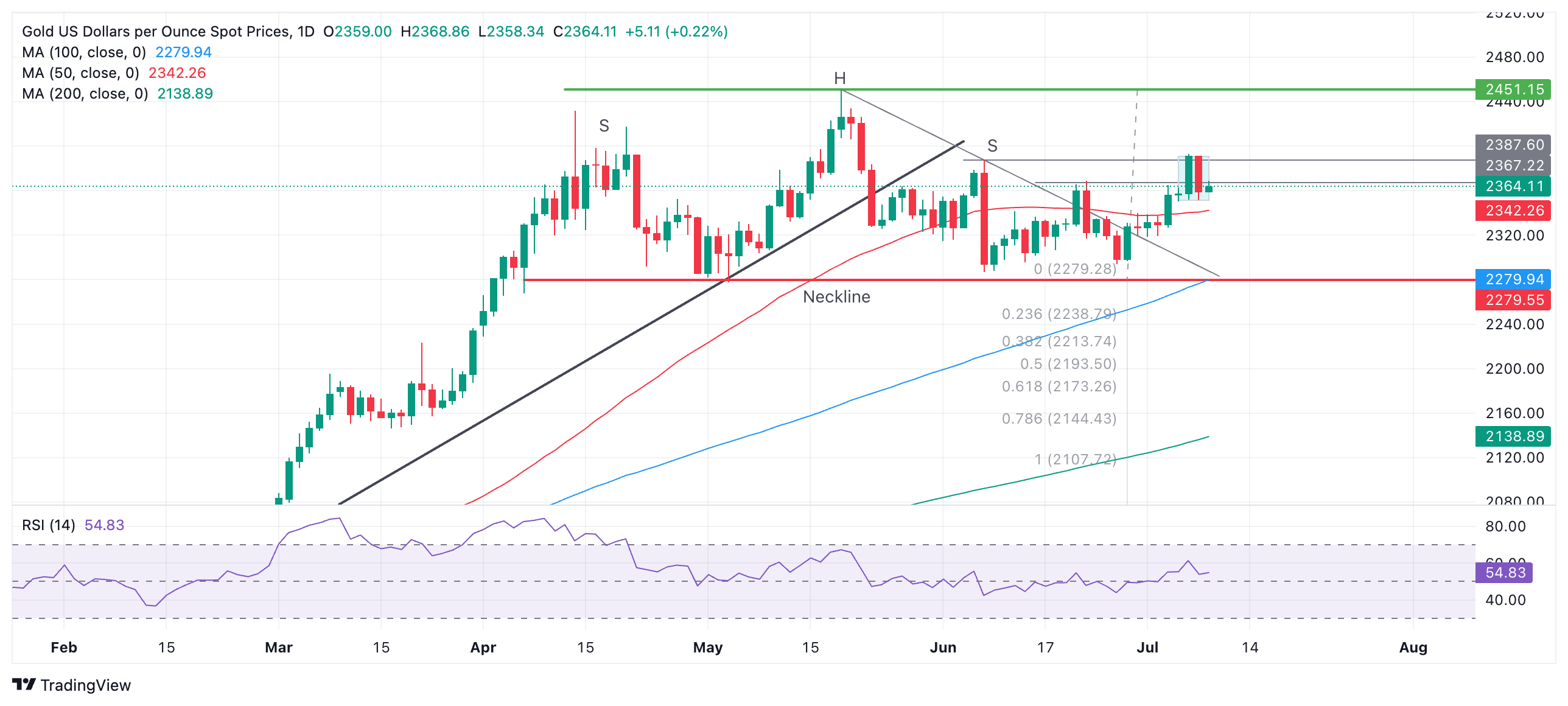
The outlook is unclear, but Gold could pull back now, perhaps falling to the 50-day Simple Moving Average (SMA) at $2,342.
If Gold can break above Friday’s peak of $2,393, it will continue the sequence of higher highs and probably unlock the next target at the $2,451 all-time high.
The bearish Head & Shoulders topping pattern that formed from April to June has been invalidated by the recent recovery. However, there is still a chance – albeit much reduced – that a more complex topping pattern may have formed instead.
If a complex pattern has formed in place of the H&S, and the price breaks below the pattern’s neckline at $2,279, a reversal lower may still be possible with a conservative target at $2,171, the 0.618 ratio of the height of the pattern extrapolated lower.
The trend is now sideways in both the short and medium term. In the long term, Gold remains in an uptrend.
Gold FAQs
Gold has played a key role in human’s history as it has been widely used as a store of value and medium of exchange. Currently, apart from its shine and usage for jewelry, the precious metal is widely seen as a safe-haven asset, meaning that it is considered a good investment during turbulent times. Gold is also widely seen as a hedge against inflation and against depreciating currencies as it doesn’t rely on any specific issuer or government.
Central banks are the biggest Gold holders. In their aim to support their currencies in turbulent times, central banks tend to diversify their reserves and buy Gold to improve the perceived strength of the economy and the currency. High Gold reserves can be a source of trust for a country’s solvency. Central banks added 1,136 tonnes of Gold worth around $70 billion to their reserves in 2022, according to data from the World Gold Council. This is the highest yearly purchase since records began. Central banks from emerging economies such as China, India and Turkey are quickly increasing their Gold reserves.
Gold has an inverse correlation with the US Dollar and US Treasuries, which are both major reserve and safe-haven assets. When the Dollar depreciates, Gold tends to rise, enabling investors and central banks to diversify their assets in turbulent times. Gold is also inversely correlated with risk assets. A rally in the stock market tends to weaken Gold price, while sell-offs in riskier markets tend to favor the precious metal.
The price can move due to a wide range of factors. Geopolitical instability or fears of a deep recession can quickly make Gold price escalate due to its safe-haven status. As a yield-less asset, Gold tends to rise with lower interest rates, while higher cost of money usually weighs down on the yellow metal. Still, most moves depend on how the US Dollar (USD) behaves as the asset is priced in dollars (XAU/USD). A strong Dollar tends to keep the price of Gold controlled, whereas a weaker Dollar is likely to push Gold prices up.
Author

Joaquin Monfort
FXStreet
Joaquin Monfort is a financial writer and analyst with over 10 years experience writing about financial markets and alt data. He holds a degree in Anthropology from London University and a Diploma in Technical analysis.