Jerome Powell Speech: Chairman testifies before House Financial Services Committee
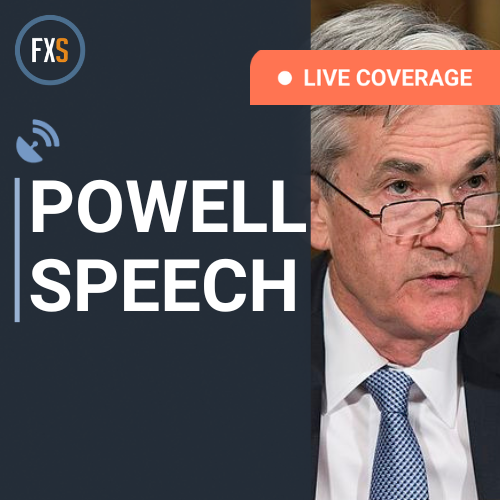
Jerome Powell, Chairman of the US Federal Reserve (Fed), delivers the Semi-Annual Monetary Policy Report and responds to questions before the House Financial Services Committee on the second day of his Congressional testimony.
On Tuesday, Powell appeared before the Senate Banking Committee and reiterated that it will not be appropriate to cut the policy rate until they gain greater confidence in inflation heading sustainably toward 2%. "The most recent labor market data sent a pretty clear signal that the labor market has cooled considerably," he added. According to the CME FedWatch Tool, the probability of the Fed leaving the policy rate unchanged in September stands at around 25% following this event.
Key highlights from Powell testimony before US Senate.
Fed FAQs
Monetary policy in the US is shaped by the Federal Reserve (Fed). The Fed has two mandates: to achieve price stability and foster full employment. Its primary tool to achieve these goals is by adjusting interest rates. When prices are rising too quickly and inflation is above the Fed’s 2% target, it raises interest rates, increasing borrowing costs throughout the economy. This results in a stronger US Dollar (USD) as it makes the US a more attractive place for international investors to park their money. When inflation falls below 2% or the Unemployment Rate is too high, the Fed may lower interest rates to encourage borrowing, which weighs on the Greenback.
The Federal Reserve (Fed) holds eight policy meetings a year, where the Federal Open Market Committee (FOMC) assesses economic conditions and makes monetary policy decisions. The FOMC is attended by twelve Fed officials – the seven members of the Board of Governors, the president of the Federal Reserve Bank of New York, and four of the remaining eleven regional Reserve Bank presidents, who serve one-year terms on a rotating basis.
In extreme situations, the Federal Reserve may resort to a policy named Quantitative Easing (QE). QE is the process by which the Fed substantially increases the flow of credit in a stuck financial system. It is a non-standard policy measure used during crises or when inflation is extremely low. It was the Fed’s weapon of choice during the Great Financial Crisis in 2008. It involves the Fed printing more Dollars and using them to buy high grade bonds from financial institutions. QE usually weakens the US Dollar.
Quantitative tightening (QT) is the reverse process of QE, whereby the Federal Reserve stops buying bonds from financial institutions and does not reinvest the principal from the bonds it holds maturing, to purchase new bonds. It is usually positive for the value of the US Dollar.
This section below was published as a preview of Fed Chairman Powell's Congressional testimony at 09:00 GMT on Tuesday, July 9.
- Jerome Powell’s testimony in the US Congress will be a top-tier market-moving event this week.
- New clues on the Federal Reserve interest rate path are awaited.
- US Dollar, stock markets, and other asset classes could see big swings with the Fed Chair’s words.
Jerome Powell, Chairman of the US Federal Reserve (Fed), will deliver the Semi-Annual Monetary Policy Report and testify before the Senate Banking Committee on Tuesday. The hearing, entitled “The Semi-Annual Monetary Policy Report to the Congress,” will start at 14:00 GMT, and it will have the full attention of all financial market players.
Jerome Powell is expected to address the main takeaways of the Fed’s Semi-Annual Federal Reserve Monetary Policy Report, published last Friday. In that report, the Fed noted that they have seen modest further progress on inflation this year but added that they still need greater confidence before moving to rate cuts. "Labor supply and demand resembles period right before the pandemic, when the labor market was relatively tight but not overheated,” the publication read.
US representatives are expected to ask Powell about the interest rate path, inflation developments, and the economic growth outlook in a long Q&A session. However, they could focus on politics because of the upcoming November Presidential election, making it difficult for Powell to respond to questions.
The CME Group FedWatch Tool shows that markets price in only 25% probability that the Fed will leave the policy rate unchanged in September. The latest jobs report showed that US Nonfarm Payrolls (NFP) rose 206,000 in June. This reading came in above the market expectation of 190,000, but the US Bureau of Labor Statistics (BLS) announced that May’s NFP increase was revised down to 218,000 from 272,000. Additionally, the Unemployment Rate edged higher to 4.1% from 4%, while the annual wage inflation, as measured by the change in the Average Hourly Earnings, declined to 3.9% on a yearly basis from 4.1%.
In case Powell adopts an optimistic tone about the inflation outlook and acknowledges loosening conditions in the labor market, investors could remain optimistic about a September rate cut. The market positioning suggests that there is some room for further US Dollar (USD) weakness in this scenario. On the other hand, market participants could reassess the probability of a rate reduction in September and help the USD hold its ground if Powell downplays the gloomy labor market figures and remains cautious about the continuation of disinflation.
About Jerome Powell (via Federalreserve.gov)
"Jerome H. Powell first took office as Chair of the Board of Governors of the Federal Reserve System on February 5, 2018, for a four-year term. He was reappointed to the office and sworn in for a second four-year term on May 23, 2022. Mr. Powell also serves as Chairman of the Federal Open Market Committee, the System's principal monetary policymaking body. Mr. Powell has served as a member of the Board of Governors since taking office on May 25, 2012, to fill an unexpired term. He was reappointed to the Board and sworn in on June 16, 2014, for a term ending January 31, 2028."
Interest rates FAQs
Interest rates are charged by financial institutions on loans to borrowers and are paid as interest to savers and depositors. They are influenced by base lending rates, which are set by central banks in response to changes in the economy. Central banks normally have a mandate to ensure price stability, which in most cases means targeting a core inflation rate of around 2%. If inflation falls below target the central bank may cut base lending rates, with a view to stimulating lending and boosting the economy. If inflation rises substantially above 2% it normally results in the central bank raising base lending rates in an attempt to lower inflation.
Higher interest rates generally help strengthen a country’s currency as they make it a more attractive place for global investors to park their money.
Higher interest rates overall weigh on the price of Gold because they increase the opportunity cost of holding Gold instead of investing in an interest-bearing asset or placing cash in the bank. If interest rates are high that usually pushes up the price of the US Dollar (USD), and since Gold is priced in Dollars, this has the effect of lowering the price of Gold.
The Fed funds rate is the overnight rate at which US banks lend to each other. It is the oft-quoted headline rate set by the Federal Reserve at its FOMC meetings. It is set as a range, for example 4.75%-5.00%, though the upper limit (in that case 5.00%) is the quoted figure. Market expectations for future Fed funds rate are tracked by the CME FedWatch tool, which shapes how many financial markets behave in anticipation of future Federal Reserve monetary policy decisions.
Author

FXStreet Team
FXStreet
Composed of a group of economic journalists and FX experts, the FXStreet content team produces and oversees all content published on FXStreet. It provides a purely journalistic approach to the Forex market.
















