Gold rally stalls with awaited CPI release just around the corner
- Gold price sees gains limited for now, ahead of December CPI release.
- Tuesday's soft PPI release triggers disinflationary expectations for the upcoming CPI release.
- Gold could snap above $2,700 if CPI comes in very disinflationary.

Gold’s price (XAU/USD) trades flat for this week, despite a steep two-day rally above $2,680 on Wednesday, where softer-than-expected United States (US) Producer Price Index (PPI) release the previous day triggered substantial easing in US yields. Market expectations are now higher for a softer US Consumer Price Index (CPI) release this Wednesday as well. A softer reading would be beneficial for Gold to head higher.
On the economic data front, the US CPI release for December will draw all attention on Wednesday. After the surprise softer PPI print on Tuesday, market expectations are that both the monthly headline and core CPI gauges would soften from their previous readings. Later in the day, be on the lookout for comments from three Federal Reserve officials.
Daily digest market movers: CPI turns into live event
- President-elect Donald Trump did not comment or push back on the rumors that his administration would likely implement its tariff schemes in a very steady and gradual approach.
- The US 10-year benchmark rate falls to 4.757% at the time of writing on Wednesday, fading from its fresh 14-month high of 4.802% seen on Monday.
- The CME (Chicago Mercantile Exchange) Fedwatch tool currently shows that the Federal Reserve will keep rate expectations steady until its meeting on June 18, when odds of keeping rates unchanged at current levels stand at 43.6%, compared to 56.4% for lower rates.
- At 13:30 GMT, the US Consumer Price Index data for December will be released. The monthly core CPI measure is expected to rise 0.2% compared to 0.3% in the previous month. The monthly headline CPI reading is expected to increase steadily by 0.3%.
- At 14:00 GMT, Federal Reserve Bank of Chicago President Austan Goolsbee will discuss the economy at the Wisconsin Bankers Association 2025 Midwest Economic Forecast Forum.
- At 15:00 GMT, Minneapolis Fed President Neel Kashkari will give welcoming remarks and participate in a fireside chat with Jay Debertin, President and CEO of CHS, Inc., as part of the Minneapolis Fed’s 2025 Regional Economic Conditions Conference.
- At 16:00 GMT, Federal Reserve Bank of New York President John Williams delivers keynote remarks at the "CBIA Economic Summit and Outlook 2025" event organized by the Connecticut Business and Industry Association (CBIA) in Connecticut.
Technical Analysis: Watch out for volatility
Gold bulls have avoided re-entering the pennant chart formation and sent prices back above the descending trend line. From here on out, Bullion should be able to spring away now. This Wednesday’s CPI release would be ideal for pouring oil on the fire.
On the downside, the 55-day Simple Moving Average (SMA) at $2,648 is the first support. Further down, the 100-day SMA at $2,638 is the next in line. Ultimately, the ascending trend line at the lower boundary of the pennant should contain the price action from falling, standing at $2,618 for now.
On the upside, the October 23 low at $2,708 is the next pivotal level to watch. Once that level is cleared, though still quite far off, the all-time high of $2,790 is the key upside level.
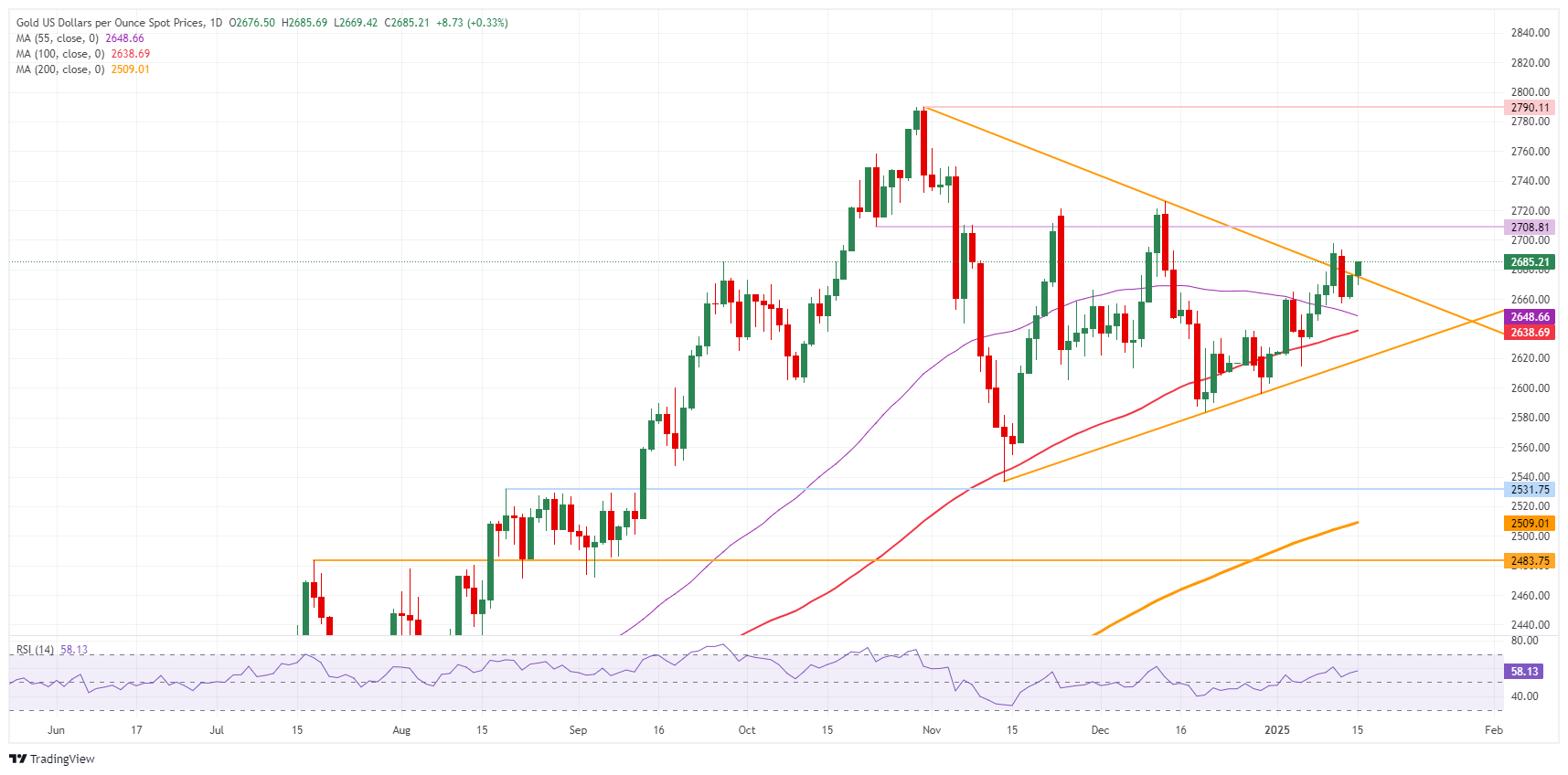
XAU/USD: Daily Chart
Inflation FAQs
Inflation measures the rise in the price of a representative basket of goods and services. Headline inflation is usually expressed as a percentage change on a month-on-month (MoM) and year-on-year (YoY) basis. Core inflation excludes more volatile elements such as food and fuel which can fluctuate because of geopolitical and seasonal factors. Core inflation is the figure economists focus on and is the level targeted by central banks, which are mandated to keep inflation at a manageable level, usually around 2%.
The Consumer Price Index (CPI) measures the change in prices of a basket of goods and services over a period of time. It is usually expressed as a percentage change on a month-on-month (MoM) and year-on-year (YoY) basis. Core CPI is the figure targeted by central banks as it excludes volatile food and fuel inputs. When Core CPI rises above 2% it usually results in higher interest rates and vice versa when it falls below 2%. Since higher interest rates are positive for a currency, higher inflation usually results in a stronger currency. The opposite is true when inflation falls.
Although it may seem counter-intuitive, high inflation in a country pushes up the value of its currency and vice versa for lower inflation. This is because the central bank will normally raise interest rates to combat the higher inflation, which attract more global capital inflows from investors looking for a lucrative place to park their money.
Formerly, Gold was the asset investors turned to in times of high inflation because it preserved its value, and whilst investors will often still buy Gold for its safe-haven properties in times of extreme market turmoil, this is not the case most of the time. This is because when inflation is high, central banks will put up interest rates to combat it. Higher interest rates are negative for Gold because they increase the opportunity-cost of holding Gold vis-a-vis an interest-bearing asset or placing the money in a cash deposit account. On the flipside, lower inflation tends to be positive for Gold as it brings interest rates down, making the bright metal a more viable investment alternative.
Author

Filip Lagaart
FXStreet
Filip Lagaart is a former sales/trader with over 15 years of financial markets expertise under its belt.














