Gold extends gains and prints a fresh two-month ahead of Trump's first full day in office
- Gold price extends gains and is on its way to have nearly 1% gains on Tuesday.
- Traders brace for the first full day in President Trump's presidency with headline risk elevated.
- Gold at a fresh two-month high at $2,732.70 and enters the area with $2,790 as firm resistance ahead.

Gold’s price (XAU/USD) is fueled by safe haven inflows and snaps above a pivotal technical resistance after US President Donald Trump confirmed he intends to impose 25% tariffs on Canada and Mexico as early as February, as well as tariffs on Silver and Gold. China was left out of the immediate levies being imposed, Bloomberg reported.
The possibility of Trump applying tariffs on Silver and Gold has caused market uncertainty, driving premiums for futures to elevated levels. President Trump's domestic agenda is the second main driver, which could extend Gold’s bullish momentum further and increase demand for haven assets. Meanwhile, bond yields took a nosedive to 4.527% in Asian trading on Tuesday after remaining closed on Monday for Martin Luther King Day.
Daily digest market movers: Watch out for a string of headlines
- Comments by President Donald Trump during the signing session of his first executive orders caught traders by surprise. During the session, Trump said tariffs for Canada and Mexico will already be implemented as soon as February. The market reaction was a knee-jerk fall in the Canadian Dollar (CAD) and Mexican Peso (MXN) due to the unexpected decision, as the Wall Street Journal had already published a story on Monday where tariffs were postponed until a task force was formed first, Bloomberg reports.
- President Trump confirmed that universal tariffs on all imports to the US are under consideration as well and will come at a later stage, Reuters reports.
- Saudi Arabia’s investment mining fund is set to buy a stake in Pakistan’s Reko Diq project, which will be one of the world’s largest Copper mines once complete, as the kingdom accelerates its expansion into the precious metal sector, the Financial Times reports.
- US yields are catching up with Monday’s turn of events after remaining closed on that same day due to Martin Luther King Day. The US 10-year benchmark sank to 4.527% before rebounding at the start of the European session. The 10-year bond is still trading 5% lower from its peak performance last week at 4.788%
Technical Analysis: Gold sweet spot
Gold’s price edges higher for the second consecutive day on Tuesday and profits from US President Donald Trump’s selective measures to single out Mexico and Canada and postpone China’s levies. While tariffs are normally seen as a negative element for precious metals, in this case, the possibility of tariffs on Gold and Silver is ramping up prices. It looks like the Gold story is not worn out just yet.
Profit-taking could emerge and push Gold’s price back to $2,700, with the downward-slopping trendline of the broken pennant chart pattern last week at $2,668 as the next support. In case more downside occurs, the 55-day Simple Moving Average (SMA) and the 100-day SMA converging at around $2,646 is the next level to watch.
At the time of writing, $2,721, a sort of double top in November and December, is being tested. In case Bullion powers through that level, the all-time high of $2,790 is the key upside barrier.
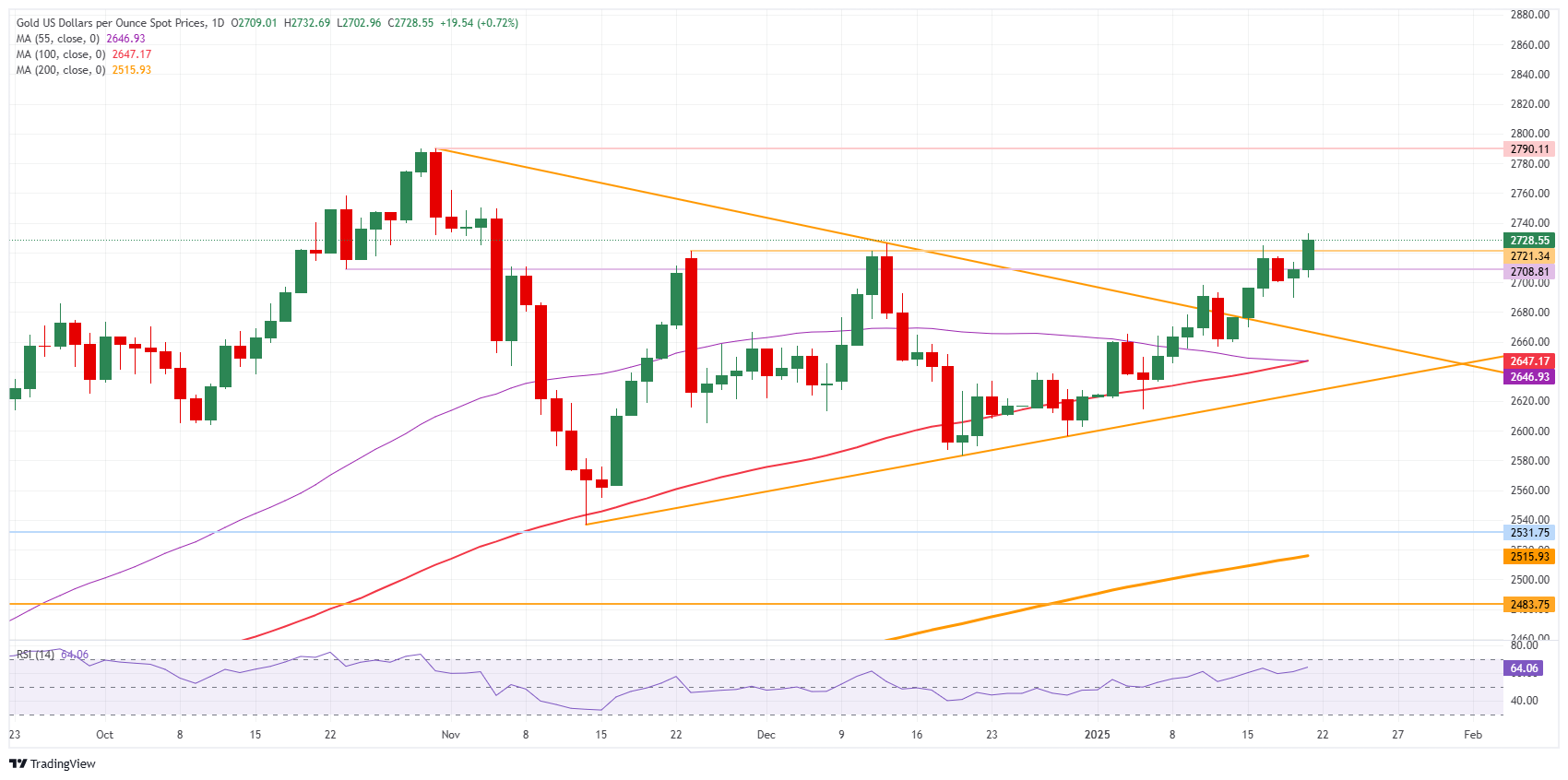
XAU/USD: Daily Chart
Gold FAQs
Gold has played a key role in human’s history as it has been widely used as a store of value and medium of exchange. Currently, apart from its shine and usage for jewelry, the precious metal is widely seen as a safe-haven asset, meaning that it is considered a good investment during turbulent times. Gold is also widely seen as a hedge against inflation and against depreciating currencies as it doesn’t rely on any specific issuer or government.
Central banks are the biggest Gold holders. In their aim to support their currencies in turbulent times, central banks tend to diversify their reserves and buy Gold to improve the perceived strength of the economy and the currency. High Gold reserves can be a source of trust for a country’s solvency. Central banks added 1,136 tonnes of Gold worth around $70 billion to their reserves in 2022, according to data from the World Gold Council. This is the highest yearly purchase since records began. Central banks from emerging economies such as China, India and Turkey are quickly increasing their Gold reserves.
Gold has an inverse correlation with the US Dollar and US Treasuries, which are both major reserve and safe-haven assets. When the Dollar depreciates, Gold tends to rise, enabling investors and central banks to diversify their assets in turbulent times. Gold is also inversely correlated with risk assets. A rally in the stock market tends to weaken Gold price, while sell-offs in riskier markets tend to favor the precious metal.
The price can move due to a wide range of factors. Geopolitical instability or fears of a deep recession can quickly make Gold price escalate due to its safe-haven status. As a yield-less asset, Gold tends to rise with lower interest rates, while higher cost of money usually weighs down on the yellow metal. Still, most moves depend on how the US Dollar (USD) behaves as the asset is priced in dollars (XAU/USD). A strong Dollar tends to keep the price of Gold controlled, whereas a weaker Dollar is likely to push Gold prices up.
Author

Filip Lagaart
FXStreet
Filip Lagaart is a former sales/trader with over 15 years of financial markets expertise under its belt.