Gold pulls back after US Retail Sales beats expectations
- Gold corrects back after the release of stronger-than-expected US Retail Sales data for June.
- The precious metal had been rallying after the Chairman of the Fed Jerome Powell said good progress was being made on inflation.
- His statements suggested a good chance the Fed will cut interest rates in the near future.
- Market-based probabilities are now showing a 100% chance of the Fed cutting interest rates at the September meeting.

Gold (XAU/USD) corrects some of its early gains on Tuesday, trading in the $2,440s after the release of US Retail Sales data showed the US consumer continuing to spend liberally despite the high cost of borrowing. The data indicates the US economy remains resilient and inflation is likely to stay relatively elevated despite having fallen in recent months. This could moderate the extent to which the Federal Reserve (Fed) cuts interest rates in the future, with consequences for Gold.
Gold had been rising prior to the release, inching up toward the $2,451 all-time high, supported by heightened expectations that the Federal Reserve (Fed) will cut interest rates at its meeting in September as inflation in the US shows signs of cooling.
Gold pulls back after US Retail Sales data boosts the USD
Gold is pulling back following the release of US Retail Sales data for June.
US Retail Sales rose by 0.0% in June, as expected and below May’s upwardly revised 0.3%, according to data from the US Census Bureau on Tuesday.
The Retail Sales ex Autos rose 0.4% in June when a 0.1% increase had been estimated from a revised-up 0.1% previously.
The Retail Sales Control Group showed an increase of 0.9% from 0.4% in May. The Control Group is adjusted for seasonal variations and trading day differences and is seen as a more accurate measure of sales.
Gold rises after Fed Chairman Powell indicates cuts are on their way
Gold rose ealier on Tuesday after Fed Chairman Jerome Powell commented in a speech on Monday on how inflation was showing promising signs of progress toward the central bank’s target and hinted that cuts to interest rates were on their way. His comments led to a dramatic recalibration of market-based expectations for the trajectory of the Fed Funds rate, the Fed’s key monetary policy rate.
The CME FedWatch tool, which uses the price of 30-day Fed Funds futures to calculate probabilities of future rate changes, is now pricing in a 100% chance of at least a 0.25% cut in the Fed Funds rate to an upper band of 5.25% when the Fed meets in September. Prior to the Chairman’s comments, the probabilities had been hovering just above the 60% mark.
The change in outlook comes after US inflation data in the form of the Consumer Price Index (CPI) undershot expectations in June – falling to 3.0%. Before that,both headline and core Personal Consumption Expenditure (PCE) inflation data – the Fed’s preferred gauge – fell to 2.6% in May, also undershooting expectations.
Technical Analysis: Gold continues rising within a range
Gold is rising within a range, and it is approaching its May 20 all-time high.
The precious metal is probably in a sideways consolidation – a pause within a broader uptrend.
XAU/USD Daily Chart
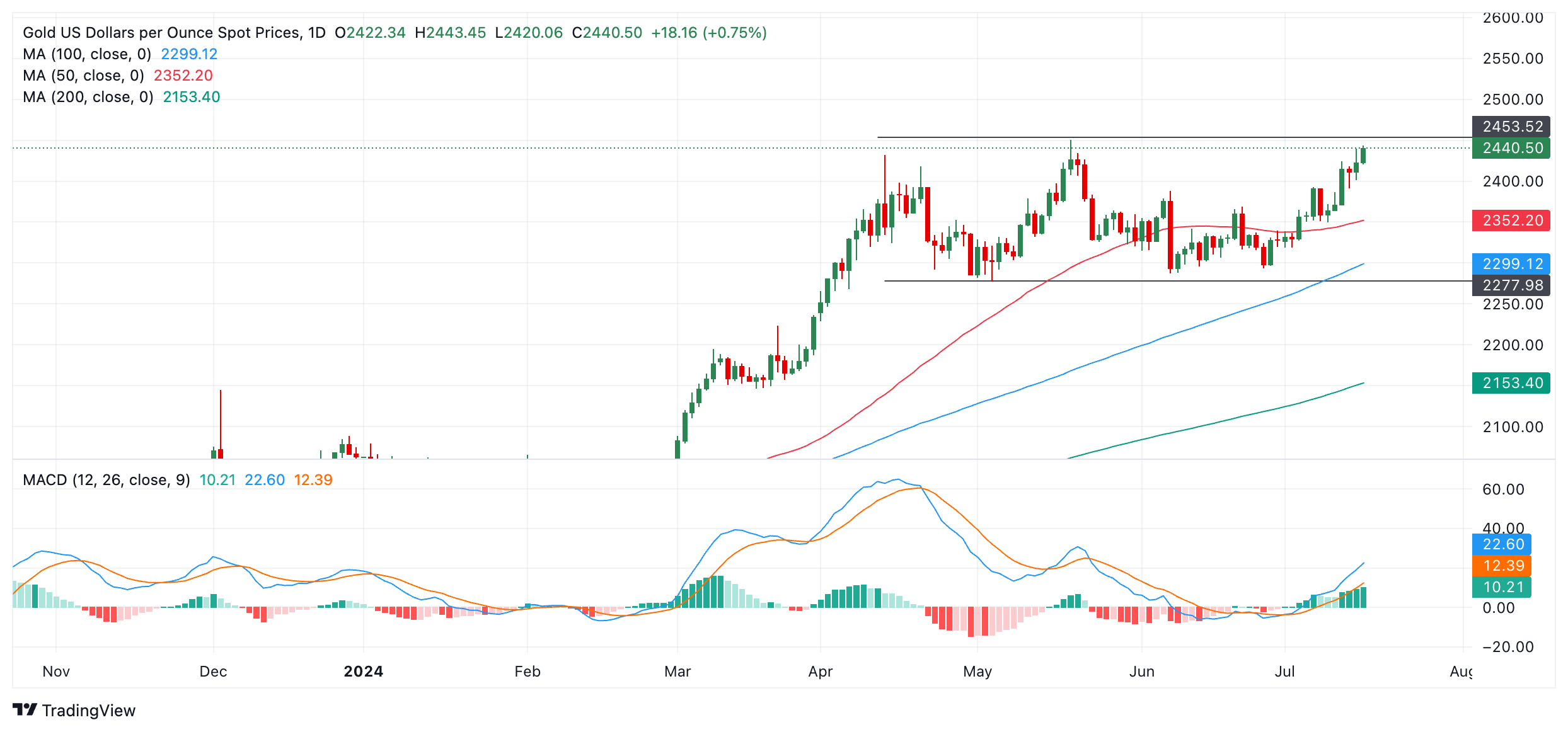
On a short-term basis, Gold could now be in a sideways trend as it extends a leg higher within the range that has unfolded since April. The sideways trend has a floor at roughly $2,280 and a ceiling at $2,451.
Since breaking above the June 7 peak of $2,388, the precious metal has received bullish confirmation, unlocking the next upside target at the $2,451 all-time high.
In the long term, Gold remains in an uptrend, suggesting odds favor an eventual breakout to the upside of the range.
A decisive break above the $2,451 high – which is also the range ceiling – would unlock a target at $2,555, calculated by extrapolating the 0.618 Fibonacci ratio of the height of the range higher.
Economic Indicator
Retail Sales ex Autos (MoM)
The Retail Sales ex Autos data, released by the US Census Bureau on a monthly basis, measures the value in total receipts of retail and food stores in the United States excluding the key sector of motor vehicles and parts. A stratified random sampling method is used to select approximately 4,800 retail and food services firms whose sales are then weighted and benchmarked to represent the complete universe of over three million retail and food services firms across the country. The data is adjusted for seasonal variations as well as holiday and trading-day differences, but not for price changes. Retail sales data is widely followed as an indicator of consumer spending, which is a major driver of the US economy. Generally, a high reading is seen as bullish for the US Dollar (USD), while a low reading is seen as bearish.
Read more.Last release: Tue Jul 16, 2024 12:30
Frequency: Monthly
Actual: 0.4%
Consensus: 0.1%
Previous: -0.1%
Source: US Census Bureau
Author

Joaquin Monfort
FXStreet
Joaquin Monfort is a financial writer and analyst with over 10 years experience writing about financial markets and alt data. He holds a degree in Anthropology from London University and a Diploma in Technical analysis.


![How Wall Street rigs the game [Video]](https://editorial.fxsstatic.com/images/i/market-chaos-01.jpg)