Gold price stumbles beneath $2,400 drops to five-day low
- Gold drops to $2,399, down 1.50%, after hitting a high of $2,447.
- Concerns over China's economic growth and Trump's election prospects boost the Greenback.
- US Dollar Index rises to 104.34, up 0.18%; US Treasury yields climb, with 10-year note at 4.233%.

Gold price sinks by more than 1.50% on Friday and hovers around $2,400 as traders book profits ahead of the weekend. The golden metal could finish the week with losses close to 1% after hitting an all-time high of $2,483 and trading at around the $2,300 handle. The XAU/USD exchanges hands at $2,399 after reaching a high of $2,447.
Trader sentiment is gyrating due to several factors. China’s economy is growing less than expected, and an increasing rumble that former President Donald Trump might win the November 5 elections boosted the Greenback, which is set to end the week with gains of more than 0.26%, according to the US Dollar Index (DXY).
Besides that, reports emerged that US President Joe Biden could pull out of the race as high-level democrats said polls following Trump’s assassination attack show that he can’t beat him.
In the meantime, Federal Reserve policymakers continued to turn slightly dovish yet failed to undermine the US Dollar. Nevertheless, the International Monetary Fund (IMF) said on Thursday that the Fed should not cut interest rates until late 2024.
The US Dollar Index, which tracks the currency's performance against six other currencies, is up 0.18% at 104.34. US Treasury bond yields are also rising across the yield curve, with the 10-year Treasury note yielding 4.233%, up more than three basis points (bps).
Daily digest market movers: Gold price tanks below $2,400
- Weaker-than-expected US Consumer Price Index (CPI) data boosted Gold prices above $2,400, as the increased likelihood of Fed rate cuts led to falling US Treasury bond yields.
- This week’s data featured mixed Retail Sales reading, a slowdown in Industrial Production, and the increase of Americans filling for unemployment benefits, reinforcing the Fed’s rhetoric that its dual mandate has become more balanced.
- December 2024 fed funds rate futures contract implies that the Fed will ease policy by 50 basis points (bps) toward the end of the year, up from 50 last Friday.
- Investors will focus on speeches from Fed policymakers: New York Fed President John Williams and Atlanta Fed President Raphael Bostic are scheduled to speak during the New York session.
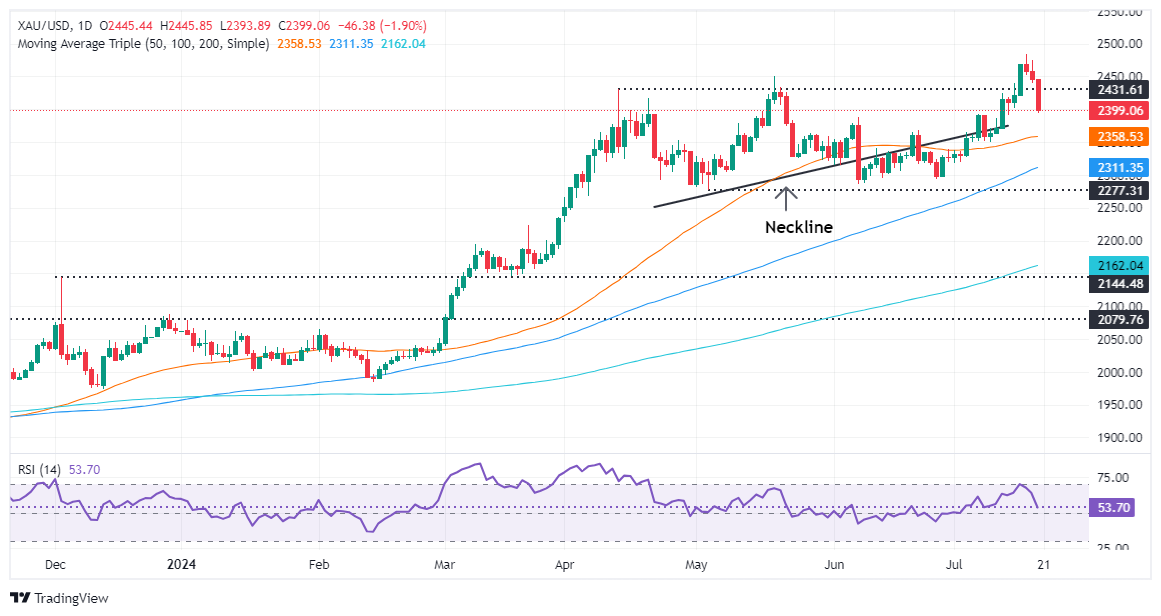
Gold technical analysis: XAU/USD tumbles beneath $2,400 as buyers stay on the sidelines
Gold prices are experiencing a pullback, signaling that traders continued to take profits after an 8% rally experienced since June 27. Although the Relative Strength Index (RSI) remains bullish, in the near-term momentum favors sellers. The RSI has experienced a vertical fall, though shy of piercing the 50-neutral line.
Therefore, XAU/USD first support would be the July 5 high at $2,392, followed by the psychological 50-day Simple Moving Average (SMA) at $2,357. The next support would be $2,350, followed by the 100-day SMA at $2,312
Otherwise, if XAU/USD stays above $2,400 and reclaims $2,450, that can pave the way to challenge the all-time high of $2,483 ahead of hitting $2,500.
Gold FAQs
Gold has played a key role in human’s history as it has been widely used as a store of value and medium of exchange. Currently, apart from its shine and usage for jewelry, the precious metal is widely seen as a safe-haven asset, meaning that it is considered a good investment during turbulent times. Gold is also widely seen as a hedge against inflation and against depreciating currencies as it doesn’t rely on any specific issuer or government.
Central banks are the biggest Gold holders. In their aim to support their currencies in turbulent times, central banks tend to diversify their reserves and buy Gold to improve the perceived strength of the economy and the currency. High Gold reserves can be a source of trust for a country’s solvency. Central banks added 1,136 tonnes of Gold worth around $70 billion to their reserves in 2022, according to data from the World Gold Council. This is the highest yearly purchase since records began. Central banks from emerging economies such as China, India and Turkey are quickly increasing their Gold reserves.
Gold has an inverse correlation with the US Dollar and US Treasuries, which are both major reserve and safe-haven assets. When the Dollar depreciates, Gold tends to rise, enabling investors and central banks to diversify their assets in turbulent times. Gold is also inversely correlated with risk assets. A rally in the stock market tends to weaken Gold price, while sell-offs in riskier markets tend to favor the precious metal.
The price can move due to a wide range of factors. Geopolitical instability or fears of a deep recession can quickly make Gold price escalate due to its safe-haven status. As a yield-less asset, Gold tends to rise with lower interest rates, while higher cost of money usually weighs down on the yellow metal. Still, most moves depend on how the US Dollar (USD) behaves as the asset is priced in dollars (XAU/USD). A strong Dollar tends to keep the price of Gold controlled, whereas a weaker Dollar is likely to push Gold prices up.
Author

Christian Borjon Valencia
FXStreet
Markets analyst, news editor, and trading instructor with over 14 years of experience across FX, commodities, US equity indices, and global macro markets.

















