Gold price skids below $2,400 as US Dollar and bond yields rebound
- Gold price hovers below $2,400 but the near-term bias remains bullish on multiple tailwinds.
- The Fed is expected to cut interest rates by more than 100 bps this year.
- Investors worry that the US could face a recession.

Gold price (XAU/USD) struggles to hold key ground at $2,400 as the US Dollar (USD) and bond yields rise in Tuesday’s North American session. The precious metal edges lower while investors look for fresh cues, which could clarify whether the United States (US) enters a recession. Also, market participants await signals about how much the Federal Reserve (Fed) will reduce interest rates this year.
The US Dollar Index (DXY), which tracks the Greenback’s value against six major currencies, climbs to near 103.00 after recovering from more than a six-month low near 102.15. The 10-year US Treasury yields jump to near above 3.86%. Historically, higher yields on interest-bearing assets reduce the opportunity cost of non-yielding assets, such as Gold.
Meanwhile, the overall outlook of the Gold price remains firm due to multiple tailwinds. Deepening Middle East tensions have improved the Gold’s appeal as a safe-haven asset. Market participants brace for a serious escalation in conflicts between Iran and Israel as the former launched dozens of missiles on Israeli territory on Saturday in retaliation to the assassination of Hamas leader Ismail Haniyeh by an Israeli airstrike in Tehran.r
Daily digest market movers: Gold price falls slightly but near-term appeal remains firm
- Gold price remains on a positive trajectory on firm speculation that fears of a US economic slowdown will bolster bulk rate cuts by the Fed. Fears of the US facing a recession were prompted by soft labor demand, a higher Unemployment Rate, and contracting activities in the manufacturing sector.
- The signal that confirms a technical recession is two consecutive declines in the nation’s Gross Domestic Product (GDP). The US economy performed strongly in the first half of this year. In the second quarter, the economy expanded by 2.8% on an annualized basis, double the growth rate recorded in the first quarter.
- Meanwhile, a faster-than-expected expansion in the US ISM Services Purchasing Managers Index (PMI) has also diminished recession fears. Commenting on the Services PMI performance, Chris Williamson, chief business economist at S&P Global Market Intelligence said, “The July surveys are indicative of the economy continuing to grow at the start of the third quarter at a rate comparable to GDP rising at a solid annualized 2.2% pace."
- According to the CME FedWatch tool, 30-day Federal Funds futures pricing data shows traders see an imminent 50-basis point (bps) cut in interest rates in September. The data also shows that the Fed is expected to reduce its key borrowing rates by more than 100 bps this year.
- The expectations of sooner rate cuts have also been bolstered by Fed officials’ dovish outlook on interest rates. On Monday, comments from Chicago Federal Bank President Austan Goolsbee, in an interview on CNBC’s "Squawk Box" program, indicated that the central bank is prepared to respond to signs of economic weakness. Goolsbee said, “It doesn’t make sense to maintain a "restrictive" policy stance if the economy is softening,” Reuters reported.
US Dollar Price Today:
US Dollar PRICE Today
The table below shows the percentage change of US Dollar (USD) against listed major currencies today. US Dollar was the strongest against the British Pound.
| USD | EUR | GBP | JPY | CAD | AUD | NZD | CHF | |
|---|---|---|---|---|---|---|---|---|
| USD | 0.36% | 0.68% | 0.64% | 0.05% | 0.22% | 0.34% | 0.25% | |
| EUR | -0.36% | 0.35% | 0.29% | -0.32% | -0.16% | -0.09% | -0.10% | |
| GBP | -0.68% | -0.35% | -0.04% | -0.63% | -0.49% | -0.42% | -0.49% | |
| JPY | -0.64% | -0.29% | 0.04% | -0.62% | -0.43% | -0.38% | -0.27% | |
| CAD | -0.05% | 0.32% | 0.63% | 0.62% | 0.15% | 0.23% | 0.15% | |
| AUD | -0.22% | 0.16% | 0.49% | 0.43% | -0.15% | 0.08% | 0.00% | |
| NZD | -0.34% | 0.09% | 0.42% | 0.38% | -0.23% | -0.08% | -0.02% | |
| CHF | -0.25% | 0.10% | 0.49% | 0.27% | -0.15% | -0.00% | 0.02% |
The heat map shows percentage changes of major currencies against each other. The base currency is picked from the left column, while the quote currency is picked from the top row. For example, if you pick the US Dollar from the left column and move along the horizontal line to the Japanese Yen, the percentage change displayed in the box will represent USD (base)/JPY (quote).
Technical Analysis: Gold price holds key 50-day EMA
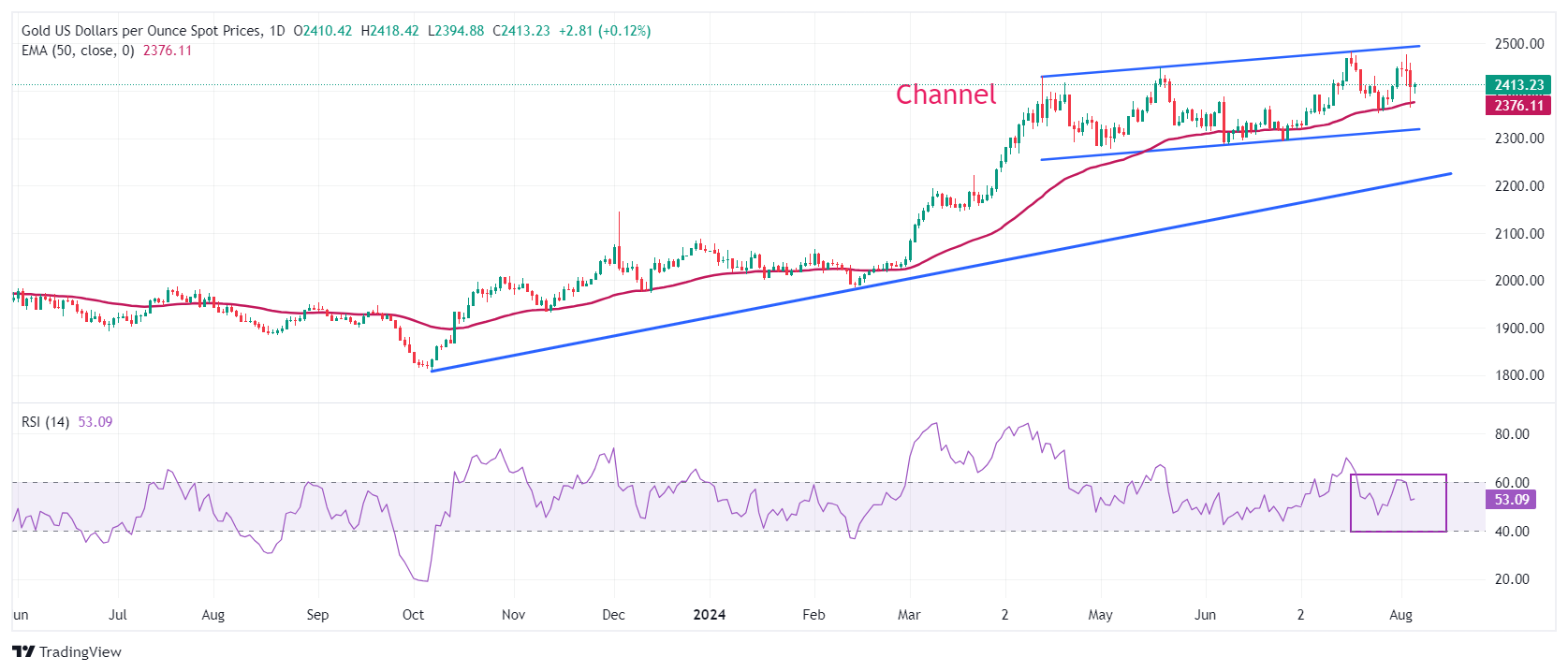
Gold price trades in a channel formation on a daily timeframe, which is slightly rising but broadly exhibited a sideways performance for more than three months. The 50-day Exponential Moving Average (EMA) near $2,370 continues to provide support to the Gold price bulls.
The 14-day Relative Strength Index (RSI) oscillates inside the 40.00-60.00 range, suggesting indecisiveness among market participants.
A fresh upside would appear if the Gold price breaks above its all-time high of $2,483.75, which will send it into unchartered territory.
On the downside, the upward-sloping trendline at $2,225, plotted from the October 6 low near $1,810.50, will be a major support in the longer term.
Fed FAQs
Monetary policy in the US is shaped by the Federal Reserve (Fed). The Fed has two mandates: to achieve price stability and foster full employment. Its primary tool to achieve these goals is by adjusting interest rates. When prices are rising too quickly and inflation is above the Fed’s 2% target, it raises interest rates, increasing borrowing costs throughout the economy. This results in a stronger US Dollar (USD) as it makes the US a more attractive place for international investors to park their money. When inflation falls below 2% or the Unemployment Rate is too high, the Fed may lower interest rates to encourage borrowing, which weighs on the Greenback.
The Federal Reserve (Fed) holds eight policy meetings a year, where the Federal Open Market Committee (FOMC) assesses economic conditions and makes monetary policy decisions. The FOMC is attended by twelve Fed officials – the seven members of the Board of Governors, the president of the Federal Reserve Bank of New York, and four of the remaining eleven regional Reserve Bank presidents, who serve one-year terms on a rotating basis.
In extreme situations, the Federal Reserve may resort to a policy named Quantitative Easing (QE). QE is the process by which the Fed substantially increases the flow of credit in a stuck financial system. It is a non-standard policy measure used during crises or when inflation is extremely low. It was the Fed’s weapon of choice during the Great Financial Crisis in 2008. It involves the Fed printing more Dollars and using them to buy high grade bonds from financial institutions. QE usually weakens the US Dollar.
Quantitative tightening (QT) is the reverse process of QE, whereby the Federal Reserve stops buying bonds from financial institutions and does not reinvest the principal from the bonds it holds maturing, to purchase new bonds. It is usually positive for the value of the US Dollar.
Author

Sagar Dua
FXStreet
Sagar Dua is associated with the financial markets from his college days. Along with pursuing post-graduation in Commerce in 2014, he started his markets training with chart analysis.