Gold breaks $2,670 fueled by China's stimulus, geopolitics
- Gold reaches an all-time high of $2,685, buoyed by China’s stimulus and Middle East tensions.
- Despite strong US Dollar, Fed’s recent 50 bps rate cut fuels bullish sentiment for continued gains in Bullion.
- US economic data points to a ‘soft landing’ scenario, keeping market optimism high for further Gold upside.

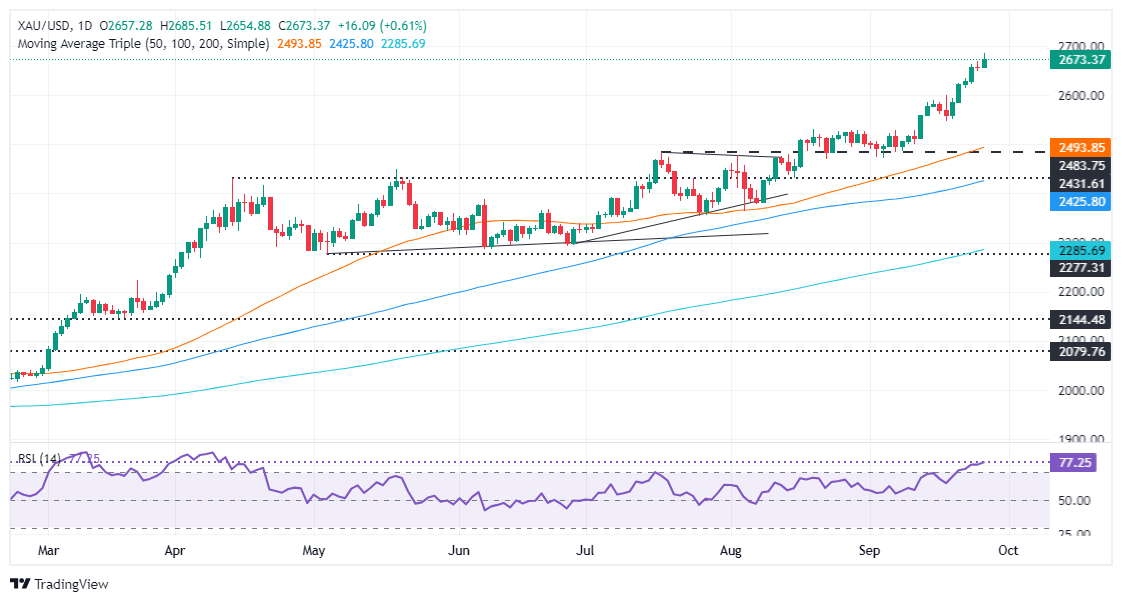
Gold hit a new all-time high of $2,685 on Thursday as the Greenback began to recover from earlier losses sustained in the Asian and European sessions. US data portrays a ‘soft landing’ scenario, while China’s stimulus and rising tensions in the Middle East boosted Bullion prices. At the time of writing, the XAU/USD trades at $2,670.
Sentiment remains positive as portrayed by US equities. US Treasury bond yields remained firm, with the 10-year T-note yielding 3.798%, up one basis point (bps), while the Greenback, as portrayed by the US Dollar Index (DXY), is flat at 100.91.
China’s news supports Gold’s upward move. The Politburo remains firm in stabilizing the real estate market, adding more fiscal stimulus after the People’s Bank of China (PBoC) lowered the 7-day reverse repo rates by 20 bps, bringing rates from 1.70% to 1.50%.
This and last week's 50 bps rate cut by the Federal Reserve (Fed) pushed the golden metal to print subsequent record highs as global central banks cut borrowing costs. Even though the US Dollar remained strong, expectations that the Fed would embark on an ‘aggressive’ easing cycle kept bulls riding the trend.
The US economy grew sharply in the second quarter of 2024, according to the Bureau of Economic Analysis (BEA). Meanwhile, the US Department of Labor revealed that fewer people asked for unemployment benefits last week, a sign that the labor market remains strong.
Daily digest market movers: Gold price stays firm amid high US yields
- Missile strikes between Israel and Hezbollah underpin Gold prices.
- The US Gross Domestic Product (GDP) for Q2 in its final reading was 3%, exceeding estimates of 2.9%.
- US Durable Goods Orders in August were unchanged at 0%, exceeding forecasts of a -2.6% contraction, but missed July’s 9.8% increase.
- Initial Jobless Claims for the week ending September 21 were 218K, below estimates for a 225K jump and the previous reading of 222K.
- According to the World Gold Council, global physically-backed Gold ETFs saw modest net inflows of 3 metric tons last week.
- Market participants have fully priced in at least a 25 bps rate cut by the Fed. However, according to the CME FedWatch Tool, the odds of a 50 bps cut have decreased to 51.3%, down from a 60% chance the previous day.
XAU/USD technical outlook: Gold price advances past $2,660
Gold price hit a record high of $2,685 on Thursday, but it has retreated to current spot prices. However, the momentum favors buyers, though the rally seems overextended, as portrayed by the Relative Strength Index (RSI) climbing further to overbought territory, close to testing the extreme levels above 80.
If XAU/USD extends its rally past the current year-to-date (YTD) peak of $2,685, the next resistance would be the $2,700 mark. Up next would be the $2,750 level, followed by $2,800.
On the flip side, if XAU/USD drops below $2,650, look for a test of the September 18 daily high at $2,600. The following key support levels to test will be the September 18 low of $2,546, followed by the 50-day Simple Moving Average (SMA) at $2,488.
Gold FAQs
Gold has played a key role in human’s history as it has been widely used as a store of value and medium of exchange. Currently, apart from its shine and usage for jewelry, the precious metal is widely seen as a safe-haven asset, meaning that it is considered a good investment during turbulent times. Gold is also widely seen as a hedge against inflation and against depreciating currencies as it doesn’t rely on any specific issuer or government.
Central banks are the biggest Gold holders. In their aim to support their currencies in turbulent times, central banks tend to diversify their reserves and buy Gold to improve the perceived strength of the economy and the currency. High Gold reserves can be a source of trust for a country’s solvency. Central banks added 1,136 tonnes of Gold worth around $70 billion to their reserves in 2022, according to data from the World Gold Council. This is the highest yearly purchase since records began. Central banks from emerging economies such as China, India and Turkey are quickly increasing their Gold reserves.
Gold has an inverse correlation with the US Dollar and US Treasuries, which are both major reserve and safe-haven assets. When the Dollar depreciates, Gold tends to rise, enabling investors and central banks to diversify their assets in turbulent times. Gold is also inversely correlated with risk assets. A rally in the stock market tends to weaken Gold price, while sell-offs in riskier markets tend to favor the precious metal.
The price can move due to a wide range of factors. Geopolitical instability or fears of a deep recession can quickly make Gold price escalate due to its safe-haven status. As a yield-less asset, Gold tends to rise with lower interest rates, while higher cost of money usually weighs down on the yellow metal. Still, most moves depend on how the US Dollar (USD) behaves as the asset is priced in dollars (XAU/USD). A strong Dollar tends to keep the price of Gold controlled, whereas a weaker Dollar is likely to push Gold prices up.
Author

Christian Borjon Valencia
FXStreet
Markets analyst, news editor, and trading instructor with over 14 years of experience across FX, commodities, US equity indices, and global macro markets.

















