Gold price surpasses $2,700 as Fed’s Waller turns dovish
- Gold rallies as US retail sales miss, offset by prior strong consumer spending.
- An unexpected rise in US jobless claims pressures the US Dollar and boosts Gold.
- Fed Governor Waller's dovish remarks hint at possible rate cuts in March.

Gold price surged above the $2,700 mark on Thursday as the Greenback trimmed some of its earlier gains. Data from the United States (US) revealed that the economy remains solid after the release of consumer spending figures and jobs data. US bond yields fell as traders expect further easing by the Federal Reserve (Fed). At the time of writing, the XAU/USD trades at $2,715, up 0.72%.
Bullion extended its gains as market participants prepare for US President-elect Donald Trump's inauguration. The US Census Bureau revealed that Retail Sales fell short of estimates in December. However, November’s data was upwardly revised, indicating consumer strength.
Other data showed that the number of Americans filing for unemployment insurance jumped for the first time since December 7, 2024, and weighed on the Greenback.
The US Dollar Index (DXY), which tracks the performance of the USD against a basket of six peers, slips 0.14%, down below the 109.00 figure.
Fed Governor Christopher Waller crossed the wires and was dovish, stating that the US Central Bank could lower borrowing costs sooner and faster if the disinflation process evolves.
The US economic docket will remain empty throughout the rest of the day and traders will eye housing data, particularly Building Permits and Housing Starts.
Daily digest market movers: Gold price bolstered by dovish comments, falling US yields
- Gold extended its gains as real yields dropped. Measured by the 10-year Treasury Inflation-Protected Securities (TIPS) yield, extended its losses for the second straight day, down five and a half basis points (bps) from 2.234% to 2.18%.
- The US 10-year Treasury bond yield slumps five bps, at 4.604%, a tailwind for the golden metal.
- US Retail Sales increased by 0.4% MoM in December, below estimates of 0.6%. Although the data missed the mark, an upward revision to November’s figures from 0.7% to 0.8%, showed the economy’s resilience.
- Regarding labor market data, Initial Jobless Claims for the week ending January 10 rose by 217K from 201K the previous week, missing estimates of 210K.
- The latest inflation data and Fed Waller’s comments pressured the US dollar, as traders had grown confident the US Central Bank would cut rates sooner rather than later. Waller didn’t rule out a cut in the March meeting as inflation “is getting close to what our 2% inflation target would be.”
- Chicago’s Fed Austan Goolsbee, a 2025 voter, said he feels more comfortable that the labor market is stabilizing via The Wall Street Journal.
- Market participants are pricing in near-even odds that the Fed will cut rates twice by the end of 2025 and see the first reduction in June.
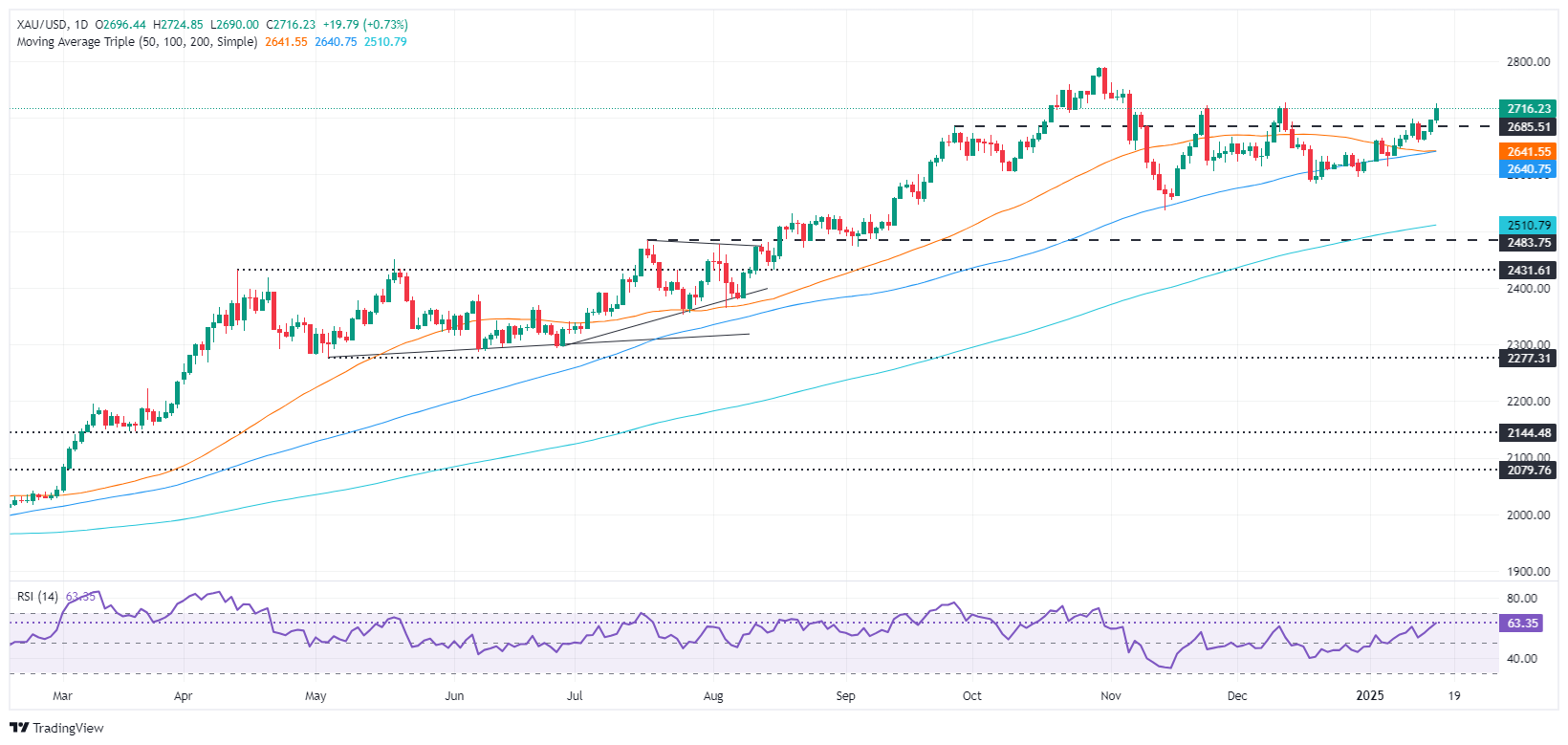
XAU/USD technical outlook: Gold buyers target $2,750 as crucial resistance ahead of ATH
Gold price uptrend extended for the third consecutive trading day, clearing key resistance at $2,700. Bullish momentum remains strong as the Relative Strength Index (RSI) depicts, giving a green light to buyers, to drive the non-yielding metal higher.
XAU/USD first resistance will be the December 12 high of $2,726. Once surpassed, the next stop would be $2,750, followed by the all-time high (ATH) at $2,790.
Conversely, XAU/USD’s drop below $2,700, would sponsor a test of the January 13 swing low of $2,656, followed by the confluence of the 50 and 100-day Simple Moving Averages (SMAs) at $2,639 - $2,642.
Gold FAQs
Gold has played a key role in human’s history as it has been widely used as a store of value and medium of exchange. Currently, apart from its shine and usage for jewelry, the precious metal is widely seen as a safe-haven asset, meaning that it is considered a good investment during turbulent times. Gold is also widely seen as a hedge against inflation and against depreciating currencies as it doesn’t rely on any specific issuer or government.
Central banks are the biggest Gold holders. In their aim to support their currencies in turbulent times, central banks tend to diversify their reserves and buy Gold to improve the perceived strength of the economy and the currency. High Gold reserves can be a source of trust for a country’s solvency. Central banks added 1,136 tonnes of Gold worth around $70 billion to their reserves in 2022, according to data from the World Gold Council. This is the highest yearly purchase since records began. Central banks from emerging economies such as China, India and Turkey are quickly increasing their Gold reserves.
Gold has an inverse correlation with the US Dollar and US Treasuries, which are both major reserve and safe-haven assets. When the Dollar depreciates, Gold tends to rise, enabling investors and central banks to diversify their assets in turbulent times. Gold is also inversely correlated with risk assets. A rally in the stock market tends to weaken Gold price, while sell-offs in riskier markets tend to favor the precious metal.
The price can move due to a wide range of factors. Geopolitical instability or fears of a deep recession can quickly make Gold price escalate due to its safe-haven status. As a yield-less asset, Gold tends to rise with lower interest rates, while higher cost of money usually weighs down on the yellow metal. Still, most moves depend on how the US Dollar (USD) behaves as the asset is priced in dollars (XAU/USD). A strong Dollar tends to keep the price of Gold controlled, whereas a weaker Dollar is likely to push Gold prices up.
Author

Christian Borjon Valencia
FXStreet
Markets analyst, news editor, and trading instructor with over 14 years of experience across FX, commodities, US equity indices, and global macro markets.

















