Gold price languishes near daily low amid Trump optimism-inspired USD buying
- Gold price drifts lower for the second straight day and is pressured by a combination of factors.
- The Trump trade optimism continues to underpin the USD and weighs on the precious metal.
- Bets for less aggressive Fed rate cuts and elevated US bond yields undermine the XAU/USD.

Gold price (XAU/USD) adds to last week's heavy losses and remains under some selling pressure for the second straight day on Monday amid the underlying bullish sentiment surrounding the US Dollar (USD). The optimism over Donald Trump's anticipated expansionary policies keeps the USD close to a four-month top touched last week, which, in turn, is seen as a key factor undermining the commodity.
Meanwhile, US President-elect Donald Trump's pledged 10% tariff on all US imports is expected to trigger a resurgence in inflation and restrict the Federal Reserve's (Fed) ability to ease aggressively. This, in turn, remains supportive of elevated US Treasury bond yields and contributes to driving flows away from the non-yielding yellow metal. That said, the cautious market mood could limit losses for the safe-haven XAU/USD.
Traders might also opt to move to the sidelines ahead of the release of the latest US consumer inflation figures and speeches by influential FOMC members, including Fed Chair Jerome Powell later this week. This, in turn, might help limit any further losses and warrants some caution before positioning for an extension of the recent sharp retracement slide from the vicinity of the $2,800 mark, or the all-time high touched on October 31.
Gold price bears retain intraday control as USD holds steady below four-month peak
- Gold price registered its steepest weekly decline in over five months in the wake of a broad-based US Dollar rally and a sharp rise in the US Treasury bond yields following Donald Trump's victory in the US presidential election.
- The so-called Trump trade euphoria continues to act as a tailwind for the Greenback and exerts some downward pressure on the Gold price for the second successive day on Monday amid the upbeat mood around the equity markets.
- The Federal Reserve last week lowered its benchmark overnight borrowing rate by 25 basis points and signaled plans to ease monetary policy further, with traders still pricing in a 65% chance of another interest rate cut in December.
- Minneapolis Fed President Neel Kashkari said that the central bank wants to have confidence and needs to see more evidence that inflation will go all the way back to the 2% target before deciding on further interest rate cuts.
- President-elect Trump’s protectionist push is expected to exacerbate global trade tensions and trigger a worldwide trend of restrictive trade practices, which could strain global markets and offer support to the safe-haven XAU/USD.
- Investors might also refrain from placing aggressive directional bets ahead of this week's release of the US consumer inflation figures on Wednesday, the US Producer Price Index on Thursday and US Retail Sales figures on Friday.
- Apart from this, investors will closely scrutinize comments from a slew of Fed officials, including Fed Chair Jerome Powell, for more signals about the rate-cut path, which will drive the USD and provide a fresh impetus to the commodity.
Technical Outlook: Gold price remains close to multi-week low and 50-day SMA pivotal support
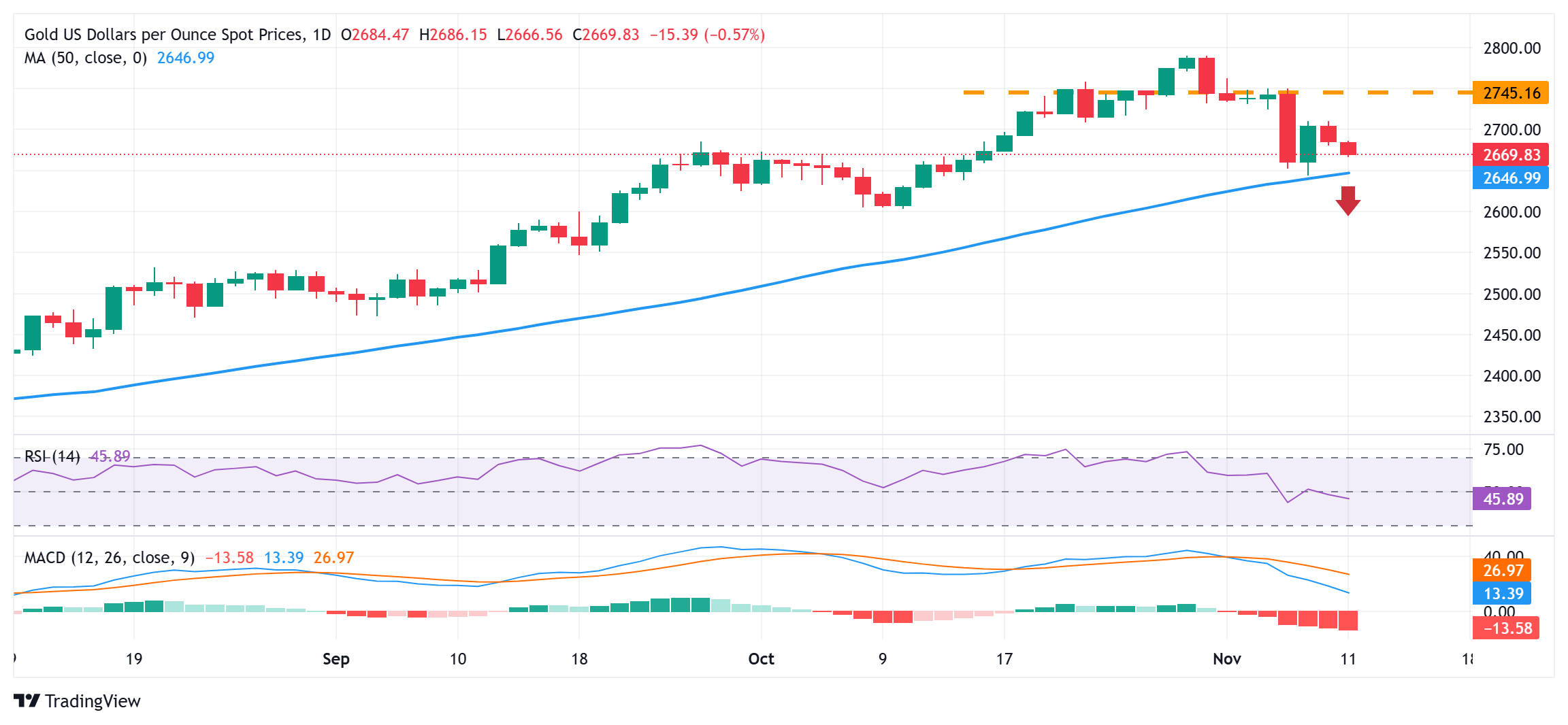
From a technical perspective, any further decline is likely to find some support near the $2,660 zone ahead of the 50-day Simple Moving Average (SMA), currently pegged near the $2,647-2,746 region. Some follow-through selling below last week's swing low, around the $2,643 area, will be seen as a fresh trigger for bearish traders. Given that oscillators on the daily chart have been losing positive traction, the Gold price might then accelerate the fall toward the October monthly swing low, around the $2,605-2,602 region.
On the flip side, momentum back above the $2,700 mark now seems to confront stiff resistance near the $2,718 region ahead of the $2,740-2,745 supply zone. A sustained strength beyond the latter will suggest that the corrective pullback has run its course and lift the Gold price beyond the $2,750 static resistance, towards the $2,758-2,790 zone, or the record high touched on October 31.
Economic Indicator
Consumer Price Index (YoY)
Inflationary or deflationary tendencies are measured by periodically summing the prices of a basket of representative goods and services and presenting the data as The Consumer Price Index (CPI). CPI data is compiled on a monthly basis and released by the US Department of Labor Statistics. The YoY reading compares the prices of goods in the reference month to the same month a year earlier.The CPI is a key indicator to measure inflation and changes in purchasing trends. Generally speaking, a high reading is seen as bullish for the US Dollar (USD), while a low reading is seen as bearish.
Read more.Next release: Wed Nov 13, 2024 13:30
Frequency: Monthly
Consensus: 2.6%
Previous: 2.4%
Source: US Bureau of Labor Statistics
The US Federal Reserve has a dual mandate of maintaining price stability and maximum employment. According to such mandate, inflation should be at around 2% YoY and has become the weakest pillar of the central bank’s directive ever since the world suffered a pandemic, which extends to these days. Price pressures keep rising amid supply-chain issues and bottlenecks, with the Consumer Price Index (CPI) hanging at multi-decade highs. The Fed has already taken measures to tame inflation and is expected to maintain an aggressive stance in the foreseeable future.
Author

Haresh Menghani
FXStreet
Haresh Menghani is a detail-oriented professional with 10+ years of extensive experience in analysing the global financial markets.