Gold corrects back, falling below $2,500 at start of week
- Gold pulls back after breaking to new all-time highs at the end of last week.
- Talk of the US economy giving “warning signals” on Friday drove safe-haven flows into the precious metal, pushing it to new highs.
- From a technical point of view, Gold is overbought and at risk of a correction although overall it enjoys an upside bias.

Gold (XAU/USD) trades back below $2,500 on Monday as it corrects the gains made after it broke above resistance to a new all-time high on Friday.
The precious metal saw gains because of lingering doubts about the resilience of the US economy, simmering geopolitical tensions – particularly in the Middle East – and a weaker US Dollar, in which Gold is mostly priced.
Gold surged to new highs after comments from Chicago Fed President
Gold surged to a new all-time high of $2,509 on Friday after comments from the President of the Federal Reserve Bank of Chicago, Austan Goolsbee, reawakened US recession fears. Goolsbee said that the US labor market and some other leading economic indicators were “flashing warning signs”. One such sign was rising levels of credit card delinquencies. His words reawakened recession concerns leading to a rise in safe-haven flows to Gold.
Investors had grown complacent after the release of US Retail Sales data on Thursday showed a 1.0% rise MoM in July, reversing the 0.3% decline in June. The data, along with lower-than-expected Initial Jobless Claims had helped calm fears the US economy was heading for a hard landing. The Chicago Fed President’s remarks, however, suggested a part of the growth in retail sales might be due to consumers borrowing beyond their limits, reviving concerns and increasing haven demand for the yellow Metal.
Changing Fed expectations
The move higher in Gold came as something of a surprise given the recent change in the outlook for interest rates in the US. Gold tends to appreciate when investors expect interest rates to fall because it is a non-interest paying asset.
Market-based estimates of the future course of interest rates altered considerably last week. At the start of the week investors were pricing in at least a 50% chance the Federal Reserve (Fed) would cut interest rates by 0.50% at their September meeting, and a 100% chance of at least a 0.25% cut.
As the week progressed, the probabilities of a “big” 0.50% cut fell to only around 30% whilst the chances of at least a 0.25% cut remained fully priced in, according to the CME Fedwatch tool. The fall in chances of the Fed cutting by 0.50% did weigh marginally on the price of Gold but that did not stop it surging late Friday. Despite the rally in Gold prices and Fed Goolsbee’s comments the probabilities of a 0.50% cut in September remain around 30%.
The sudden rally at the end of Friday was also surprising because data on investor positioning in the Gold futures market suggests a bearish bias rather than a bullish one. Most large investors are already long Gold with the uneven allocation into Gold longs and Gold option calls actually suggesting a risk of the market rebalancing in a reaction in the opposite direction.
“Several of the major cohorts in Gold markets are now facing buying exhaustion, whereas the narrative that propelled prices to these all-time highs now appears stale. The risk of a positioning washout is at its highest levels of the year,” says TD Securities senior commodity strategist Daniel Ghali.
There is the potential for Gold to be buffeted by a host of factors in the week ahead, including the outcome of peace talks in Cairo aimed at ending the war between Israelis and Palestinians, whether Iran’s threat of all out war with Israel finally bears fruit, and commentary around interest rates coming out of the the Jackson Hole central banking summit at the end of the week.
Technical Analysis: Gold breaks out of range
Gold (XAU/USD) pulls back after breaking decisively out of the top of a range it has been trapped in since the middle of July and rises to new all-time highs.
Although Gold is pulling back it will probably eventually find a floor and then rise to an initial target at $2,550, calculated by taking the 0.618 Fibonacci ratio of the range’s height and extrapolating it higher.
XAU/USD 4-hour Chart
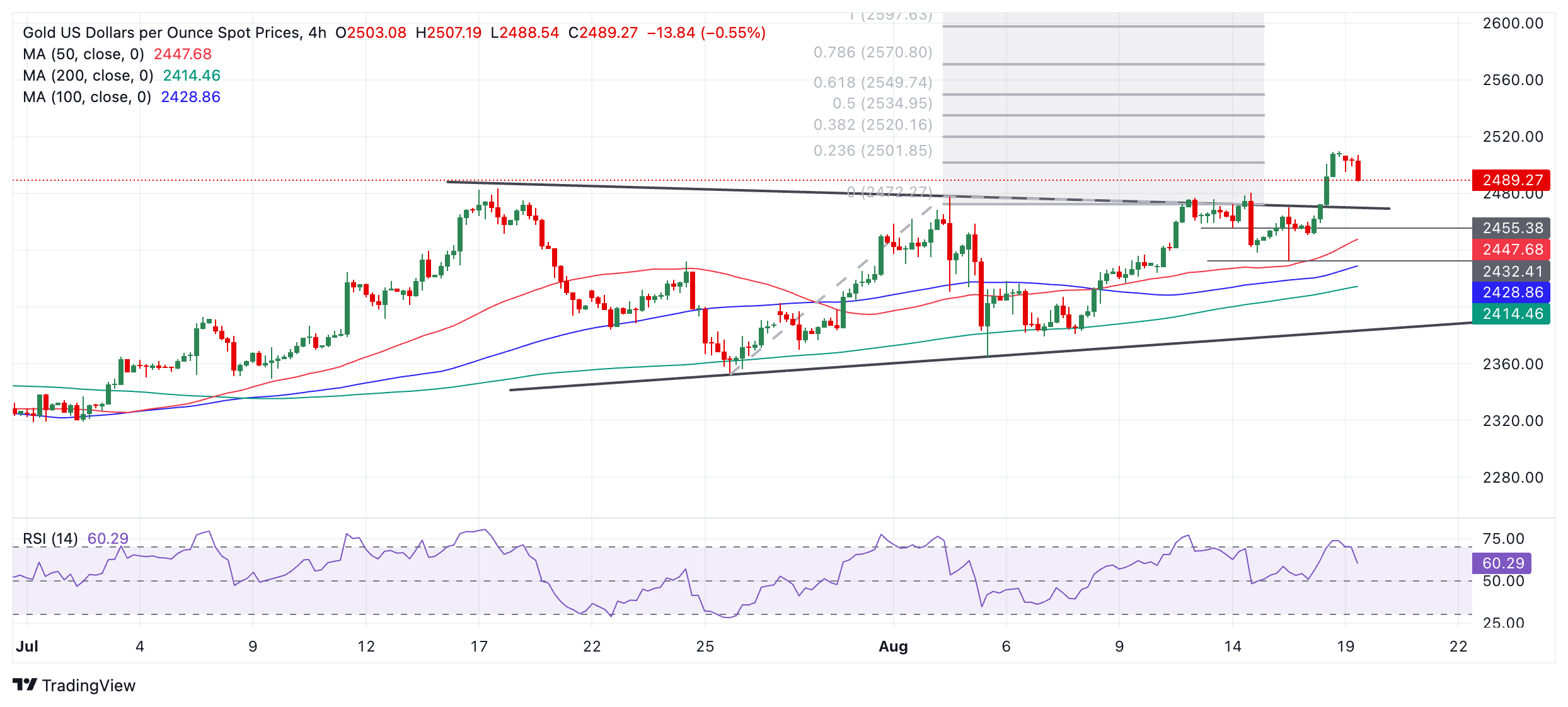
The Relative Strength Index (RSI) has just exited overbought, and Gold is pulling back accordingly. The correction signalled by the RSI is likely to drag Gold price down, perhaps, to support in the $2,480s, at around the level of the July 17 high.
Gold is in a broad uptrend on the short, medium and long-term timeframes, however, and given “the trend is your friend”, this uptrend is more likely than not to resume and continue higher.
Gold FAQs
Gold has played a key role in human’s history as it has been widely used as a store of value and medium of exchange. Currently, apart from its shine and usage for jewelry, the precious metal is widely seen as a safe-haven asset, meaning that it is considered a good investment during turbulent times. Gold is also widely seen as a hedge against inflation and against depreciating currencies as it doesn’t rely on any specific issuer or government.
Central banks are the biggest Gold holders. In their aim to support their currencies in turbulent times, central banks tend to diversify their reserves and buy Gold to improve the perceived strength of the economy and the currency. High Gold reserves can be a source of trust for a country’s solvency. Central banks added 1,136 tonnes of Gold worth around $70 billion to their reserves in 2022, according to data from the World Gold Council. This is the highest yearly purchase since records began. Central banks from emerging economies such as China, India and Turkey are quickly increasing their Gold reserves.
Gold has an inverse correlation with the US Dollar and US Treasuries, which are both major reserve and safe-haven assets. When the Dollar depreciates, Gold tends to rise, enabling investors and central banks to diversify their assets in turbulent times. Gold is also inversely correlated with risk assets. A rally in the stock market tends to weaken Gold price, while sell-offs in riskier markets tend to favor the precious metal.
The price can move due to a wide range of factors. Geopolitical instability or fears of a deep recession can quickly make Gold price escalate due to its safe-haven status. As a yield-less asset, Gold tends to rise with lower interest rates, while higher cost of money usually weighs down on the yellow metal. Still, most moves depend on how the US Dollar (USD) behaves as the asset is priced in dollars (XAU/USD). A strong Dollar tends to keep the price of Gold controlled, whereas a weaker Dollar is likely to push Gold prices up.
Author

Joaquin Monfort
FXStreet
Joaquin Monfort is a financial writer and analyst with over 10 years experience writing about financial markets and alt data. He holds a degree in Anthropology from London University and a Diploma in Technical analysis.

















