GBP/USD Price Analysis: Subdued hovers around 1.2900
- GBP/USD at 1.2910, stable despite US political developments, after touching high of 1.2942.
- Technicals: GBP/USD finds support at 1.2894, consolidating from highs.
- Bullish momentum holds; RSI positive with resistance at 1.2950, 1.3044 and supports at 1.2860, 1.2803.

The Pound Sterling begins the week virtually flat against the Greenback on Monday, trading at around 1.2910 after hitting a daily high of 1.2942.
Over the weekend, political developments in the US saw President Joe Biden drop out of the presidential race and endorse Vice-President Kamala Harris. The effects are pending to be felt by the Forex markets, though Wall Street recovers ground.
GBP/USD Price Analysis: Technical outlook
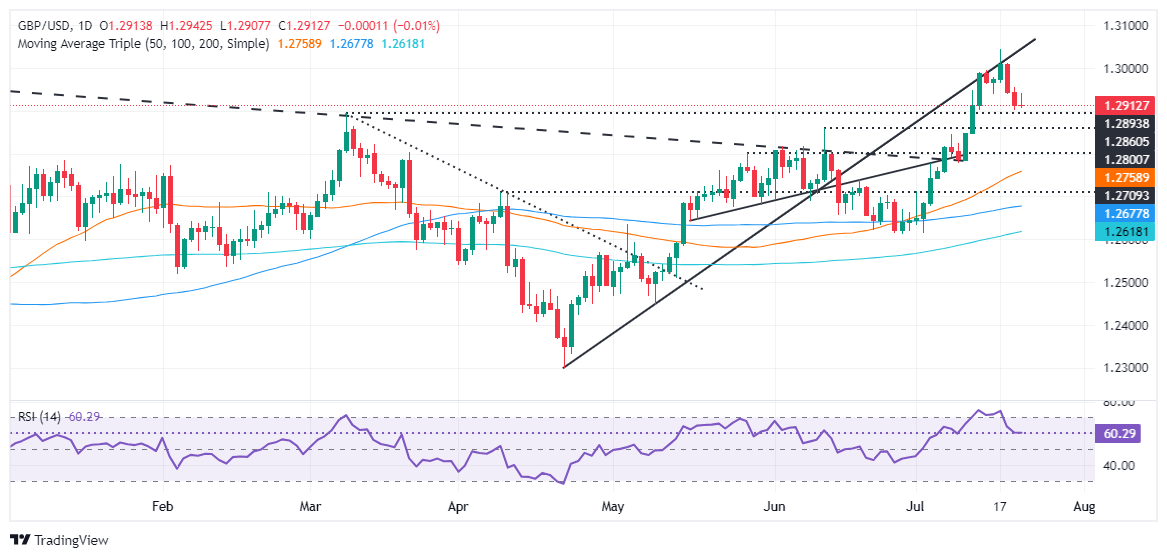
From a technical standpoint, the GBP/USD consolidates after rallying from 1.2600 to 1.3000 during the last three weeks. Nevertheless, the pair pulled back from recent highs and faced solid support at 1.2894, and the March 8 peak turned support.
Momentum suggests buyers had stepped in, capping the GBP/USD drop. The Relative Strength Index (RSI) stays in bullish territory, though market participants remain undecisive about lifting the Pound or letting it slide for a deeper correction.
For a bullish continuation, buyers must reclaim the 1.2950 psychological figure before testing the July 17 high at 1.3044. Once cleared, the next supply zone to encounter would be last year’s high at 1.3142.
Conversely, if GBP/USD tumbles under 1.2900, the first support would be the June 12 high turned support at 1.2860. Once surpassed, further downside lies ahead, like the March 21 high at 1.2803, before aiming toward the 50-day moving average (DMA) at 1.2757.
GBP/USD Price Action – Daily Chart
Pound Sterling FAQs
The Pound Sterling (GBP) is the oldest currency in the world (886 AD) and the official currency of the United Kingdom. It is the fourth most traded unit for foreign exchange (FX) in the world, accounting for 12% of all transactions, averaging $630 billion a day, according to 2022 data. Its key trading pairs are GBP/USD, aka ‘Cable’, which accounts for 11% of FX, GBP/JPY, or the ‘Dragon’ as it is known by traders (3%), and EUR/GBP (2%). The Pound Sterling is issued by the Bank of England (BoE).
The single most important factor influencing the value of the Pound Sterling is monetary policy decided by the Bank of England. The BoE bases its decisions on whether it has achieved its primary goal of “price stability” – a steady inflation rate of around 2%. Its primary tool for achieving this is the adjustment of interest rates. When inflation is too high, the BoE will try to rein it in by raising interest rates, making it more expensive for people and businesses to access credit. This is generally positive for GBP, as higher interest rates make the UK a more attractive place for global investors to park their money. When inflation falls too low it is a sign economic growth is slowing. In this scenario, the BoE will consider lowering interest rates to cheapen credit so businesses will borrow more to invest in growth-generating projects.
Data releases gauge the health of the economy and can impact the value of the Pound Sterling. Indicators such as GDP, Manufacturing and Services PMIs, and employment can all influence the direction of the GBP. A strong economy is good for Sterling. Not only does it attract more foreign investment but it may encourage the BoE to put up interest rates, which will directly strengthen GBP. Otherwise, if economic data is weak, the Pound Sterling is likely to fall.
Another significant data release for the Pound Sterling is the Trade Balance. This indicator measures the difference between what a country earns from its exports and what it spends on imports over a given period. If a country produces highly sought-after exports, its currency will benefit purely from the extra demand created from foreign buyers seeking to purchase these goods. Therefore, a positive net Trade Balance strengthens a currency and vice versa for a negative balance.
Author

Christian Borjon Valencia
FXStreet
Markets analyst, news editor, and trading instructor with over 14 years of experience across FX, commodities, US equity indices, and global macro markets.