|

GBP/USD Price Analysis: Fails to justify bullish spinning top near multi-day low around 1.1850

  • GBP/USD retreats from intraday high, fades bounce off the lowest levels since late November 2022.
  • Bearish MACD signals, sustained trading below the key support line and 200-DMA favor sllers.
  • Buyers lack conviction below 1.2150, one-month-old descending trend line adds to the upside filter.

GBP/USD struggles to extend the previous day’s corrective bounce off the lowest levels since November 21, 2022, making rounds to 1.1850 on Thursday morning in Asia.

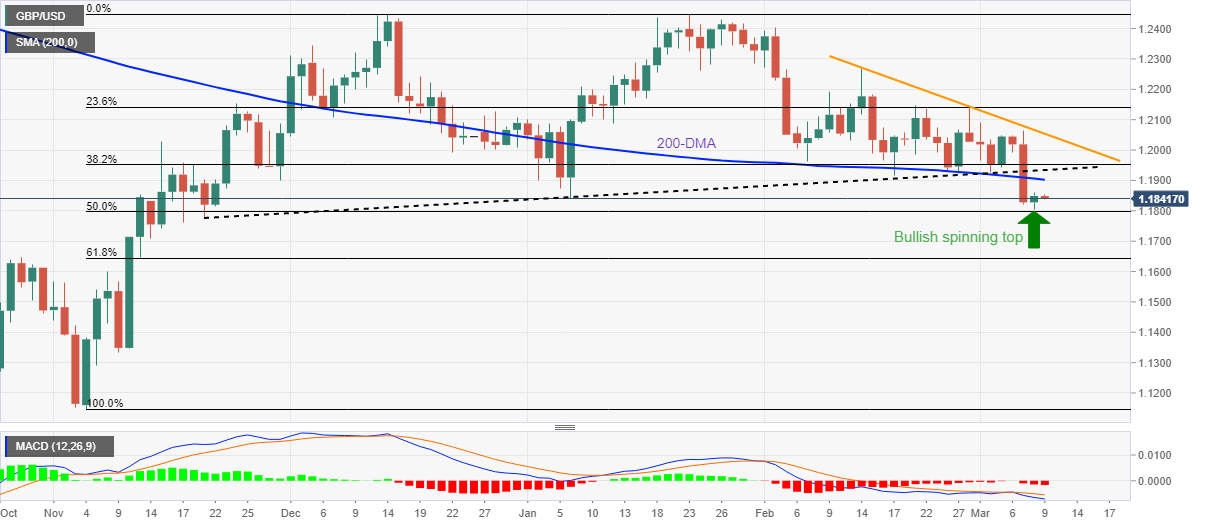
In doing so, the Cable pair fails to justify the previous day’s bullish candlestick on the daily chart, namely the bullish spinning top.

The reason could be linked to the pair’s sustained downside break of a 15-week-old ascending trend line, previous support near 1.1935, as well as the 200-DMA breakdown. Also adding strength to the downside bias are the bearish MACD signals.

That said, the GBP/USD quote’s fresh weakness could aim for the 50% Fibonacci retracement level of November 2022 to January 2023 upside, near 1.1800.

Following that, a slump toward the 61.8% Fibonacci retracement level surrounding 1.1645, also known as the golden ratio, can’t be ruled out.

Meanwhile, the 200-DMA hurdle of around 1.1900 restricts immediate GBP/USD recovery before highlighting the support-turned-resistance line close to 1.1935.

Even if the Cable pair crosses the 1.1935 hurdle, a downward-sloping resistance line from early February, near 1.2055 could act as the last defense of the GBP/USD bears.

To sum up, GBP/USD remains on the bear’s radar despite the latest rebound, as well as posting the bullish candlestick.

GBP/USD: Daily chart
Trend: Bearish

Additional important levels

Overview
Today last price1.1845
Today Daily Change-0.0004
Today Daily Change %-0.03%
Today daily open1.1849
 
Trends
Daily SMA201.2025
Daily SMA501.2133
Daily SMA1001.2003
Daily SMA2001.1906
 
Levels
Previous Daily High1.186
Previous Daily Low1.1803
Previous Weekly High1.2143
Previous Weekly Low1.1922
Previous Monthly High1.2402
Previous Monthly Low1.1915
Daily Fibonacci 38.2%1.1838
Daily Fibonacci 61.8%1.1824
Daily Pivot Point S11.1814
Daily Pivot Point S21.178
Daily Pivot Point S31.1758
Daily Pivot Point R11.1871
Daily Pivot Point R21.1894
Daily Pivot Point R31.1928

Author

Anil Panchal

Anil Panchal

FXStreet

Anil Panchal has nearly 15 years of experience in tracking financial markets. With a keen interest in macroeconomics, Anil aptly tracks global news/updates and stays well-informed about the global financial moves and their implications.


More from Anil Panchal
Share:

Editor's Picks

GBP/USD stays offered near 1.3370

GBP/USD remains on the back foot, slipping back toward the 1.3370 zone on Tuesday. Cable has come under pressure soon after testing the 1.3400 neighbourhood as investors turned more cautious in response to renewed effervescence on the geopolitical front.

EUR/USD slips back to 1.1420, daily lows

EUR/USD now accelerates its daily retracement and revisits the 1.1420 region, or daily troughs. The pair’s decline comes amid the gain of upside momentum in the US Dollar amid renewed tensions in the Strait of Hormuz and a sell-off in Asian technology stocks.

Gold weakens toward $4,100

Gold adds to Monday’s decent pullback and trades close to the $4,100 mark per troy ounce on Tuesday. In the meantime, fresh geopolitical effervescence appear to have reignited inflation concerns, which in turn, limit any recovery attempt from the precious metal.

Bitcoin: BTC struggles despite renewed ETF inflows as Strategy sale impact fades
Bitcoin (BTC) falls below $64,000 on Tuesday, erasing part of the recent gains following six consecutive days of price rises. Institutional demand shows signs of recovery, with spot ETFs recording a second day of inflows through Monday after weeks of outflows.
Bye, forward guidance: How to trade when central banks choose silence
Central banks have spent years telling markets what might come next. Now, traders face the possibility that they say a lot less. From the Federal Reserve to the European Central Bank and the Bank of England, policymakers are pushing back against forward guidance, arguing that the current world demands more flexibility.
Bye, forward guidance: How to trade when central banks choose silence

Central banks have spent years telling markets what might come next. Now, traders face the possibility that they say a lot less. From the Federal Reserve to the European Central Bank and the Bank of England, policymakers are pushing back against forward guidance.