GBP/USD continues win streak, extends rally post-NFP
- GBP/USD climbed above 1.2800 after US NFP figures sparked risk rally.
- Broad-market risk sentiment recovered on Friday as rate cut hopes reignite.
- Coming up next week, Fed Chair Powell appearance, US CPI, UK industrial activity.

GBP/USD rallied back over the 1.2800 handle on Friday, bolstered by a broad-market risk appetite recovery fueled by reinvigorated rate cut hopes. Investors are betting that the Federal Reserve (Fed) will be pushed further towards rate cuts in the third quarter after US Nonfarm Payrolls (NFP) labor figures gave a lopsided print, beating forecasts but carrying steep revisions to previous figures.
Read more: US Nonfarm Payrolls increase 206,000 in June vs. 190,000 forecast
The UK’s latest Parliamentary Election came and went with little market volatility. The British populace swept in the UK Labour Party’s Kier Starmer as the next Prime Minister, casting out Rishi Sunak after 14 years of Conservative Party leadership and its revolving door of leaders. GBP traders will be buckling down for the long wait to next week’s UK Industrial Production figures for May, which are expected to rebound after a firm contraction in April.
Friday’s US NFP beat median market forecasts, adding 206K net new jobs in June. While the figure handily beat the expected 190K, the previous month saw a sharp downside revision to 218K from the initial print of 272K.
US Average Hourly Earnings growth also cooled for the year ended June, easing to the expected 3.9% YoY compared to the previous period’s 4.1%. The US Unemployment Rate also ticked higher, rising to 4.1% for the first time since December of 2021. Markets had broadly forecast a hold at 4.0%.
Fed Semi-Annual Policy Report: Need greater confidence before moving to rate cuts
Investors have brushed off the above-forecast NFP print to focus on rising unemployment, cooling wages, and downside revisions to previous jobs reports to scale up bets that the Fed will get pushed towards rate cuts sooner rather than later. According to the CME’s FedWatch Tool, rate markets are pricing in nearly 80% odds of at least a quarter-point rate trim on September 18.
With Friday’s NFP over, investors will pivot to Fed Chairman Jerome Powell's appearance on Tuesday next week. Final US Consumer Price Index (CPI) figures are slated for Thursday, with Producer Price Index (PPI) inflation and the University of Michigan’s Consumer Sentiment Index in the pipeline for next Friday.
Economic Indicator
Nonfarm Payrolls
The Nonfarm Payrolls release presents the number of new jobs created in the US during the previous month in all non-agricultural businesses; it is released by the US Bureau of Labor Statistics (BLS). The monthly changes in payrolls can be extremely volatile. The number is also subject to strong reviews, which can also trigger volatility in the Forex board. Generally speaking, a high reading is seen as bullish for the US Dollar (USD), while a low reading is seen as bearish, although previous months' reviews and the Unemployment Rate are as relevant as the headline figure. The market's reaction, therefore, depends on how the market assesses all the data contained in the BLS report as a whole.
Read more.Last release: Fri Jul 05, 2024 12:30
Frequency: Monthly
Actual: 206K
Consensus: 190K
Previous: 272K
Source: US Bureau of Labor Statistics
America’s monthly jobs report is considered the most important economic indicator for forex traders. Released on the first Friday following the reported month, the change in the number of positions is closely correlated with the overall performance of the economy and is monitored by policymakers. Full employment is one of the Federal Reserve’s mandates and it considers developments in the labor market when setting its policies, thus impacting currencies. Despite several leading indicators shaping estimates, Nonfarm Payrolls tend to surprise markets and trigger substantial volatility. Actual figures beating the consensus tend to be USD bullish.
GBP/USD technical outlook
GBP/USD scaled the 1.2800 handle on Friday, extending its win streak to seven consecutive trading days. Cable has gained 1.62% from the last swing low into 1.2613. Price action halted a decline into the 200-day Exponential Moving Average (EMA) at 1.2608, and bids are poised to challenge a supply zone price in above 1.2800.
GBP/USD hourly chart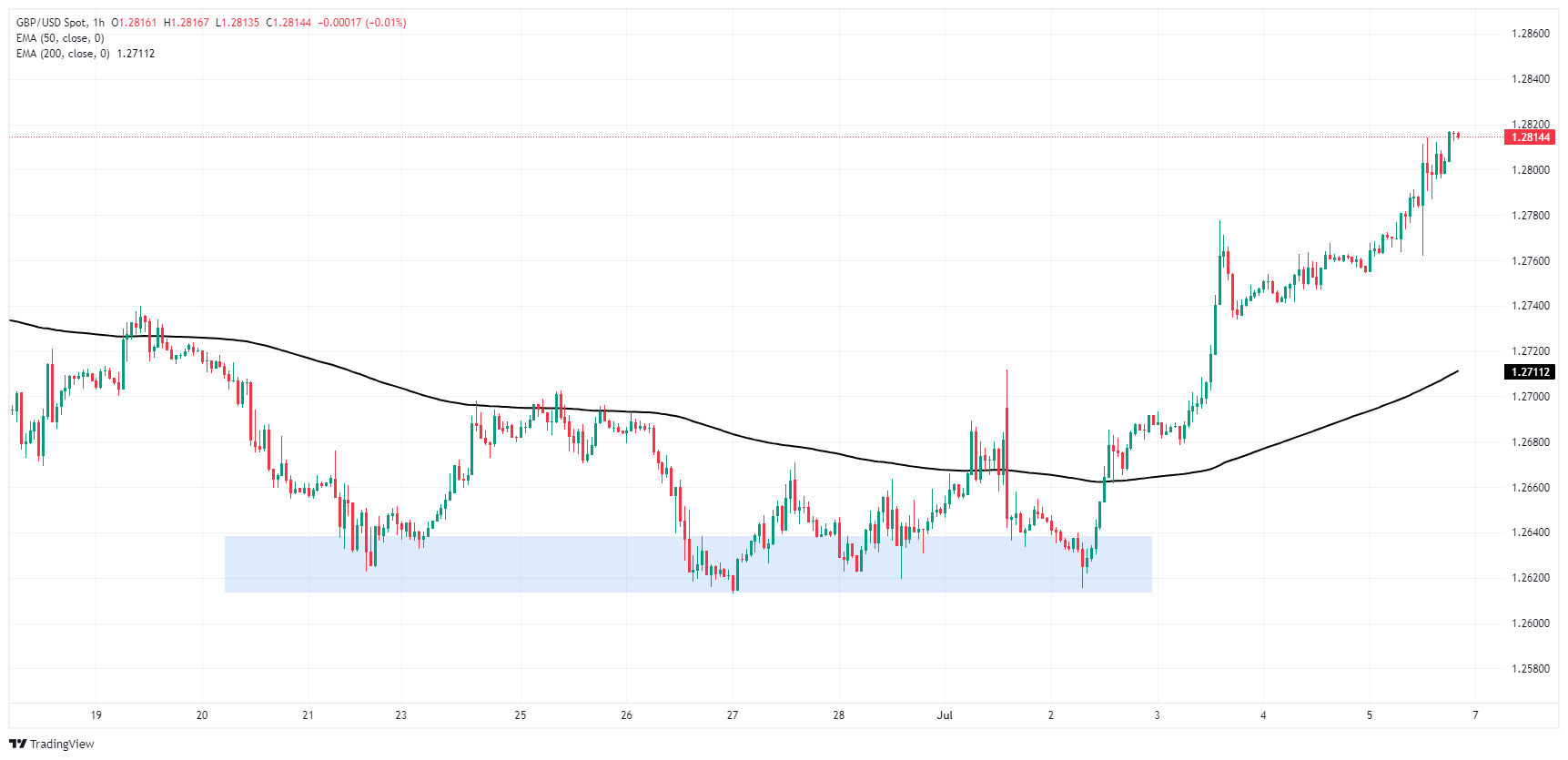
GBP/USD daily chart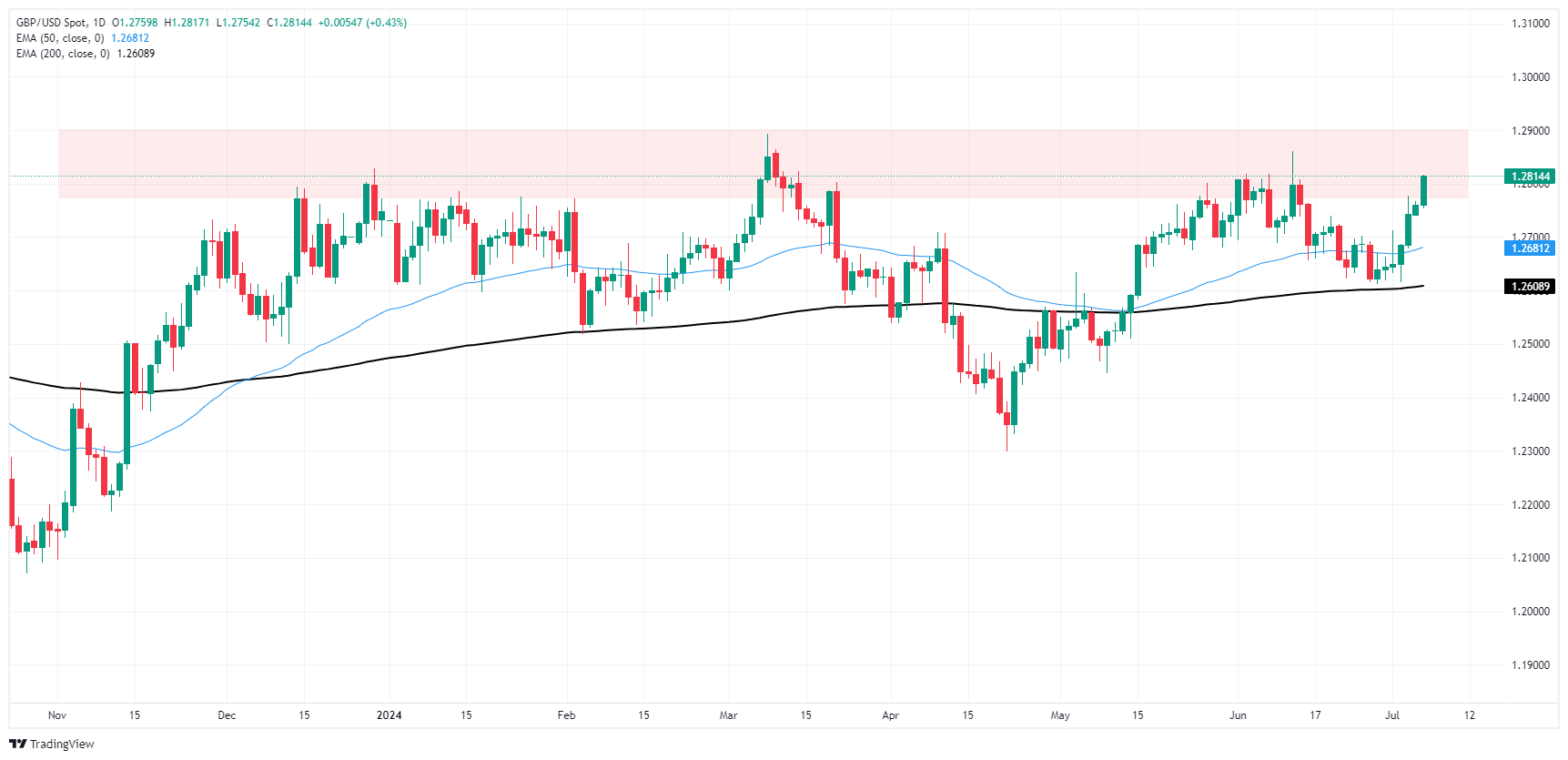
Pound Sterling FAQs
The Pound Sterling (GBP) is the oldest currency in the world (886 AD) and the official currency of the United Kingdom. It is the fourth most traded unit for foreign exchange (FX) in the world, accounting for 12% of all transactions, averaging $630 billion a day, according to 2022 data. Its key trading pairs are GBP/USD, aka ‘Cable’, which accounts for 11% of FX, GBP/JPY, or the ‘Dragon’ as it is known by traders (3%), and EUR/GBP (2%). The Pound Sterling is issued by the Bank of England (BoE).
The single most important factor influencing the value of the Pound Sterling is monetary policy decided by the Bank of England. The BoE bases its decisions on whether it has achieved its primary goal of “price stability” – a steady inflation rate of around 2%. Its primary tool for achieving this is the adjustment of interest rates. When inflation is too high, the BoE will try to rein it in by raising interest rates, making it more expensive for people and businesses to access credit. This is generally positive for GBP, as higher interest rates make the UK a more attractive place for global investors to park their money. When inflation falls too low it is a sign economic growth is slowing. In this scenario, the BoE will consider lowering interest rates to cheapen credit so businesses will borrow more to invest in growth-generating projects.
Data releases gauge the health of the economy and can impact the value of the Pound Sterling. Indicators such as GDP, Manufacturing and Services PMIs, and employment can all influence the direction of the GBP. A strong economy is good for Sterling. Not only does it attract more foreign investment but it may encourage the BoE to put up interest rates, which will directly strengthen GBP. Otherwise, if economic data is weak, the Pound Sterling is likely to fall.
Another significant data release for the Pound Sterling is the Trade Balance. This indicator measures the difference between what a country earns from its exports and what it spends on imports over a given period. If a country produces highly sought-after exports, its currency will benefit purely from the extra demand created from foreign buyers seeking to purchase these goods. Therefore, a positive net Trade Balance strengthens a currency and vice versa for a negative balance.
Author

Joshua Gibson
FXStreet
Joshua joins the FXStreet team as an Economics and Finance double major from Vancouver Island University with twelve years' experience as an independent trader focusing on technical analysis.















