EUR/USD sees more downside below 1.0950 as ECB dovish bets swell
- EUR/USD struggles to sustain above 1.0950 as the US Dollar performs strongly ahead of the FOMC Minutes.
- Traders have priced out Fed large rate cut bets for November.
- The ECB is expected to reduce interest rates by 50 bps in the last quarter of the year.

EUR/USD walks on a thin rope near the eight-week low of 1.0950 in Wednesday’s New York session. The major currency pair remains under pressure as the US Dollar (USD) extends its previous week’s rally further, with the US Dollar Index (DXY) rising above the seven-week high of 102.70.
The Greenback has strengthened as traders have priced out expectations for the Federal Reserve (Fed) to reduce interest rates again by 50 basis points (bps) in November. Traders were forced to unwind Fed large rate cut bets as the upbeat United States (US) Nonfarm Payrolls (NFP) report for September diminished downside risks to economic growth and consumer spending. Also, dismal market sentiment due to Middle East tensions has improved the Greenback’s appeal as a safe haven.
Financial market participants expect the Fed to cut interest rates by 25 bps in the remaining two policy meetings this year at the time of writing, according to the CME FedWatch tool.
In Wednesday’s session, investors will pay close attention to the Federal Open Market Committee (FOMC) Minutes of the September meeting, which will be released at 18:00 GMT. The FOMC Minutes will convey the views of all officials on the interest rate and the economic outlook. In the September meeting, all members unanimously voted to start the policy-easing cycle with a 50-bps rate cut, except Fed Governor Michelle Bowman who favored a smaller reduction of 25 bps.
Going forward, the major trigger for the US Dollar will be the US Consumer Price Index (CPI) and the Producer Price Index (PPI) data for September, which will be published on Thursday and Friday, respectively.
Daily digest market movers: EUR/USD remains vulnerable amid fragile Euro
- The Euro (EUR) faces selling pressure as traders have priced in more rate cuts by the European Central Bank (ECB). The ECB is expected to cut its Deposit Facility Rate further by 50 bps to 3% by the year-end, suggesting that there will be a rate cut of 25 bps in each of the two policy meetings scheduled for next week and in December.
- The ECB has already reduced its key borrowing rates by 50 bps this year as officials have remained confident that inflation will return to the bank’s target of 2% in 2025. Market expectations for the ECB to cut interest rates further have been prompted by the declining trend in price pressures and the economic vulnerability in the Eurozone.
- ECB policymaker and Governor of the Greek Central Bank Yannis Stournaras has also backed two more rate cuts in each of the remaining meetings this year and emphasized the need to reduce them further in 2025 as inflation continues to decelerate, in his comments in an interview with Financial Times published on Wednesday. His comments also indicated that price pressures are declining faster than what the ECB forecasted in September.
- Also, ECB policymaker Martins Kazaks supported an interest rate cut in October in his comments on Tuesday. ECB Kazaks emphasized the need of rate cuts as the economy is weak.
Euro PRICE Today
The table below shows the percentage change of Euro (EUR) against listed major currencies today. Euro was the strongest against the New Zealand Dollar.
| USD | EUR | GBP | JPY | CAD | AUD | NZD | CHF | |
|---|---|---|---|---|---|---|---|---|
| USD | 0.25% | 0.18% | 0.61% | 0.28% | 0.41% | 1.24% | 0.21% | |
| EUR | -0.25% | -0.06% | 0.34% | 0.01% | 0.20% | 0.94% | -0.05% | |
| GBP | -0.18% | 0.06% | 0.43% | 0.11% | 0.26% | 1.02% | 0.02% | |
| JPY | -0.61% | -0.34% | -0.43% | -0.32% | -0.18% | 0.61% | -0.42% | |
| CAD | -0.28% | -0.01% | -0.11% | 0.32% | 0.13% | 0.94% | -0.09% | |
| AUD | -0.41% | -0.20% | -0.26% | 0.18% | -0.13% | 0.77% | -0.25% | |
| NZD | -1.24% | -0.94% | -1.02% | -0.61% | -0.94% | -0.77% | -1.01% | |
| CHF | -0.21% | 0.05% | -0.02% | 0.42% | 0.09% | 0.25% | 1.01% |
The heat map shows percentage changes of major currencies against each other. The base currency is picked from the left column, while the quote currency is picked from the top row. For example, if you pick the Euro from the left column and move along the horizontal line to the US Dollar, the percentage change displayed in the box will represent EUR (base)/USD (quote).
Technical Analysis: EUR/USD remains vulnerable near 1.0950
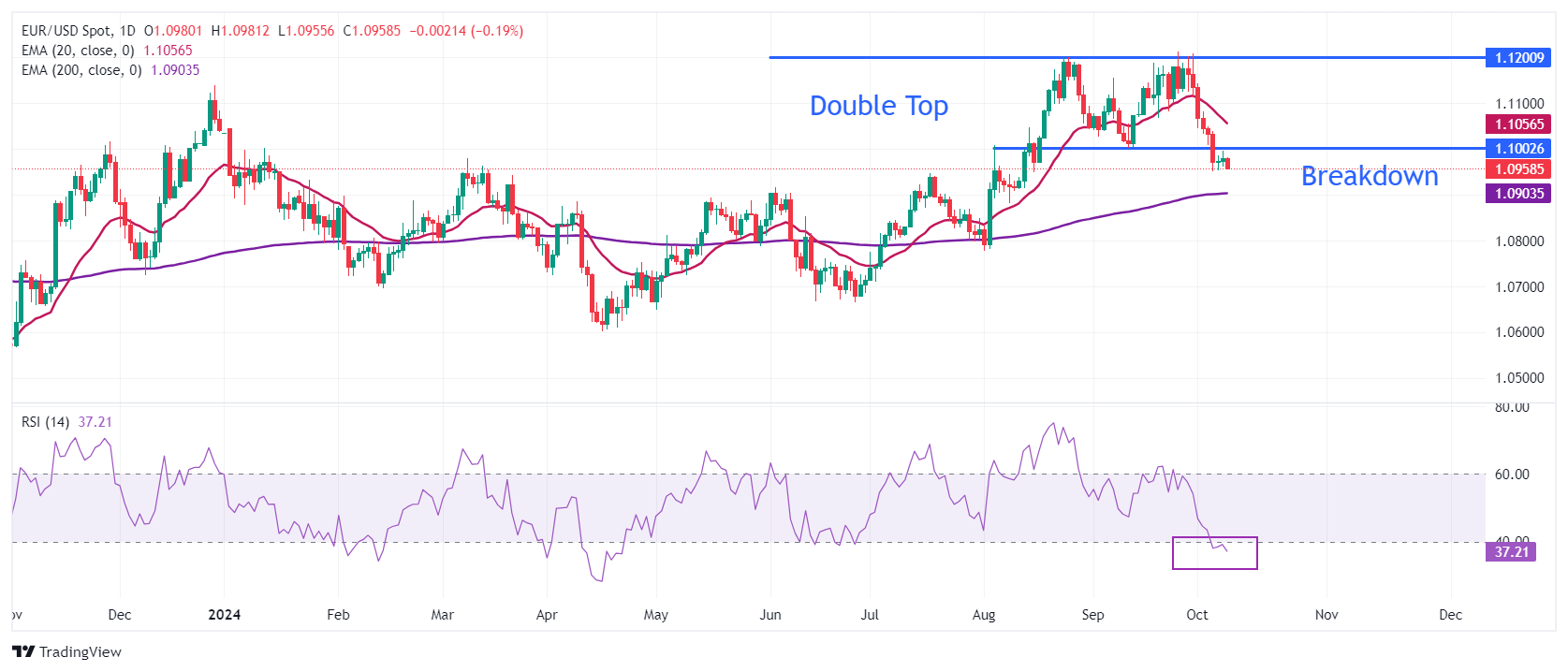
EUR/USD struggles to hold the immediate support of 1.0950. The major currency pair stays on the backfoot as it has delivered a breakdown of the Double Top chart pattern formation on a daily timeframe. The above-mentioned chart pattern was triggered after the shared currency pair broke below the September 11 low of 1.1000.
The 14-day Relative Strength Index (RSI) settles inside the bearish range of 20.00-40.00, suggesting more weakness ahead for EUR/USD.
Looking down, the pair is expected to find support near the 200-day EMA around 1.0900. On the upside, the 20-day EMA at 1.1090 and the September high around 1.1200 will be major resistance zones.
Economic Indicator
Consumer Price Index ex Food & Energy (YoY)
Inflationary or deflationary tendencies are measured by periodically summing the prices of a basket of representative goods and services and presenting the data as the Consumer Price Index (CPI). CPI data is compiled on a monthly basis and released by the US Department of Labor Statistics. The YoY reading compares the prices of goods in the reference month to the same month a year earlier. The CPI Ex Food & Energy excludes the so-called more volatile food and energy components to give a more accurate measurement of price pressures. Generally speaking, a high reading is bullish for the US Dollar (USD), while a low reading is seen as bearish.
Read more.Next release: Thu Oct 10, 2024 12:30
Frequency: Monthly
Consensus: 3.2%
Previous: 3.2%
Source: US Bureau of Labor Statistics
The US Federal Reserve has a dual mandate of maintaining price stability and maximum employment. According to such mandate, inflation should be at around 2% YoY and has become the weakest pillar of the central bank’s directive ever since the world suffered a pandemic, which extends to these days. Price pressures keep rising amid supply-chain issues and bottlenecks, with the Consumer Price Index (CPI) hanging at multi-decade highs. The Fed has already taken measures to tame inflation and is expected to maintain an aggressive stance in the foreseeable future.
Author

Sagar Dua
FXStreet
Sagar Dua is associated with the financial markets from his college days. Along with pursuing post-graduation in Commerce in 2014, he started his markets training with chart analysis.