EUR/USD rises to near 1.0800 as US labor market strength ebbs
- EUR/USD moves higher to near 1.0800 as the US Dollar declines amid deepening concerns over the US labor market.
- Investors remain uncertain about when the ECB will cut interest rates further.
- Market participants shift focus to the US NFP and French elections outcome.

EUR/USD jumps to near the round-level resistance of 1.0800 in Thursday’s New York session. The major currency pair strengthens as the US Dollar (USD) is facing severe pressure due to cooling United States (US) labor market strength and deteriorating economic health. Meanwhile, the trading volume appears to be light due to a holiday in the US markets on account of Independence Day.
On Wednesday, the US ADP Employment data showed that labor demand in the private sector unexpectedly cooled in June. Private employers hired 150K job-seekers, while economists estimated that the number of fresh payrolls would be higher at 160K from the prior release of 157K, upwardly revised from 152K.
Signs of easing labor market conditions were also exhibited by Initial Jobless Claims data for the week ending June 28. The number of individuals applying for jobless claims for the first time came in higher at 238K than estimates of 235K and the former release of 233K.
Also, the economic health of the US economy appears to be deteriorating as the ISM Services Purchasing Managers’ Index (PMI), a measure of service sector activity, contracted to 48.8 from expectations of 52.5 and the prior release of 53.8. A figure below the 50.0 threshold is itself considered as contraction in service activities. Other sub-components such as Prices Paid and New Orders Index were weaker than their former readings.
The US Dollar Index (DXY), which tracks the Greenback’s value against six major currencies, looks fragile near 105.30 ahead of the US Nonfarm Payrolls (NFP) data for June, which will be published on Friday.
Daily digest market movers: EUR/USD strengthens ahead of French elections outcome
- EUR/USD gains to near 1.0800 ahead of the second round of legislative elections in the Eurozone’s second-largest economy, France, on Sunday. After suffering a defeat by the Marine Le Pen-led-far right National Rally party, a coalition by the Central Alliance led by French President Emmanuel Macron and the left wing moved to a tactical withdrawal of at least 200 candidates from Sunday’s parliamentary elections in an attempt to thwart the far right from gaining an absolute majority.
- An attempt to block the far right from winning a majority in the legislative elections has limited the downside in the Euro. Investors worry that the formation of a new government would favor expansionary fiscal policies, which will widen the already vulnerable financial crisis in France.
- On the monetary policy front, International Monetary Fund (IMF) European Department Director Alfred Kammer said on Wednesday that the latest Eurozone inflation figures confirm that disinflation remains on track to the European Central Bank (ECB) target of 2% and the bank has more room to cut interest rates further. However, investors are more interested in knowing whether the ECB will extend the rate-cutting cycle in its next meeting, scheduled for July 18.
- Preliminary Eurozone inflation report for June showed that annual headline Harmonized Index of Consumer Prices (HICP) softened expectedly to 2.5%. While the core HICP that excludes volatile items grew steadily by 2.9%.
Technical Analysis: EUR/USD aims stabilization above 1.0800
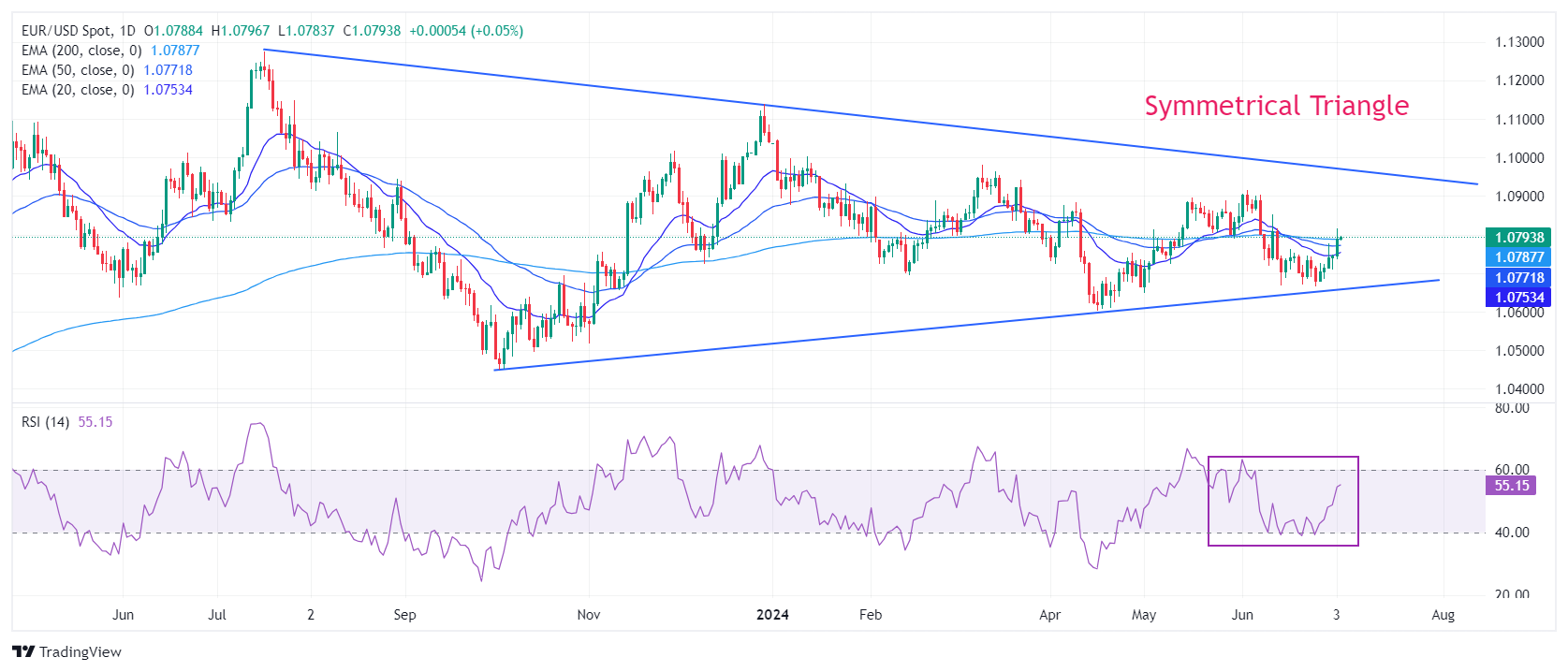
EUR/USD trades inside Wednesday’s trading range near 1.0800. The major currency pair has climbed above the 20-day and 50-day Exponential Moving Averages (EMAs), which trade around 1.0750 and 1.0770, respectively, suggesting a steady near-term outlook. The long-term appeal of the shared currency pair has also improved as it has jumped above the 200-day EMA, which trades around 1.0800.
The Symmetrical Triangle formation on the daily timeframe exhibits a sharp volatility contraction, which indicates low volume and narrow ticks.
Also, the 14-day Relative Strength Index (RSI) oscillates in the 40.00-60.00 range, suggesting indecisiveness among market participants.
Interest rates FAQs
Interest rates are charged by financial institutions on loans to borrowers and are paid as interest to savers and depositors. They are influenced by base lending rates, which are set by central banks in response to changes in the economy. Central banks normally have a mandate to ensure price stability, which in most cases means targeting a core inflation rate of around 2%. If inflation falls below target the central bank may cut base lending rates, with a view to stimulating lending and boosting the economy. If inflation rises substantially above 2% it normally results in the central bank raising base lending rates in an attempt to lower inflation.
Higher interest rates generally help strengthen a country’s currency as they make it a more attractive place for global investors to park their money.
Higher interest rates overall weigh on the price of Gold because they increase the opportunity cost of holding Gold instead of investing in an interest-bearing asset or placing cash in the bank. If interest rates are high that usually pushes up the price of the US Dollar (USD), and since Gold is priced in Dollars, this has the effect of lowering the price of Gold.
The Fed funds rate is the overnight rate at which US banks lend to each other. It is the oft-quoted headline rate set by the Federal Reserve at its FOMC meetings. It is set as a range, for example 4.75%-5.00%, though the upper limit (in that case 5.00%) is the quoted figure. Market expectations for future Fed funds rate are tracked by the CME FedWatch tool, which shapes how many financial markets behave in anticipation of future Federal Reserve monetary policy decisions.
Author

Sagar Dua
FXStreet
Sagar Dua is associated with the financial markets from his college days. Along with pursuing post-graduation in Commerce in 2014, he started his markets training with chart analysis.
















