EUR/USD weakens as US Dollar strengthens after upbeat US NFP report
- EUR/USD declines from 1.0900 as upbeat US NFP report for May boosts US Dollar's appeal.
- The US NFP report suggests that labor market conditions have tightened further.
- The ECB commenced its policy easing campaign but refrained from committing to a predefined interest-rate path.

EUR/USD witnesses an intense sell-off and drops to near 1.0820 in Friday’s New York session as the United States Nonfarm Payrolls (NFP) report for May has indicated that labor demand and wage growth were stronger than expected. The Employment report showed that fresh payrolls added by US employers were higher at 272K than expectations of 185K payrolls and the prior release of 165K, downwardly revised from 175K. However, the Unemployment Rate rose to 4.0% from estimates and the prior release of 3.9%.
Higher-than-expected payroll numbers are expected to clear doubts about easing labor demand that deepened after recent employment-oriented indicators have suggested that the jobs market is loosening. The JOLTS Job Openings data for April and ADP Employment Change for May came in weaker than expected. Also, Initial Jobless Claims for the week ending May 31 were higher than estimates, suggesting that some heat has been released from the labor market.
Meanwhile, the Average Hourly Earnings, which measures wage inflation, accelerated to 4.1% from expectations of 3.9% and the prior release of 4.0%, upwardly revised from 3.9% on a year-on-year basis. On a monthly basis, the wage inflation measure grew at a robust pace of 0.4% against the consensus of 0.3% and the former reading of 0.2%. This has deepened fears of inflation remaining persistent, which has resulted in a sharp decline in market expectations for the Federal Reserve (Fed) to start reducing interest rates from the September meeting. According to the CME FedWatch tool, the probability of rate cuts in September has come down to 54.4% from 68% after the release of the US NFP report.
Daily digest market movers: EUR/USD weakens US Dollar rallies
- EUR/USD faces a sharp sell-off from 1.0900 as a strong US NFP report has indicated that the Fed may not consider reducing interest rates from the September meeting.
- On the other side of the Atlantic, the Euro weakens after the European Central Bank (ECB) cut interest rates by 25 basis points (bps) as expected on Thursday.
- The ECB reduced its key borrowing rates for the first time since 2019 as officials were confident over progress in inflation declining towards the desired rate of 2%. All officials voted for a rate-cut decision except policymaker Robert Holzmann, who dissented. However, ECB President Christine Lagarde refused to commit to any specific interest-rate path, saying that the battle against inflation is far from over and price pressures are expected to stay around current levels this year. The ECB will remain data-dependent, she said.
- The latest inflation projections by the ECB staff indicate that the Eurozone's annual core inflation will average 2.8% in 2024, 2.2% in 2025, and 2.0% in 2026, slightly up from the previous forecasts.
- The ECB was expected to remain data-dependent, as the recent Eurozone’s Harmonized Index of Consumer Prices (HICP) report showed that annual headline and core inflation grew more than expected. Economic growth in Q1 was also stronger at 0.3%, which showed that the technical recession in the second half of 2023 was shallow.
Technical Analysis: EUR/USD declines to 1.0820
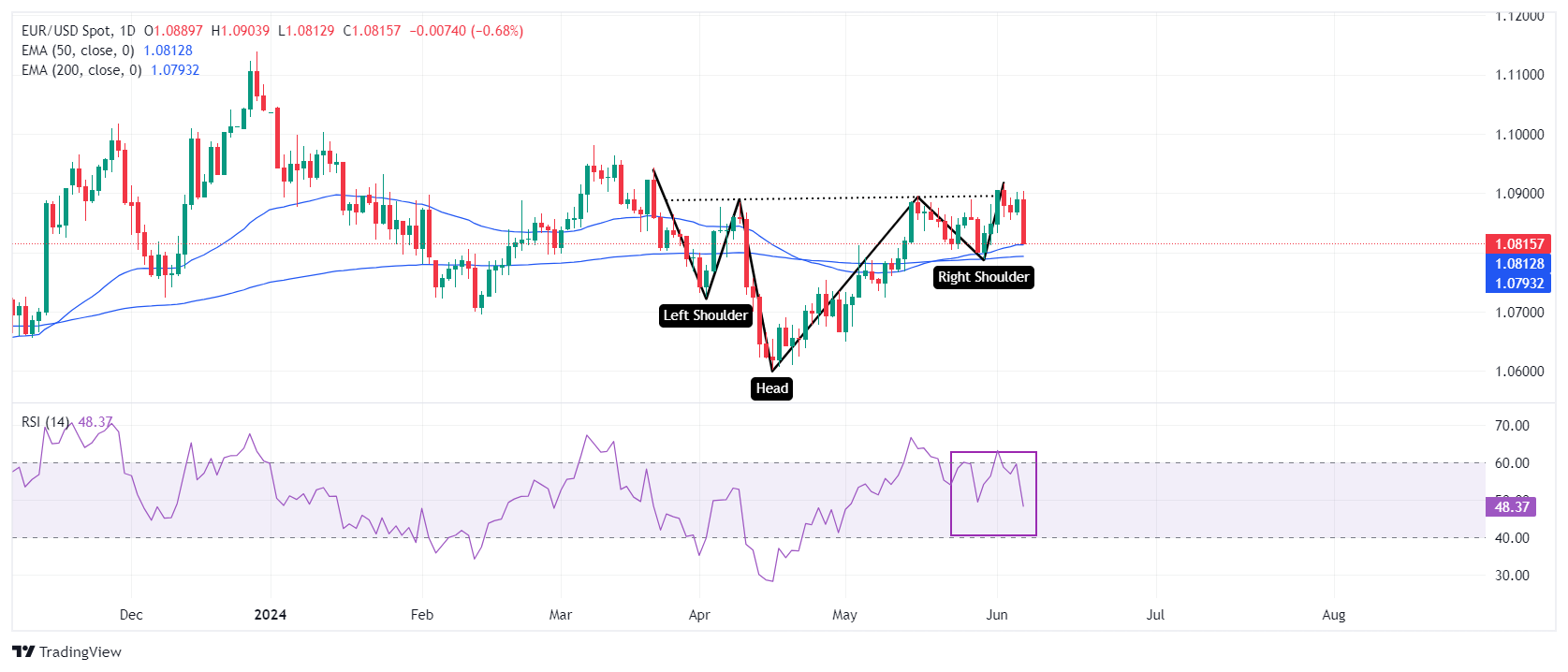
EUR/USD falls vertically from the round-level resistance of 1.0900 after strong US NFP data diminished hopes of the Fed lowering its key borrowing rates from September. For the time being, the major currency pair appears to be failing to break the neckline of the Inverted Head and Shoulder (H&S) pattern, which is marked from April 9 high at 1.0885. A breakout of this pattern could result in a bullish reversal.
The near-term outlook remains has become uncertain as it falls sharply to near the 50-day Exponential Moving Average (EMA) near 1.0812.
The 14-period Relative Strength Index (RSI) has slipped into the 40.00-60.00 range, suggesting that the momentum, which was leaned toward the upside has faded for now.
Looking down, a break below the 200-day EMA at 1.0800 could push it into a bearish trajectory. However, a recovery move above the round-level resistance of 1.0900 could drive the major currency pair towards the March 21 high at around 1.0950 and the psychological resistance of 1.1000.Economic Indicator
ECB Rate On Deposit Facility
One of the European Central Bank's three key interest rates, the rate on the deposit facility, is the rate at which banks earn interest when they deposit funds with the ECB. It is announced by the European Central Bank at each of its eight scheduled annual meetings.
Read more.Last release: Thu Jun 06, 2024 12:15
Frequency: Irregular
Actual: 3.75%
Consensus: 3.75%
Previous: 4%
Source: European Central Bank
Author

Sagar Dua
FXStreet
Sagar Dua is associated with the financial markets from his college days. Along with pursuing post-graduation in Commerce in 2014, he started his markets training with chart analysis.

















