EUR/USD surges as US Dollar tumbles after weak US Employment and Services PMI
- EUR/USD rallies above 1.0800 as the US Dollar tumbles, and the preliminary Eurozone service inflation for June remains sticky.
- The US Dollar declines as US private labor demand slows and the Services PMI contracts in June.
- Headline Eurozone HICP decelerated expectedly, while the core figure grew steadily year-on-year.

EUR/USD jumps higher above the round-level resistance of 1.0800 in Wednesday’s American session after a strong recovery from the key support of 1.0700 on Tuesday. The major currency pair extends its recovery as sticky preliminary Eurozone service inflation for June deepens fears of price pressures remaining elevated for a longer period.
Also, other components of the preliminary Eurozone Harmonized Index of Consumer Prices (HICP) report showed that headline inflation decelerated expectedly to 2.5% from May’s reading of 2.6%. In the same period, the core HICP that excludes volatile items rose at a steady pace of 2.9% and remained higher than estimates of 2.8%. The overall data fails to provide any clarity on where price pressures are heading and kept the European Central Bank’s (ECB) interest-rate outlook uncertain.
However, ECB President Christine Lagarde said at the ECB Forum on Central Banking that inflation is moving in the right direction, and the central bank is very advanced in the disinflation path.
On the interest rate outlook, ECB policymaker and Ireland’s Central Bank Governor Gabriel Makhlouf said he is comfortable with one more rate cut this year but not with market expectations of two. However, he didn’t rule out the possibility.
On the political front, the centralist alliance and the left wing of the European Union’s (EU) second-largest nation withdrew more than 200 candidates from Sunday’s parliamentary elections in an attempt to thwart the far right from gaining an absolute majority.
Daily digest market movers: EUR/USD strengthens as US Dollar hits hard
- EUR/USD recovers further to near 1.0780 as the US Dollar (USD) slides vertically. The US Dollar weakens as the number of individuals hired by private employers unexpectedly came in lower at 150K than the prior release of 157K, downwardly revised from 152K. Economists expected that new payrolls to come out slightly higher at 160K. This has triggered uncertainty over the labor market outlook.
- Also, weak US Services PMI has weighed heavily on the US Dollar. The Services PMI, which is a measure of activities in the service sector, contracted to 48.8 from expectations of 52.5 and the prior release of 53.8. A figure below the 50.0 threshold is itself considered as contraction in service activities. Other indexes, such as the Prices Paid and New Orders, were weaker than their prior readings.
- The US Dollar was already under pressure, as Federal Reserve (Fed) Chair Jerome Powell's commentary at the ECB Forum on Central Banking indicated that the United States (US) economy has resumed its journey on the disinflation path.
- Powell said that recent data indicate the disinflation process has resumed and added that the central bank has made quite a bit of progress in inflation. However, he also said policymakers want to see more good inflation data before cutting interest rates. Powell's comments were much more in line with expectations and his speech delivered at the June policy meeting.
- Meanwhile, expectations for the Fed to reduce interest rates twice this year and initiate the easing cycle from the September meeting remain firm. Going forward, investors will pay close attention to the US Nonfarm Payrolls (NFP) data for June, which will be published on Friday. The NFP report will indicate the current status of labor demand and wage growth, which will influence market speculation for Fed rate cuts in September.
- The US Dollar will remain uncertain on an event-packed Wednesday as ISM Services Purchasing Managers’ Index (PMI), and the Federal Open Market Committee (FOMC) Minutes for June are scheduled for release.
Technical Analysis: EUR/USD climbs above 1.0800
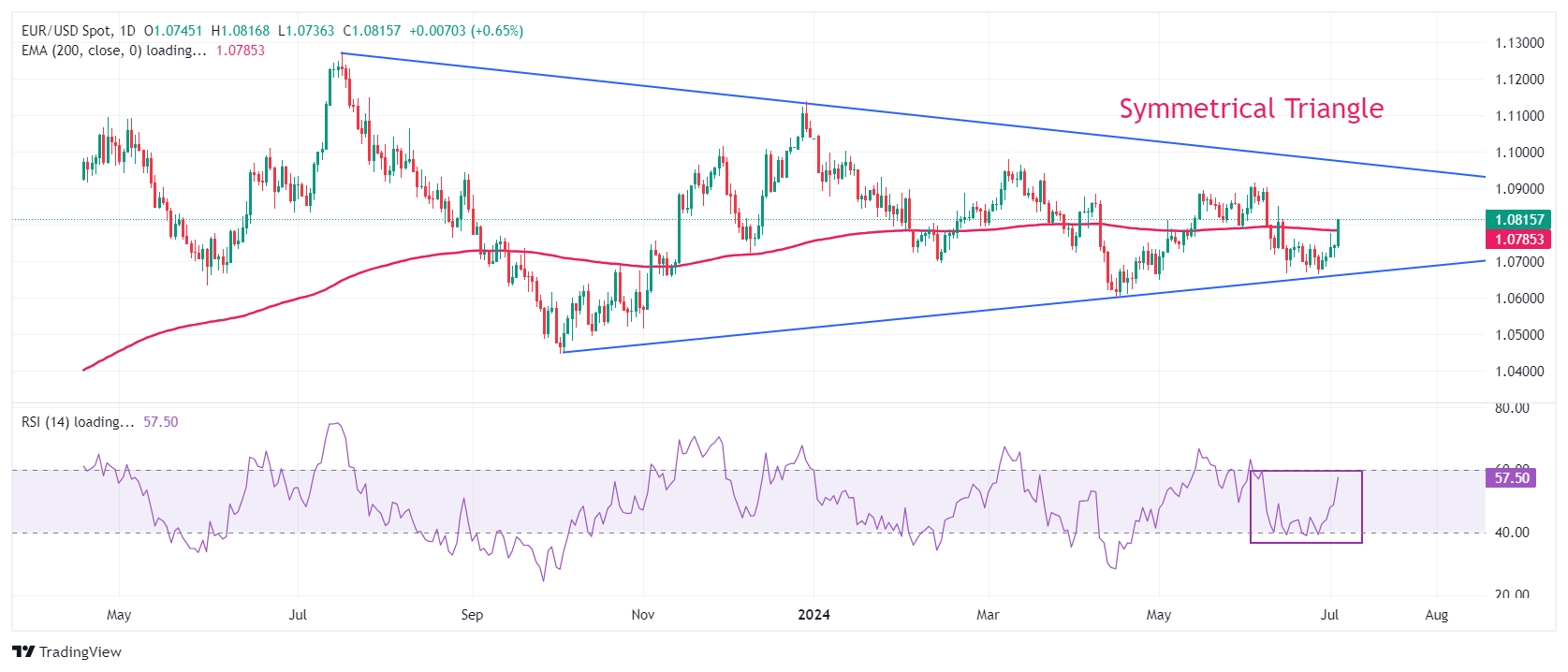
EUR/USD rises vertically above the round-level resistance of 1.0800 after a decisive break of the Hammer candlestick formation on a daily timeframe. The broader trend remains sideways amid a Symmetrical Triangle formation that exhibits a volatility contraction.
Last week, the major currency pair rebounded after finding strong buying interest near the upward-sloping border of the Symmetrical Triangle formation near 1.0666, which is marked from the 3 October 2023 low at 1.0448. The downward-sloping border of the above-mentioned chart pattern is plotted from 18 July 2023 high at 1.1276. The Symmetrical Triangle formation exhibits a sharp volatility contraction, which indicates low volume and narrow ticks.
The major currency pair climbs above the 200-day Exponential Moving Average (EMA), which trades around 1.0790.
The 14-period Relative Strength Index (RSI) oscillates in the 40.00-60.00 range, suggesting indecisiveness among market participants.
Economic Indicator
ISM Services PMI
The Institute for Supply Management (ISM) Services Purchasing Managers Index (PMI), released on a monthly basis, is a leading indicator gauging business activity in the US services sector, which makes up most of the economy. The indicator is obtained from a survey of supply executives across the US based on information they have collected within their respective organizations. Survey responses reflect the change, if any, in the current month compared to the previous month. A reading above 50 indicates that the services economy is generally expanding, a bullish sign for the US Dollar (USD). A reading below 50 signals that services sector activity is generally declining, which is seen as bearish for USD.
Read more.Last release: Wed Jul 03, 2024 14:00
Frequency: Monthly
Actual: 48.8
Consensus: 52.5
Previous: 53.8
Source: Institute for Supply Management
The Institute for Supply Management’s (ISM) Services Purchasing Managers Index (PMI) reveals the current conditions in the US service sector, which has historically been a large GDP contributor. A print above 50 shows expansion in the service sector’s economic activity. Stronger-than-expected readings usually help the USD gather strength against its rivals. In addition to the headline PMI, the Employment Index and the Prices Paid Index numbers are also watched closely by investors as they provide useful insights regarding the state of the labour market and inflation.
Author

Sagar Dua
FXStreet
Sagar Dua is associated with the financial markets from his college days. Along with pursuing post-graduation in Commerce in 2014, he started his markets training with chart analysis.
















