EUR/USD slumps on soft Eurozone Q2 wage growth, upbeat US PMI
- EUR/USD falls sharply on multiple headwinds.
- The German PMI suggested that activity contracted at a faster pace in August.
- The US Dollar rebounds after an upbeat flash of US PMI for August.

EUR/USD declines sharply to near the round-level support of 1.1100 in Thursday’s early North American session from a fresh year-to-date high of 1.1175 posted on Wednesday. The major currency pair weakens as the US Dollar (USD) bounces back from a fresh 2024 low. The US Dollar Index (DXY), which tracks the Greenback’s value against six major currencies, jumps to near 101.50 after the release of the better-than-estimated flash United States (US) S&P Global PMI data for August.
The Composite PMI rose to 54.1, from the estimates of 53.5 but fell short of 54.3 in July. Overall business activity expanded at a faster-than-expected due to robust demand seen in the service sector. While, the Manufacturing PMI contracted sharply to 48.0. Economists already anticipated activities in manufacturing activities to contract but at a steady pace to 49.6.
However, the outlook of the US Dollar is still uncertain as the Federal Reserve (Fed) appears to be on track to cut interest rates in September. This would be the first dovish interest rate decision by the Fed in more than four years. The US central bank has maintained a restrictive monetary policy stance since March 2022 to bring down inflation.
Market speculation for Fed interest rate cuts has strengthened as the "vast majority" of Fed officials see policy-easing in September as appropriate, given that inflationary pressures continue to ease further, according to the Federal Open Market Committee (FOMC) minutes of July 30-31 policy meeting. The FOMC minutes also showed that some policymakers were ready to reduce interest rates already back in July.
For more cues on the interest rate path, investors will focus on Fed Chair Jerome Powell’s speech on Friday at the Jackson Hole (JH) Symposium, which will begin at 14:00 GMT. Investors will pay attention to clues about the size of interest rate cuts in September and by how much the Fed could reduce them this year.
Daily digest market movers: EUR/USD declines on better-than-projected flash US PMI
- EUR/USD falls sharply as investors underpinned the US Dollar against the Euro (EUR). The Euro faces selling pressure on sharp contraction in the German flash HCOB Composite PMI pace in August, and soft Q2 Eurozone Negotiated Wage Rates.
- The flash German PMI report showed that activities in the manufacturing sector declined further to 42.1. In the service sector, activities expanded data at a slower-than-projected pace to 51.4.
- On the contrary, Eurozone Composite PMI unexpectedly rose to 51.2, beating economists' expectations. The report showed that the strong expansion came from robust growth in the service sector's activity. The Service PMI expanded strongly to 53.3 from the estimates and the prior release of 51.9. On the contrary, the Manufacturing PMI declined further to 45.6, lower than the 45.8 expected.
- Commenting on the flash PMI data, Dr. Cyrus de la Rubia, Chief Economist at Hamburg Commercial Bank, said: “The boost largely comes from a surge in services activity in France, with the Business Activity Index jumping by almost five points, likely linked to the buzz surrounding the Olympic Games in Paris. It’s doubtful this momentum will carry over into the coming months, however. Meanwhile, the overall pace of growth in the services sector has slowed down in Germany, and the Eurozone’s manufacturing sector remains in rapid decline.”
- The slowdown in the German economy signaled by the PMI data is unlikely to weigh on market speculation about the European Central Bank (ECB) interest-rate outlook. However, slower wage growth momentum would strengthen them further. Negotiated Wage Rates rose at a slower pace of 3.55% from 4.69% seen in the first quarter this year, upwardly revised from 4.74%.
- Markets broadly expect the ECB to cut its key borrowing rates one more time in the last quarter of this year, given that price pressures are anticipated to return to the bank’s target of 2% next year.
Technical Analysis: EUR/USD gives up gains above 1.1100
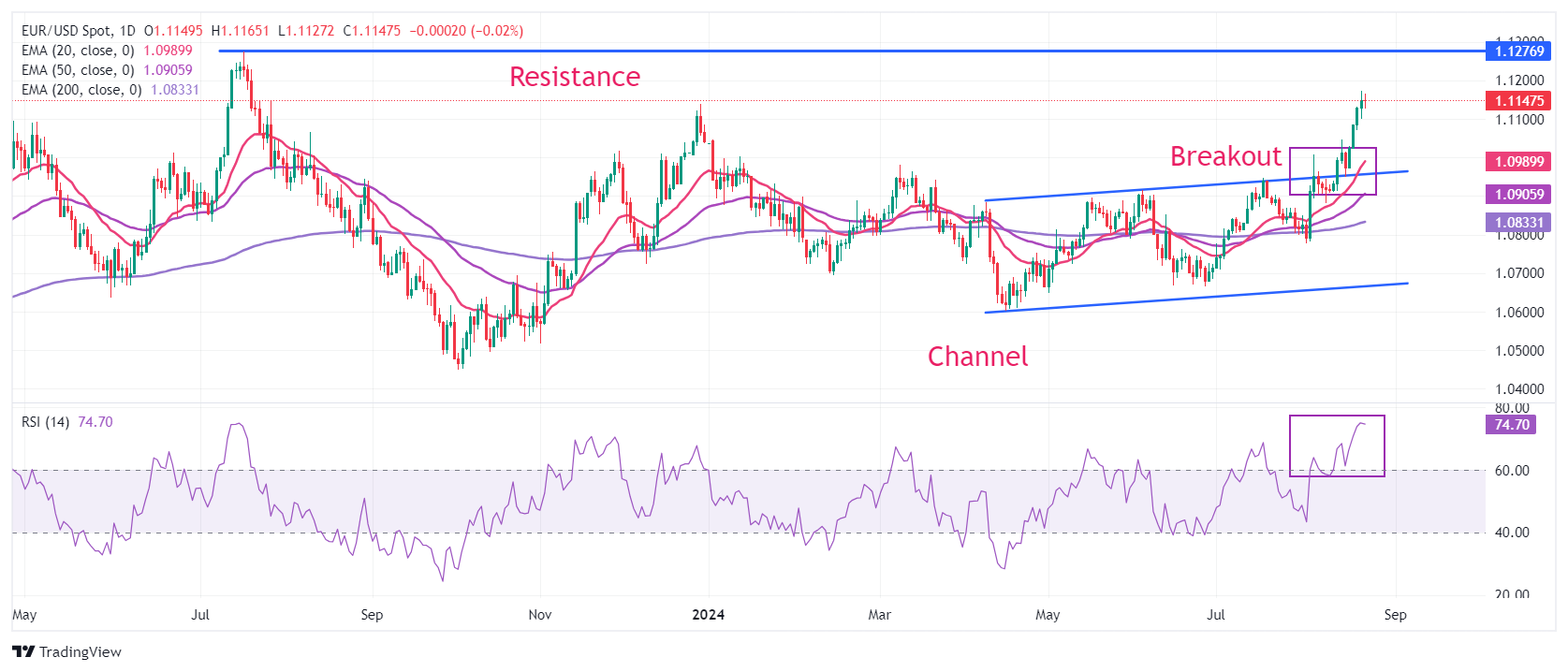
EUR/USD falls to near 1.1100 after failing to hold a fresh annual high of 1.1175. The major currency pair fails to continue its four-day winning streak while its outlook remains strengthened, given that it is still close to a year-to-date high near 1.1175.
Earlier, the shared currency pair strengthened after a breakout of a channel formation on a daily time frame. All short-to-long-term Exponential Moving Averages (EMAs) are sloping higher, suggesting a strong uptrend.
The 14-day Relative Strength Index (RSI) oscillates in the bullish range of 60.00-80.00, suggesting a strong upside momentum. Still, chances of a corrective pullback increase as the momentum indicator is in overbought territory.
After a decisive break above the December 28, 2023, high at 1.1140, Euro bulls aim to recapture round-level resistance of 1.1200. On the downside, the round-level figure of 1.1100 will act as a major support zone.
Economic Indicator
S&P Global Composite PMI
The S&P Global Composite Purchasing Managers Index (PMI), released on a monthly basis, is a leading indicator gauging US private-business activity in the manufacturing and services sector. The data is derived from surveys to senior executives. Each response is weighted according to the size of the company and its contribution to total manufacturing or services output accounted for by the sub-sector to which that company belongs. Survey responses reflect the change, if any, in the current month compared to the previous month and can anticipate changing trends in official data series such as Gross Domestic Product (GDP), industrial production, employment and inflation. The index varies between 0 and 100, with levels of 50.0 signaling no change over the previous month. A reading above 50 indicates that the private economy is generally expanding, a bullish sign for the US Dollar (USD). Meanwhile, a reading below 50 signals that activity is generally declining, which is seen as bearish for USD.
Read more.Last release: Thu Aug 22, 2024 13:45 (Prel)
Frequency: Monthly
Actual: 54.1
Consensus: 53.5
Previous: 54.3
Source: S&P Global
Author

Sagar Dua
FXStreet
Sagar Dua is associated with the financial markets from his college days. Along with pursuing post-graduation in Commerce in 2014, he started his markets training with chart analysis.