EUR/USD remains firm with Fed Powell’s testimony in focus
- EUR/USD steadies above 1.0800 as easing US labor market strength weighs on the US Dollar.
- Fed’s Powell may refrain from providing a specific timeframe for rate cuts.
- ECB’s Knot doesn’t see the central bank delivering subsequent rate cuts in July.

EUR/USD clings to gains above the crucial support of 1.0800 in Tuesday’s American session. The major currency pair holds gains as the US Dollar (USD) remains under pressure due to firm market speculation that the Federal Reserve (Fed) will start reducing interest rates in September.
According to the CME FedWatch tool, traders see a 77% chance that interest rates will be lower than current levels in the September meeting, up from 65.6% recorded a week ago. Easing United States (US) labor market strength has prompted expectations for the Fed to pivot to policy normalization in September. The Unemployment Rate rose to its highest in more than two years, and Average Hourly Earnings eased expectedly in June, pointing to moderating labor market conditions.
For fresh guidance on interest rates, investors will shift focus to the Fed Chair Jerome Powell’s semi-annual Congressional testimony, scheduled at 14:00 GMT. Powell is expected to reiterate that interest rates need to be held steady at their current levels until they observe a decline in inflationary pressures for months.
Powell acknowledged, in the European Central Bank (ECB) Forum of Central Banking, that the central bank has made quite a bit of progress on inflation, and recent data shows that the disinflation process has resumed.
For more clarity on disinflation, investors will focus on the US Consumer Price Index (CPI) report for June, which will be published on Thursday. The core CPI data, which excludes volatile food and energy prices, is estimated to have grown steadily, while headline figures are expected to have decelerated.
Daily digest market movers: EUR/USD stabilizes above 1.0800 as Far Right fails to achieve absolute majority
- EUR/USD turns sideways above 1.0800 after printing a fresh three-week high near 1.0850 on Monday. The major currency pair strengthens as the Euro’s outlook improves after French election polls showed the Marine Le Pen-led-far right National Rally missing an absolute majority. This has reduced the risks of widening France’s debt crisis.
- However, political uncertainty remains intact as no Party gains an outright majority. This leads to the formation of a coalition government that results in a significant delay in fiscal decisions due to divergent opinions. Investors expect that Jean-Luc Mélenchon's left-wing coalition, which unexpectedly gained higher seats than the rest, will join hands with President Emmanuel Macron's centrist alliance to form a new government.
- Meanwhile, easing speculation that the ECB will deliver subsequent rate cuts in the July meeting has supported the downside in the Euro. Officials expect price pressures will not deviate far from their current levels this year, but an aggressive policy easing stance could revamp them.
- On Monday, ECB policymaker and Dutch central bank chief Klaas Knot pushed back expectations of rate cuts in July. Knot said in an interview with Handelsblatt, “I don't see a case for another rate cut in July." However, he remained comfortable with market expectations of more rate cuts this year, and for that, he is open for the September meeting.
Technical Analysis: EUR/USD trades inside Symmetrical Triangle formation
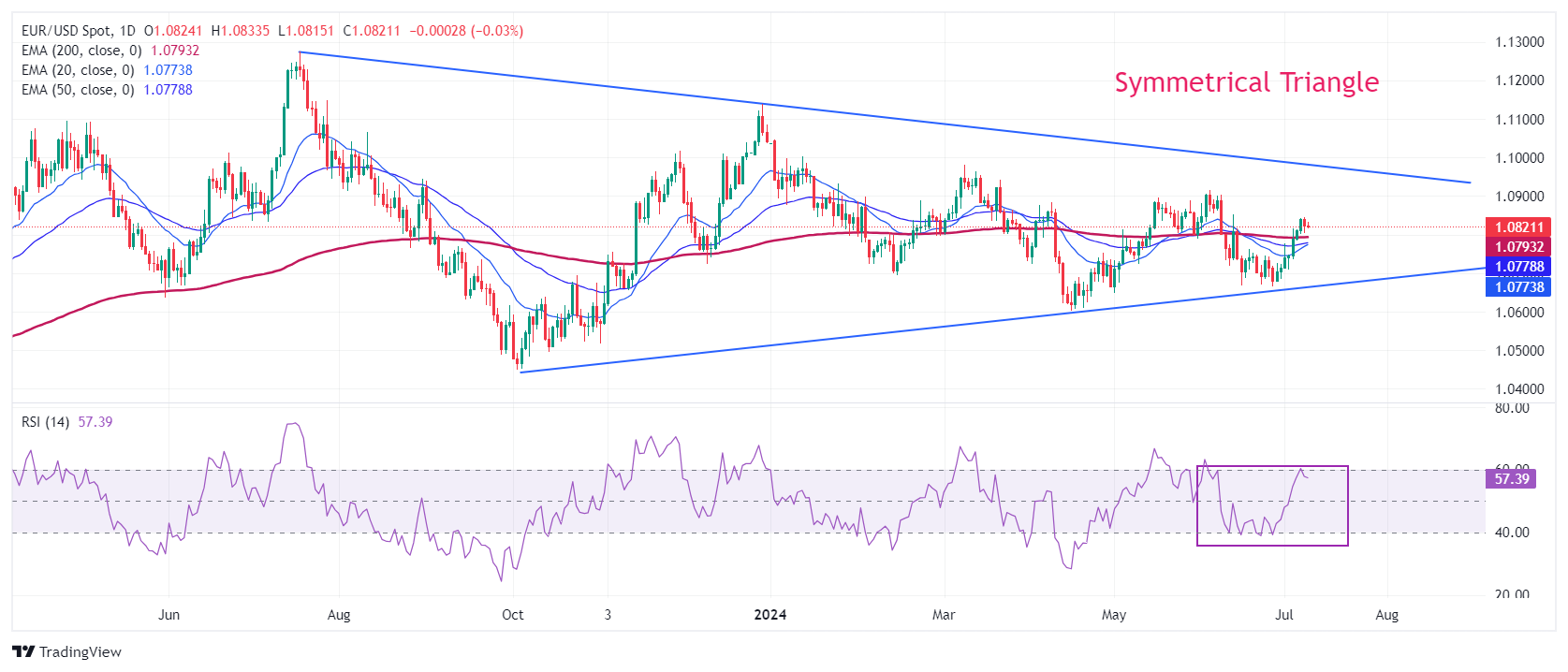
EUR/USD trades inside Monday’s trading range as investors stay on the sidelines ahead of the Fed Powell’s testimony. The major currency pair stabilizes above the 20-day and 50-day Exponential Moving Averages (EMAs), which trade around 1.0750 and 1.0770, respectively. The overall trend of the shared currency pair has also strengthened as it has jumped above the 200-day EMA, which trades around 1.0800.
The Symmetrical Triangle formation on the daily timeframe exhibits a sharp volatility contraction, which indicates low volume and narrow ticks.
The 14-day Relative Strength Index (RSI) reaches 60.00. Should the bullish momentum be triggered if it breaks above 60.00?
Inflation FAQs
Inflation measures the rise in the price of a representative basket of goods and services. Headline inflation is usually expressed as a percentage change on a month-on-month (MoM) and year-on-year (YoY) basis. Core inflation excludes more volatile elements such as food and fuel which can fluctuate because of geopolitical and seasonal factors. Core inflation is the figure economists focus on and is the level targeted by central banks, which are mandated to keep inflation at a manageable level, usually around 2%.
The Consumer Price Index (CPI) measures the change in prices of a basket of goods and services over a period of time. It is usually expressed as a percentage change on a month-on-month (MoM) and year-on-year (YoY) basis. Core CPI is the figure targeted by central banks as it excludes volatile food and fuel inputs. When Core CPI rises above 2% it usually results in higher interest rates and vice versa when it falls below 2%. Since higher interest rates are positive for a currency, higher inflation usually results in a stronger currency. The opposite is true when inflation falls.
Although it may seem counter-intuitive, high inflation in a country pushes up the value of its currency and vice versa for lower inflation. This is because the central bank will normally raise interest rates to combat the higher inflation, which attract more global capital inflows from investors looking for a lucrative place to park their money.
Formerly, Gold was the asset investors turned to in times of high inflation because it preserved its value, and whilst investors will often still buy Gold for its safe-haven properties in times of extreme market turmoil, this is not the case most of the time. This is because when inflation is high, central banks will put up interest rates to combat it. Higher interest rates are negative for Gold because they increase the opportunity-cost of holding Gold vis-a-vis an interest-bearing asset or placing the money in a cash deposit account. On the flipside, lower inflation tends to be positive for Gold as it brings interest rates down, making the bright metal a more viable investment alternative.
Author

Sagar Dua
FXStreet
Sagar Dua is associated with the financial markets from his college days. Along with pursuing post-graduation in Commerce in 2014, he started his markets training with chart analysis.