EUR/USD refreshes two-week high on robust Eurozone GDP growth, hot inflation
- EUR/USD rises further around 1.0890 on Eurozone upbeat GDP growth and hot inflation.
- ECB Lagarde sees more interest-rate cuts and said she is hopeful about inflation returning to the bank’s target of 2%.
- The US Dollar will be influenced by the US presidential election, NFP, and the ISM Manufacturing PMI data.

EUR/USD extends its upside to near 1.0890 in Thursday’s North American session following Wednesday’s sharp recovery. The major currency pair strengthened as traders have pared back bets of a large interest-rate cut from the European Central Bank (ECB) in the December monetary policy meeting after a faster-than-expected Eurozone Gross Domestic Product (GDP) growth and hotter-than-forecasted inflation data.
Eurostat reported on Wednesday that the Eurozone expanded at a faster pace of 0.9% in the third quarter of the year compared with the same period a year earlier. A major contribution to higher growth in the Eurozone came from its largest nation, Germany, which managed to dodge a technical recession. The German economy surprisingly rose by 0.2% compared with the previous quarter, beating expectations of a 0.1% contraction. Meanwhile, the growth rate in Spain was higher than expected, as forecasted in France, and slower than anticipated in Italy.
Released in the European session, the Eurozone flash Harmonized Index of Consumer Prices (HICP) for October accelerated at a faster pace of 2% on year, higher than estimates of 1.9% and the prior release of 1.7%, suggesting that the battle against inflation is yet not over.
"The just-released flash estimate of German inflation in October could make some members of the ECB regret the latest rate cut and the European Central Bank's new openness to more aggressive cuts," said analysts at ING.
Meanwhile, ECB President Christine Lagarde has shown confidence about taming price pressures in an interview with the French newspaper Le Monde published on Thursday. “The objective is in sight, but I am not going to tell you that inflation is under control,” Lagarde said. She reaffirmed her commitment to interest rate reduction but refrained from committing to a specific rate cut path.
Euro PRICE Today
The table below shows the percentage change of Euro (EUR) against listed major currencies today. Euro was the strongest against the New Zealand Dollar.
| USD | EUR | GBP | JPY | CAD | AUD | NZD | CHF | |
|---|---|---|---|---|---|---|---|---|
| USD | -0.15% | 0.29% | -0.53% | -0.02% | 0.27% | 0.31% | -0.27% | |
| EUR | 0.15% | 0.44% | -0.37% | 0.14% | 0.43% | 0.46% | -0.11% | |
| GBP | -0.29% | -0.44% | -0.81% | -0.30% | -0.01% | 0.01% | -0.55% | |
| JPY | 0.53% | 0.37% | 0.81% | 0.50% | 0.81% | 0.79% | 0.25% | |
| CAD | 0.02% | -0.14% | 0.30% | -0.50% | 0.30% | 0.32% | -0.25% | |
| AUD | -0.27% | -0.43% | 0.01% | -0.81% | -0.30% | 0.02% | -0.57% | |
| NZD | -0.31% | -0.46% | -0.01% | -0.79% | -0.32% | -0.02% | -0.57% | |
| CHF | 0.27% | 0.11% | 0.55% | -0.25% | 0.25% | 0.57% | 0.57% |
The heat map shows percentage changes of major currencies against each other. The base currency is picked from the left column, while the quote currency is picked from the top row. For example, if you pick the Euro from the left column and move along the horizontal line to the US Dollar, the percentage change displayed in the box will represent EUR (base)/USD (quote).
Daily digest market movers: EUR/USD gains despite lower US Initial Jobless Claims
- EUR/USD rises further around 1.0890 on upbeat Eurozone GDP data. Even though higher Eurozone GDP growth has improved the Euro’s (EUR) appeal, its outlook is still in danger amid uncertainty ahead of the United States (US) presidential election.
- Traders seem to have priced in a victory from former President Donald Trump against current Vice President Kamala Harris, a scenario that would have significant repercussions on the Eurozone economy as Trump is expected to raise tariffs by 10% on all imports, hitting the Eurozone’s powerful export sector. Trump said this week that the European Union (EU) would have to "pay a big price" for not buying enough American exports if he won the November 5 election, Reuters reported.
- Meanwhile, the US Dollar (USD) remains flat after the release of the US Initial Jobless Claims for the week ending October 25, which surprisingly came in lower than estimates. Individuals claiming jobless benefits for the first time were 216K, lower than the estimates of 230K and the prior release of 228K. This is the lowest release in almost 22 weeks, pointing to improving labor market conditions.
- The core Personal Consumption Expenditure (PCE) Price Index, which is the Federal Reserve's (Fed) preferred inflation gauge, has accelerated steadily to 2.7%, faster than estimates of 2.6%.
- Going forward, investors will focus on the US Nonfarm Payrolls (NFP) and the ISM Manufacturing PMI data for October, which will be published on Friday. The economic data will influence market speculation for the Federal Reserve (Fed) interest rate cut path. According to the CME FedWatch tool, the central bank is expected to cut interest rates in both policy meetings in November and December.
Technical Analysis: EUR/USD aims to revisit 1.0900
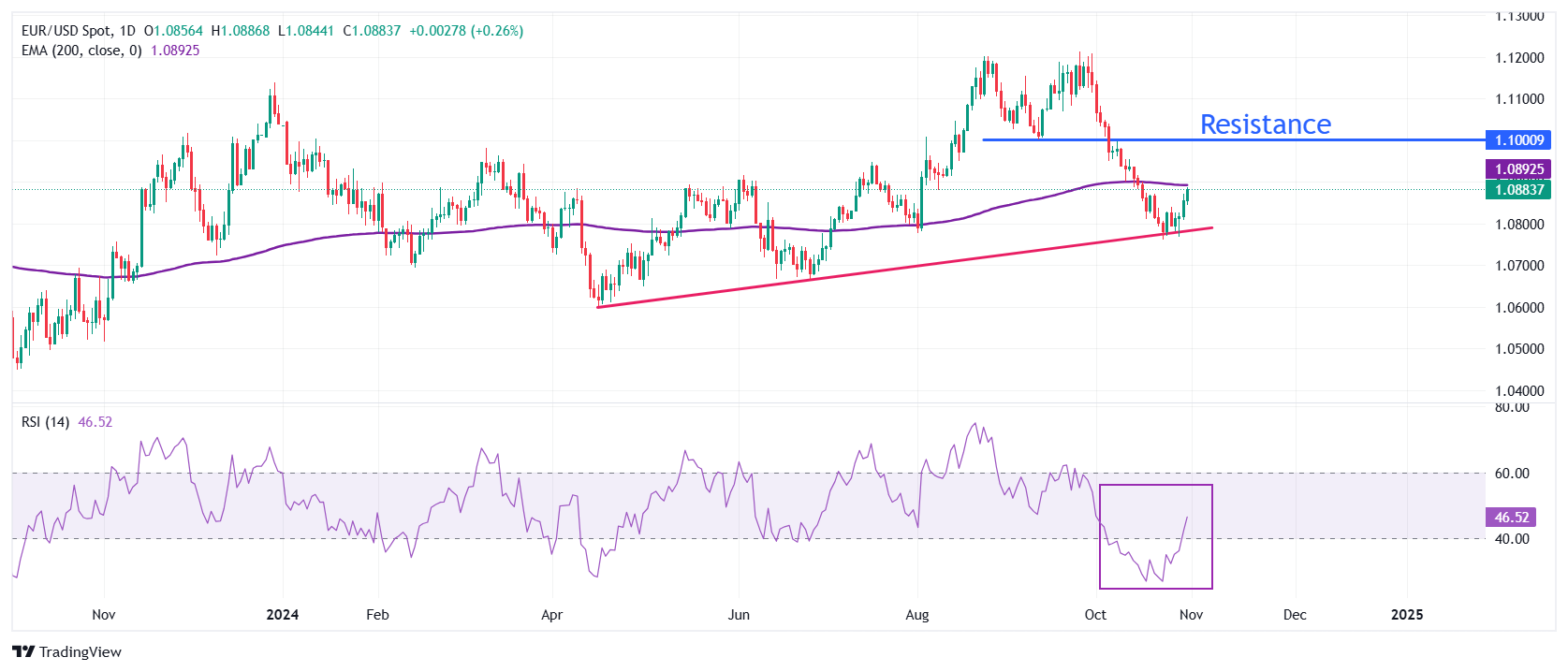
EUR/USD trades close to a fresh more than a week high around 1.0890 in North American trading hours. The major currency pair holds onto its recent recovery after breaking above the round-level resistance of 1.0800. However, its broader outlook is still bearish as it trades below the 200-day Exponential Moving Average (EMA) at around 1.0900.
The 14-day Relative Strength Index (RSI) climbs to near 42.00 after staying in the 20.00-40.00 range for almost a month, suggesting that the bearish momentum has terminated.
Looking up, the shared currency pair could rise to near the September 11 low around 1.1000 after breaking above the 200-day EMA around 1.0900. On the downside, the upward-sloping trendline near 1.0750, which is plotted from the April 16 low at around 1.0600, will be the key support area for the Euro bulls.
Author

Sagar Dua
FXStreet
Sagar Dua is associated with the financial markets from his college days. Along with pursuing post-graduation in Commerce in 2014, he started his markets training with chart analysis.

















