EUR/USD jumps sharply from 1.1100 as Fed Powell emphasize on policy adjustment
- EUR/USD soars as the US Dollar tumbles after Fed Powell’s dovish guidance on interest rates at the Jackson Hole Symposium.
- Fed Powell emphasized the need to adjust monetary policy.
- The ECB is widely anticipated to cut interest rates again in September.

EUR/USD delivers a sharp upside to near 1.1160 from the intraday low of 1.1100 in Friday’s New York session. The major currency pair strengthens as the US Dollar (USD) dives after Federal Reserve (Fed) Chair Jerome Powell delivers a dovish guidance on interest rates in his speech at the Jackson Hole (JH) Symposium.
The US Dollar Index (DXY), which tracks the Greenback’s value against six major currencies, falls vertically to near a more-than-seven-month low of 101.00 from a short-lived pullback to nearly 101.60. In his speech at the JH Symposium, Jerome Powell emphasized the need to reduce interest rates. Powell said, "The time has come for policy to adjust." Fed Powell showed concerns over easing labor market conditions, saying "The balance of risks to our mandate has changed," and " We will do everything we can to support a strong labor market."
On the inflation outlook, Powell remained confident that price pressures are sustainably declining to the bank's target of 2%. He refrained from committing a pre-defined rate-cut path and preferred to remain data-dependent.
Earlier, the US Dollar's pullback move came after the flash US S&P Global PMI report for August showed that the Composite PMI came in better than estimated at 54.1. Overall, the report showed that business activity was boosted by a robust expansion in the services sector, while the manufacturing part of the economy contracted at a faster-than-expected pace.
Daily digest market movers: EUR/USD surges at the cost of US Dollar
- EUR/USD bounces backs trongly from the round-level support of 1.1100 as investors underpin the Euro (EUR) against the US Dollar. However, the Euro is underperforming against other major peers as markets increasingly expect the European Central Bank (ECB) to reduce interest rates again in September.
- Rising expectations of ECB rate cuts in September are supported by the uncertainty over the Eurozone’s economic outlook and cooling wage pressures.
- The flash Eurozone HCOB PMI report for August, released on Thursday, rose to 51.2, higher than expected, indicating that overall business activity expanded at a faster pace. However, this rosy picture signaled by the PMI surveys was linked to strong demand from the Olympic Games in Paris and it is likely to be short-lived rather than structural. Therefore, the uncertainty over the economic performance in the coming months remains intact.
- PMI data also signaled that business activity in the Eurozone’s largest economy, Germany, declined sharply mainly due to a significant drop in foreign demand, with no recovery in sight, signaling the need for fresh stimulus to boost demand.
- Meanwhile, a sharp decline in the Q2 Negotiated Wage Rates propelled hopes of more ECB rate cuts this year. The data, which was released in Thursday’s European trading hours, showed that Negotiated Wage Rates grew at a slower pace of 3.55% from 4.74% in the first quarter this year, easing fears of inflation remaining persistent.
- Economists at ING said in a note on Thursday, "The European Central Bank has remained uncomfortable with cutting interest rates while wage growth is elevated.” Lower wage growth in Q2 should help ease policymakers’ concerns in this matter.
Euro PRICE Today
The table below shows the percentage change of Euro (EUR) against listed major currencies today. Euro was the strongest against the Swiss Franc.
| EUR | USD | GBP | JPY | CAD | AUD | NZD | CHF | |
|---|---|---|---|---|---|---|---|---|
| EUR | 0.43% | -0.29% | -0.19% | -0.25% | -0.62% | -0.58% | 0.43% | |
| USD | -0.43% | -0.72% | -0.58% | -0.67% | -1.05% | -1.23% | -0.00% | |
| GBP | 0.29% | 0.72% | 0.10% | 0.04% | -0.33% | -0.27% | 0.48% | |
| JPY | 0.19% | 0.58% | -0.10% | -0.10% | -0.46% | -0.43% | 0.36% | |
| CAD | 0.25% | 0.67% | -0.04% | 0.10% | -0.38% | -0.32% | 0.44% | |
| AUD | 0.62% | 1.05% | 0.33% | 0.46% | 0.38% | 0.05% | 0.80% | |
| NZD | 0.58% | 1.23% | 0.27% | 0.43% | 0.32% | -0.05% | 0.75% | |
| CHF | -0.43% | 0.00% | -0.48% | -0.36% | -0.44% | -0.80% | -0.75% |
The heat map shows percentage changes of major currencies against each other. The base currency is picked from the left column, while the quote currency is picked from the top row. For example, if you pick the Euro from the left column and move along the horizontal line to the US Dollar, the percentage change displayed in the box will represent EUR (base)/USD (quote).
Technical Analysis: EUR/USD aims to recapture 1.1200
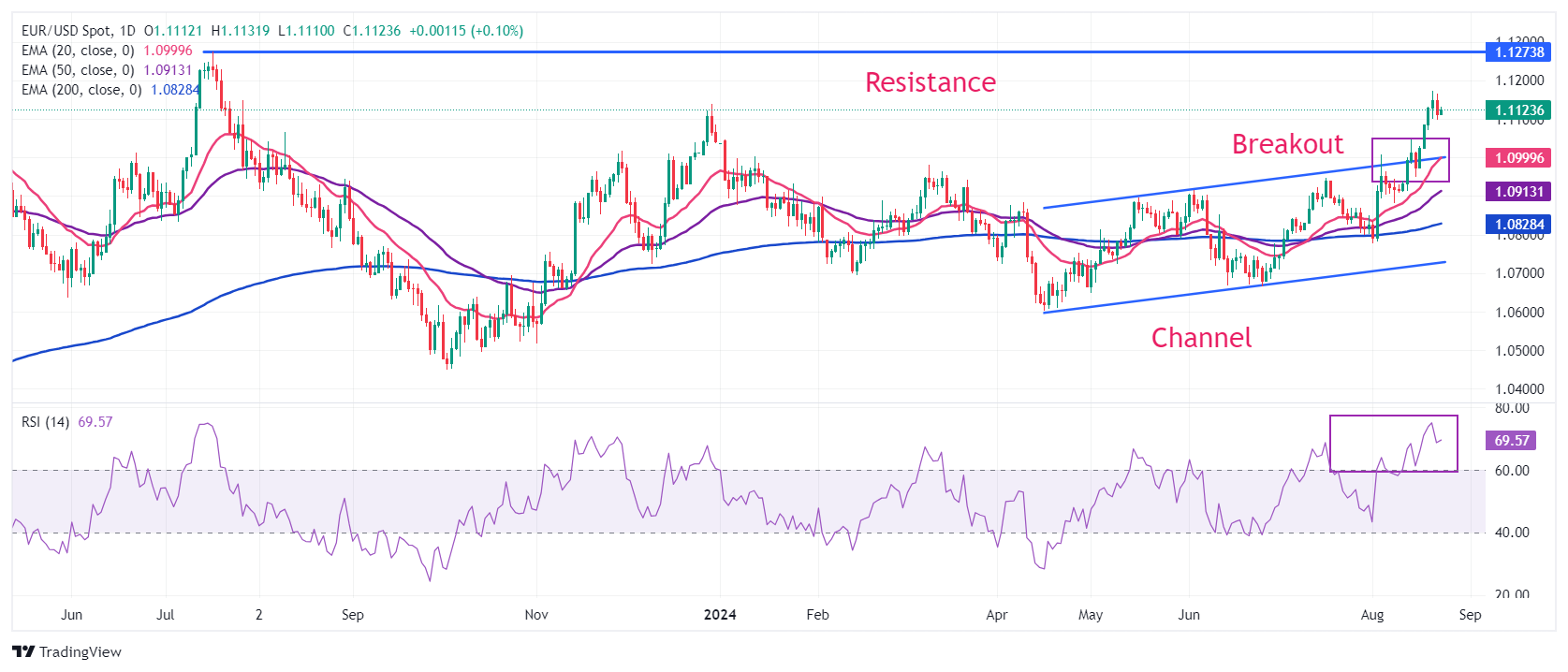
EUR/USD holds above the round-level support of 1.1100, with investors focusing on Fed Powell’s speech at the JH Symposium. The outlook of the shared currency pair has remained upbeat after a breakout of a channel formation on a daily time frame. All short-to-long-term Exponential Moving Averages (EMAs) are sloping higher, suggesting a strong uptrend.
The 14-day Relative Strength Index (RSI) oscillates in the bullish range of 60.00-80.00, touching overbought levels but still suggesting a strong upside momentum.
In case of a decisive break above the December 28, 2023, high at 1.1140, Euro bulls could aim to recapture round-level resistance of 1.1200. On the downside, the round-level figure of 1.1100 acts as a major support zone.
Economic Indicator
Jackson Hole Symposium
The Jackson Hole Economic Policy Symposium is an annual symposium sponsored by the Federal Reserve Bank of Kansas City since 1978, and held in Jackson Hole, Wyoming, since 1981. It is a forum for central bankers, policy experts and academics to come together to focus on a topic.
Read more.Last release: Fri Aug 23, 2024 00:00
Frequency: Irregular
Actual: -
Consensus: -
Previous: -
Author

Sagar Dua
FXStreet
Sagar Dua is associated with the financial markets from his college days. Along with pursuing post-graduation in Commerce in 2014, he started his markets training with chart analysis.

















